AI Citations: What to Check Before Reacting to a Lost One
/ 9 min read

Summary
Tracking the same citations for consecutive days, the study was able to see what can happen after a site has disappeared from an. The practical question is what this changes for SEO, content quality, and AI search visibility.
It is easy to panic when you notice your brand has vanished from an AI overview or a ChatGPT response. The immediate instinct for most of us is to assume the content is no longer relevant or that a competitor has out optimized us, leading to a frantic rush to rewrite the page.
However, reacting too quickly to a single data point can lead to wasted effort and misleading conclusions. If you rewrite a page just as a temporary dip ends, you might mistakenly credit your edits for a recovery that was already inevitable. Understanding the volatility of these systems is essential before you touch a single line of copy.
The Reality of AI Citation Volatility
A recent study by Ahrefs looked at five different AI products over a 20 day window, tracking roughly 37,500 citations from tools like Google AI Mode, AI Overviews, ChatGPT, Gemini, and Copilot. The findings were striking: about three out of four citation drops were only temporary.
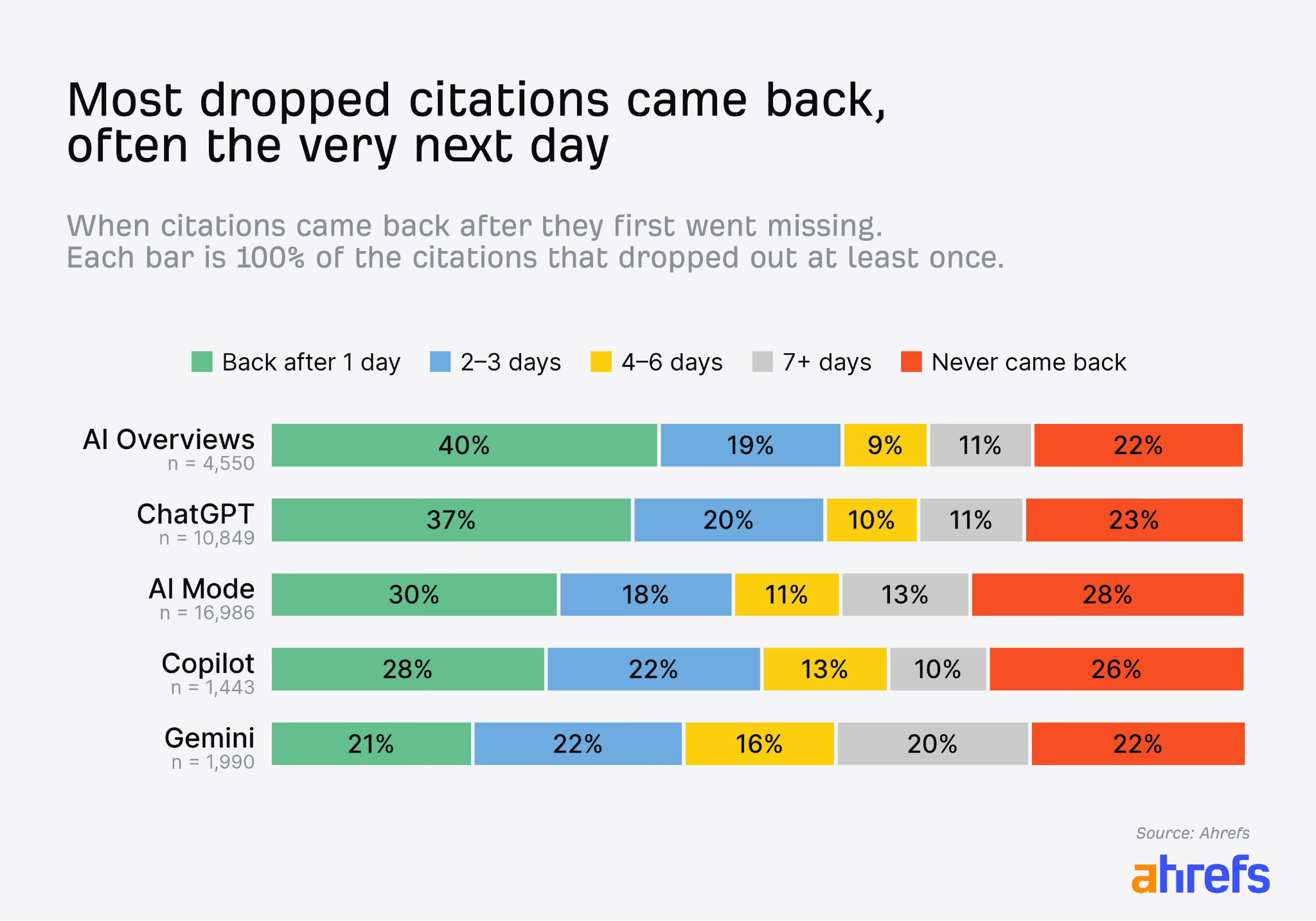
The researchers found that sites that disappeared from an answer were actually more likely to reappear than to stay gone. This suggests that the "loss" of a citation is often a flicker in the system rather than a permanent demotion. If you are reporting these metrics to a client or a manager, teams need to frame a loss as a potential fluctuation rather than a definitive failure.
Expert Interpretation: The tradeoff here is between agility and accuracy. While we want to be agile in responding to search trends, reacting to a 20 day window of volatility with permanent content changes is a high risk. The decision you should inspect is whether your reporting is based on a "snapshot" or a "trend." A snapshot tells you that you are gone today; a trend tells you if you are actually losing ground.
How the Tracking Was Conducted
To get these results, Mateusz Makosiewicz and Xibeijia Guan tracked citations from day one through day 20. They discovered a high rate of immediate churn. By the second day, roughly half of the references in AI Overviews had vanished, and the attrition was even higher across other AI tools.
Despite this initial drop, most of these citations returned before the study ended. In fact, about half of the citations that disappeared came back within just three days. the study tracked websites rather than specific URLs, so while a site might return, it is not guaranteed that the exact same page returned.
Expert Interpretation: This data highlights the "noise" inherent in AI responses. When half of your citations vanish in 24 hours but return in 72, the "daily check" becomes a source of anxiety rather than a source of insight. You must decide if your current tracking cadence is creating artificial urgency for your team. The same pattern also shows up in to Choose Your Next Move, where the practical question is how the signal becomes visible.
Connecting Daily Shifts to Prompt Variability
This study builds on earlier research regarding how AI tools behave across different runs of the same prompt. For instance, SparkToro previously found that ChatGPT and Google's AI in Search provided the same list of brands less than 1% of the time when the same prompt was run repeatedly.
Interestingly, while the specific ranking of a brand within a list fluctuates wildly, the frequency with which a brand appears at all is generally more stable. Because of this, the Ahrefs researchers suggest moving away from "yes/no" tracking and instead counting how many days out of the last seven a site was cited.
Expert Interpretation: There is a fundamental difference between "run frequency" (how often you appear across 10 prompts right now) and "day frequency" (how often you appear over a week). If you only track the former, you are measuring the AI's randomness. If you track the latter, you are measuring your brand's authority. Shift your focus to the seven day window to filter out the noise.
Check One: Did the Tool Cite Anyone at All?
Before assuming you were replaced by a competitor, check if the AI provided any citations at all. In the Ahrefs study, Gemini and Copilot frequently produced answers with zero citations. Gemini had no citations about 64% of the time, and Copilot was around 53%.
If the AI simply stopped citing sources for a specific query, your "loss" is a reflection of the tool's behavior, not your content's quality. This is distinct from AI Overviews, AI Mode, and ChatGPT, which almost always provide citations. In those tools, a loss usually means another site has taken your spot.
Expert Interpretation: This is a critical distinction in attribution. If you lose a citation on Gemini, it might be a "system void." If you lose it on ChatGPT, it is likely a "competitive loss." You should inspect the actual response text before deciding if this is a content problem or a platform quirk.
Check Two: The Importance of Citation Longevity
Not all citations are created equal. The study found that the longer a citation had been active before it disappeared, the more likely it was to return. For citations that only lasted one day, between 34% and 41% never came back during the study.
Conversely, for citations that had remained active for eight to 14 days, the failure rate was 4% or lower. This means a site that has been a staple for two weeks and suddenly vanishes is in a very different position than a site that appeared once and disappeared the next day.
Expert Interpretation: This suggests that "tenure" is a proxy for stability. A short lived citation is often a test by the AI model, while a long term citation represents a settled preference. When a long term citation vanishes, it is more likely a temporary glitch than a loss of authority, meaning you should be even more cautious about making drastic edits.
Check Three: Distinguishing Mentions from Citations
It is possible to lose the link but keep the name. A citation is a clickable link, but a mention is simply the brand name appearing in the text. The data showed that brand mentions are far more stable than citations. While 50% to 70% of cited sites appeared on only one day, only about one in five brand mentions behaved that way. A useful companion note is AI Search Cites Your Content, because it looks at a nearby part of the same system.
AI tools often vary the version of a brand name they use, switching between long and short forms. If you only look for a specific string of text or a specific link, you might record a loss when the brand is still present in the answer under a slightly different name.
Expert Interpretation: The tradeoff here is between tracking "traffic potential" (citations) and "brand awareness" (mentions). If the link is gone but the name remains, your authority is still recognized by the model, but the delivery mechanism has shifted. Mentions are a more reliable metric for long term health than citations.
Check Four: The Correlation with Traditional Search Rankings
There is a strong link between traditional SEO and AI visibility. For AI Overviews and AI Mode, pages that already ranked in standard Google Search results for the same question tended to hold their AI citations longer.
While this correlation was less pronounced for ChatGPT, the general trend holds: appearing in the search results at all was more important for citation longevity than the specific position the page held in those results. Essentially, being "in the conversation" in traditional search provides a safety net for AI citations.
Expert Interpretation: This reveals that AI citations are not a separate silo from traditional SEO. If you lose an AI citation, the first place to look is your traditional organic ranking. If your organic ranking is stable but the AI citation is gone, it is likely a temporary AI fluctuation. If both are dropping, you have a genuine content or authority problem.
Avoiding the "False Positive" Edit
Because most citations eventually return on their own, you must be careful not to credit a content edit for a recovery that would have happened anyway. If you rewrite a page and the citation returns a few days later, you have a correlation, not necessarily a causation.
The researchers warn against crediting a single comeback to a page edit. To prove an edit actually worked, you would need to see a sustained increase in the frequency of citations over a longer period. Similarly, if a citation vanishes the day after you edit a page, it is not necessarily proof that the edit damaged the page, as half of all citations vanish by the next day regardless of changes.
Expert Interpretation: This is the most dangerous trap for content teams. The "I fixed it" narrative is satisfying, but it can lead to a strategy of "editing for the sake of editing," which can actually degrade a page's performance over time. You must decide to implement a "waiting period" before attributing changes to specific edits.
Practical Implications for Content Strategy
Before proposing a content overhaul due to a lost citation, there is a logical order of operations to follow. First, observe the loss over several days to see if it is a temporary dip. Second, analyze the response to see if the tool has stopped citing sources entirely or if it is still mentioning your brand without a link.
For those managing clients or internal stakeholders, reporting a "five out of seven days" metric is far more useful than a binary "yes/no" report. It provides a realistic view of visibility and prevents unnecessary panic. A content team should be wary of the urge to optimize every single flicker in the data.
Expert Interpretation: The decision here is about resource allocation. Do you spend your hours rewriting a page that might return to the AI overview tomorrow, or do you spend that time building the foundational authority that makes citations more stable? Prioritize the latter.
Remaining Uncertainties
While this study provides a great baseline, there are still gaps in our understanding. The researchers tracked the disappearance of citations, but they did not specifically test whether changing a page actually brings a lost citation back. They also only tracked the first time a citation went missing, leaving it unclear how often those same citations vanish and return in a cycle.
because the study ended at day 20, some citations that disappeared late in the window may not have had enough time to return, meaning the return rate could actually be higher than reported. Finally, as AI models are updated, these stability patterns may shift.
Managing Future Losses
The best way to handle the next lost citation is to have a historical log already in place. By maintaining a daily record of citations for your most important queries, you can provide a factual tally of "days cited" before a manager asks why visibility is down.
If a citation remains missing for two to three weeks, that is the appropriate time to investigate the page. Start by checking the traditional search rankings for that specific question. If the organic ranking is gone, the AI citation likely followed. If the organic ranking is still there, you can then look at the content for potential gaps or updates.
Expert Interpretation: The goal is to move from a reactive posture to a diagnostic one. By establishing a baseline of "normal volatility," you can ignore the noise and only intervene when the data indicates a genuine trend of decline. This preserves your content's integrity and your team's sanity.
Comments
Comments are reviewed before they are published. Links are not allowed inside comments.