AI Visibility Belongs in the Marketing Mix, but Not Where You Think
/ 7 min read

Summary
Most C-suite leaders have realized their organic clicks may never return to the numbers they saw before AI Overviews. But growth. The practical question is what this changes for SEO, content quality, and AI search visibility.

There is a growing tension in the search industry right now. We are seeing a clash between the theoretical promise of AI visibility and the actual data coming back from the field. For many of us, the instinct is to optimize for every new platform the moment it appears, but the numbers are starting to tell a different story.
Recent studies have cast a cold light on the idea that AI assistants are the next great traffic engine. Marie Haynes found that ChatGPT sessions contributed a mere 0.62% of the volume driven by Google Organic in her sample. Similarly, The SEO Works reported that organic search outperformed AI assistants by a factor of 39 in terms of traffic. Even Kevin Indig found no reliable link between being visible in AI responses and an increase in direct traffic or branded searches. This connects with We Earned 1 when the same signal needs a clearer operating decision.
These findings are uncomfortable for leadership teams who have been told that Generative Engine Optimization (GEO) is the new frontier of growth. However, the real issue isn't the data itself, but how we categorize the value of that visibility.
The gap between traffic and growth expectations
Most executives have already noticed that organic clicks are not returning to pre AI Overview levels. The traffic is gone, but the pressure to grow has not diminished. This creates a dangerous incentive to treat AI visibility as a direct replacement for lost Google clicks. The same pattern also shows up in Not the Outputs), where the practical question is how the signal becomes visible.
The expectation is often that if we can just "win" at GEO or AEO, we will not only recover the lost revenue but accelerate the business to a new level of performance. I see this constantly in conversations with clients and in the hype cycles on social media, where AI automation is framed as a magic bullet for overnight wealth.
The problem is that wanting AI optimization to act as a performance channel does not actually make it one. We are essentially trying to build a financial strategy based on an expectation of what the channel should do, rather than what it actually does. When we treat a brand awareness tool as a lead generation tool, we set ourselves up for failure because the mechanisms of influence are entirely different from the mechanisms of acquisition.
Expert Interpretation: The tradeoff here is between short term reporting and long term positioning. If you measure AI visibility by clicks, you will likely conclude it is a waste of time. The decision to make is whether you are optimizing for a click or optimizing for a mention. If leadership demands immediate ROI in the form of traffic, you are fighting a losing battle against the nature of the technology.
Reframing GEO as a brand play
We have spent years measuring SEO through the lens of traffic and conversions, but I have long questioned if that is the wrong way to look at it. Some of the most valuable work in search is actually brand marketing, even if it doesn't show up in a referral log.
Mike King recently touched on this, suggesting that while the data regarding low traffic is correct, the category we are placing this data in is wrong. AI search does not necessarily drive a user to a website, but it does influence how a user discovers, understands, and considers a business.
Referral traffic is a lagging indicator. It tells us who arrived, but it cannot capture the psychological shift that happened inside the AI interface before the user ever decided to click. This is a strong argument for evaluating AI visibility through the lens of brand value, though it is not a blanket permission to assume that value exists without evidence.
Expert Interpretation: This matters because it shifts the KPI from "sessions" to "sentiment and presence." The risk is that "brand value" can become a convenient hiding place for ineffective work. You must decide if your presence in AI answers is actually moving the needle on perception or if you are simply chasing a vanity metric.
Defining the actual value of AI mentions
To understand what brand value looks like in an AI context, imagine a potential customer asking an AI which companies can solve a specific problem. The AI provides a shortlist, compares options, and discusses drawbacks.
In this moment, several critical questions are answered before the user ever hits your landing page: Is your company mentioned? Is the description accurate? Does the AI explain why you are a good fit for this specific user?
This process mirrors the role of traditional PR. A well placed article in a trade publication establishes credibility and introduces a company to a new audience, often long before a trackable visit occurs. Leadership typically accepts this investment in PR without demanding a direct, one to one ROI for every single mention. There is no logical reason why AI visibility should carry the heavier burden of replacing lost organic acquisition while simultaneously acting as a new growth engine.
we need to stop treating a citation to a blog post and a direct recommendation of a business as the same thing. They are different outcomes with different values. Reporting them as interchangeable "visibility wins" provides no real insight into whether the business is actually gaining a competitive advantage.
Expert Interpretation: The real opportunity here is influencing the "consideration" phase of the buyer's journey. The tradeoff is that this is much harder to track than a click. You have to decide if you are willing to move away from the comfort of the Google Search Console and toward more qualitative measures of influence.
The necessity of earning the budget
Simply labeling AI visibility as "brand marketing" does not automatically make it a worthwhile investment. We cannot ignore the research showing that AI visibility does not reliably lead to more branded search or direct traffic. We cannot simply assume the revenue is "hiding" somewhere in the data.
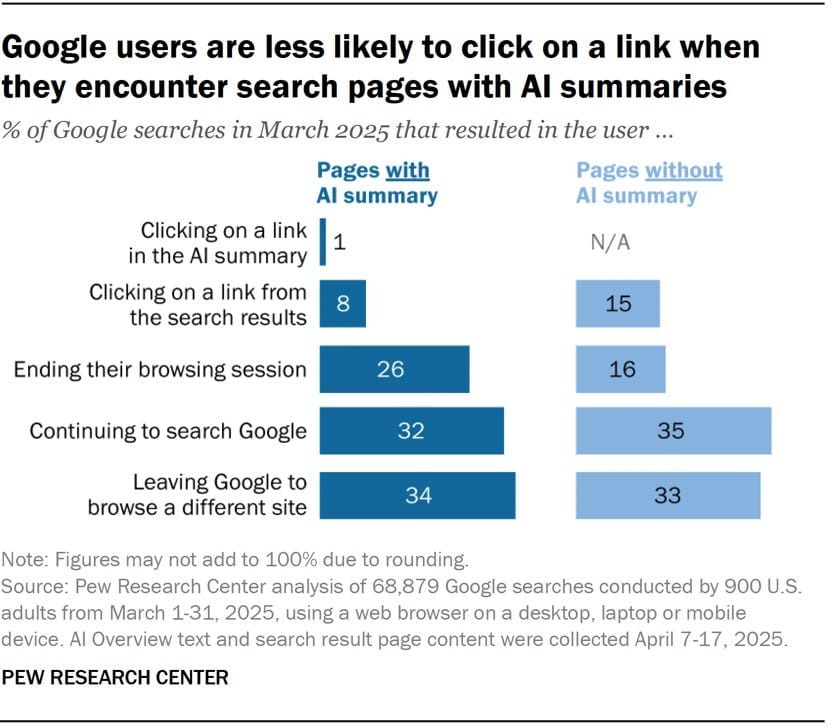
If you want to justify the spend, you have to look at a cluster of signals. This means tracking how the business appears across key buying questions, but also asking customers directly where they first heard of the company and what influenced their decision to buy.
A prompt tracking dashboard is a useful tool for identifying gaps in how an AI describes you, but it cannot tell you how many real buyers saw that answer or if it changed their mind. The evidence must drive the investment, not the other way around. We should not pretend the evidence supports a performance target just because that is what leadership wants to see.
Expert Interpretation: This is where most SEOs fail. They try to use a tool to prove a result that the tool isn't designed to measure. The decision here is to stop relying solely on dashboards and start integrating customer interviews and attribution surveys to see if the AI mentions are actually appearing in the customer's journey.
Aligning objectives with the right budget
If a company decides to invest in AI visibility, it should be funded using the same expectations applied to TV ads, brand campaigns, or PR. This means defining the target audience, determining what they should understand about the business, and establishing how to evaluate if the investment is influencing consideration.

The goal should be to budget for AI visibility as a brand expense, not a performance expense. While SEO skills are necessary to execute this strategy, that does not mean the work should inherit the performance targets of traditional SEO or be tasked with recovering lost Google revenue.
Accountability is still required, but it must be aligned with the objective. The question is not "how many leads did this generate?" but rather "are more relevant buyers discovering and considering our business?"
If leadership wants brand influence, they need to provide a brand budget. If they need predictable, scalable acquisition growth, they should not be told that an AI visibility budget can guarantee it. It is a strange irony that "brand exposure" is a respected investment until the work is owned by the SEO team, at which point it is suddenly questioned as to why there is no immediate revenue. A useful companion note is Which Brands Are Vanishing from AI Search?, because it looks at a nearby part of the same system.
Expert Interpretation: The final decision is a matter of organizational alignment. You must decide whether to continue fighting for "performance" wins in a channel that doesn't deliver them, or to push for a structural change in how the budget is allocated. The tradeoff is a potential short term loss in "lead" reporting for a long term gain in market positioning.

Comments
Comments are reviewed before they are published. Links are not allowed inside comments.