CMS Market Share Trends: Top Content Management Systems (Nov 2026)
/ 6 min read

Summary
2. Top 10 CMS By Market Share (Globally), November 2026 3. WordPress Vs. Joomla Vs. Drupal Market Share 4. Website Builders. The practical question is what this changes for SEO, content quality, and AI search visibility.

Choosing a content management system is rarely just a technical decision. It is a business decision that dictates how you scale, how you handle security, and how much friction exists between your idea and a live webpage. For years, the conversation was dominated by a single player, but the landscape is starting to fragment.
When we look at the current data, we see a shift in where trust is placed. While one platform still holds the crown, the growth of SaaS alternatives suggests that businesses are prioritizing ease of use and managed infrastructure over total control. Understanding these trends helps us identify where the industry is moving and which platforms are becoming the new standards for specific business models. The same pattern also shows up in Key AEO & Content Marketing Trends, where the practical question is how the signal becomes visible.
The Scale of the Global CMS Market
To understand the shifts in market share, we first need to look at the total volume of the market. Based on data from W3Techs, roughly 67.7% of all websites currently use a CMS. When you cross reference this with Netcraft's report of over 323 million domains, the estimated market size for content management systems has climbed to approximately 218.8 million websites.
This massive number tells us that the "barrier to entry" for creating a website has effectively vanished. However, the sheer size of the market also means that even a small percentage shift in share represents millions of websites moving from one ecosystem to another. For a strategist, this indicates that the ecosystem for plugins, themes, and specialized developers is shifting in real time.
Analyzing the Top 10 CMS Platforms (November 2026)
It is important to distinguish between two different metrics here: usage and market share. Usage refers to the percentage of all surveyed websites, regardless of whether they use a CMS. Market share refers specifically to the percentage of websites that are known to use a CMS. This distinction is vital because it shows us how much of the "CMS using world" a platform controls versus the entire internet.
WordPress
WordPress remains the dominant force, but the trajectory has changed. After peaking in January 2022 with a usage rate of 43.2%, it has dipped to 39.2%. Its specific CMS market share has also seen a decline, falling from 65.2% in early 2022 to 57.9% as of November 2026. While it still holds a massive lead, this is the most significant drop since 2013. This connects with Publishers and Brands in 2026 and Beyond when the same signal needs a clearer operating decision.
The trade off with WordPress has always been power versus maintenance. While the platform offers unparalleled flexibility, the burden of security management, core updates, and plugin compatibility remains a constant overhead for the user. The current downturn suggests that a segment of the market is tired of this maintenance burden.
Shopify
Shopify has solidified its position as the second most popular standalone CMS. Its market share now sits at 7.9%, with a total website usage of 5.4%. Both of these figures have climbed since the start of 2026, when they were 7.0% and 5.0% respectively.
From a business perspective, Shopify's growth is a signal that the "all in one" commerce approach is winning. The decision to move to Shopify is usually a trade off where the user accepts a monthly subscription and less architectural control in exchange for a platform that "just works" for revenue generation. If you are building a store, the growing footprint of Shopify means a larger ecosystem of integrated apps and a more standardized SEO environment.
Wix
Wix currently powers 4.2% of all surveyed websites and holds a 6.2% share of the known CMS market. This is an increase from the 5.8% market share recorded at the beginning of 2026.
Wix has successfully moved beyond the reputation of being a simple "drag and drop" tool for hobbyists. By investing in branding and expanding its platform capabilities, it has become a legitimate option for mid market businesses. The key decision here for a business owner is whether the speed of deployment offered by Wix outweighs the long term portability of their data.
Squarespace
Squarespace has seen steady growth, moving from a tiny 0.5% market share in 2015 to 3.6% today, with 2.4% of all surveyed websites using the platform.
This growth is likely driven by the demand for design forward, low maintenance sites. Squarespace appeals to those who value aesthetics and a curated experience over the "build it yourself" chaos of WordPress. It is a strategic choice for small businesses and individuals who want a professional presence without needing a dedicated webmaster.
Joomla, Webflow, and Drupal
The trend for these three is markedly different. Joomla and Drupal are continuing to lose ground, now holding 1.6% and 0.9% of the CMS market, respectively. Both have fallen from their positions as the primary alternatives to WordPress, overtaken by the SaaS growth of Wix and Squarespace.
Webflow, which many expected to surge, has remained relatively flat. It holds 1.2% of the known CMS market, and its overall website usage has actually slipped slightly from 0.9% to 0.8% since the start of the year.
The decline of Joomla and Drupal reflects a broader industry shift. These platforms were once the darlings of developers and amateur coders, but the market has moved toward SaaS platforms that remove the technical friction of hosting and server management. The trade off here is a loss of granular control in exchange for operational velocity.
The "No CMS" Category
Interestingly, the proportion of websites that do not use a monitored CMS rose from 28.6% to 32.3% between January and November 2026. This coincides with the drop in WordPress usage.
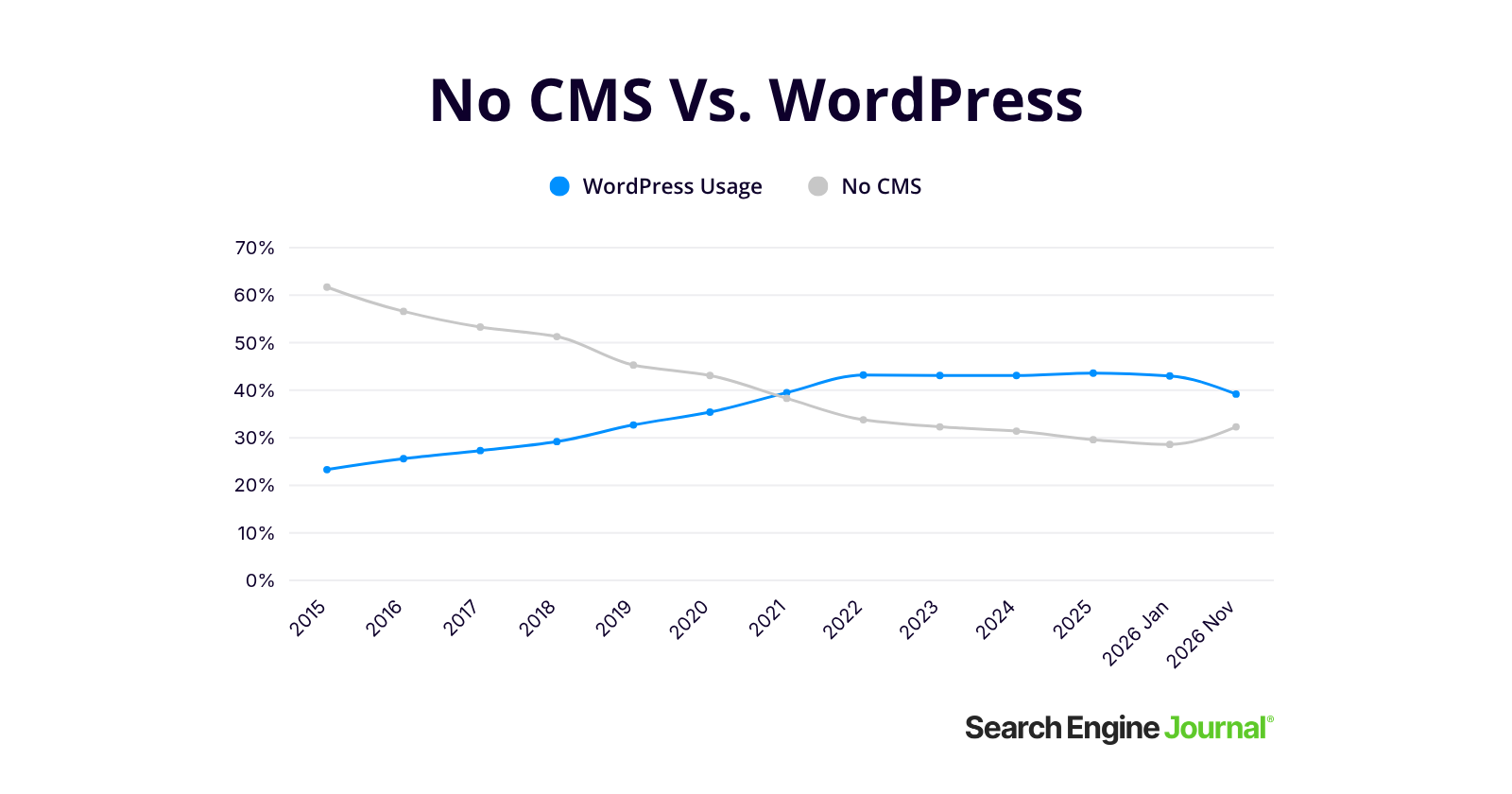
"No CMS" does not necessarily mean these sites are custom coded from scratch. It simply means the detection tools did not find a known CMS. However, this trend is worth watching. As "vibecoding" and AI driven site generation become more common, we may see a rise in sites that don't fit the traditional CMS mold.
The Decline of the Traditional Powerhouses: WordPress, Joomla, and Drupal
Looking back at the long term data, the fall of Joomla and Drupal is stark. Joomla has dropped from 8.6% in 2015 to 1.6% today, while Drupal fell from 5.1% to 0.9%. They have tumbled from the number two and three spots to number five and ten.
Joomla once had immense momentum, even surpassing WordPress in search interest around 2008. The reason for the eventual decline is largely the ecosystem. WordPress built a massive moat of third party plugins and themes that made it accessible to non developers. While Shopify is now attempting a similar strategy with its own app ecosystem, Joomla and Drupal couldn't keep pace with the demand for extreme user friendliness. A useful companion note is WordPress and Astro Versus Everyone Else, because it looks at a nearby part of the same system.
Comparing Website Builders: Wix vs. Squarespace
Between November 2025 and November 2026, we saw the following growth in CMS market share: Shopify grew by 16.2% (to 7.9%), Wix grew by 8.8% (to 6.2%), and Squarespace grew by 5.9% (to 3.6%).
The most notable detail here is the acceleration of Shopify. While Wix and Squarespace are still growing, their pace has slowed. Shopify has taken the lead in growth velocity, likely because it is capturing users who are moving away from the complexity of WooCommerce.
The Role of Elementor
While not a standalone CMS, Elementor is a critical piece of the current landscape. It is installed on 18.2% of all websites with a known CMS. To put that in perspective, Elementor's footprint is larger than Wix and Squarespace combined.
Because Elementor is a WordPress plugin, its numbers overlap with WordPress. Its prevalence shows that a huge portion of the WordPress community is relying on page builders to bridge the gap between the core software and the design forward experience offered by SaaS builders. It is essentially a "bridge" that allows WordPress to compete with the ease of use found in Wix.
Comments
Comments are reviewed before they are published. Links are not allowed inside comments.