Entities Are the Foundation of Modern SEO
/ 8 min read

Summary
Entity SEO isn't new. It's making sure modern information retrieval systems know who you and your brand are with clarity. It. The practical question is what this changes for SEO, content quality, and AI search visibility.

Most of the conversation around Generative Engine Optimization (GEO) feels like a rebranding exercise. We talk about AI and LLMs as if they have fundamentally changed the rules of the game, but the reality is that the core principles of information retrieval haven't shifted in fifteen years. The real challenge isn't the technology, but the fact that most brands still ignore the basics of how search engines actually perceive the world.
At its heart, modern SEO is about discoverability. Whether you are optimizing for a traditional search result or a response from an AI, the goal is the same: reducing the amount of guesswork the system has to do. If you want to be visible, you have to stop thinking in strings of text and start thinking in entities.
Defining Entity SEO
Entity SEO is essentially the process of removing ambiguity. It is the practice of ensuring that the people, organizations, products, and topics central to your business are clearly defined and distinct. When we talk about entities, we are talking about "things, not strings." A string is just a sequence of characters; an entity is a unique object with properties and relationships.
The most visible example of this is Google's Knowledge Graph, which acts as a massive database of these entities. To influence this, you have to look at your on page content, your navigation, and the consistency between your owned assets and the mentions you earn from third parties. Everything you say about your brand must be accurate, and the rest of the web should ideally corroborate those claims.
From a strategic perspective, this is where SEO overlaps heavily with brand marketing. While an SEO might handle the technical implementation, the actual "truth" of the entity should be managed by someone with a bird's eye view of the brand, such as a Director of Marketing or a Director of Discoverability. The goal is to control the variables you can and ensure that the right entities are the ones talking about you. A useful companion note is AI Recommendation Sets Leave Some Brands Out, because it looks at a nearby part of the same system.
Why This Matters for Visibility
If an LLM or a search engine cannot confidently identify who you are, it cannot accurately connect the signals associated with your brand. Without clarity, the system struggles to interpret your authority or your relationship to a specific topic. This is why on site consistency and a verifiable third party presence are non negotiable; they serve as a guarantee to the system that you are indeed who you claim to be.
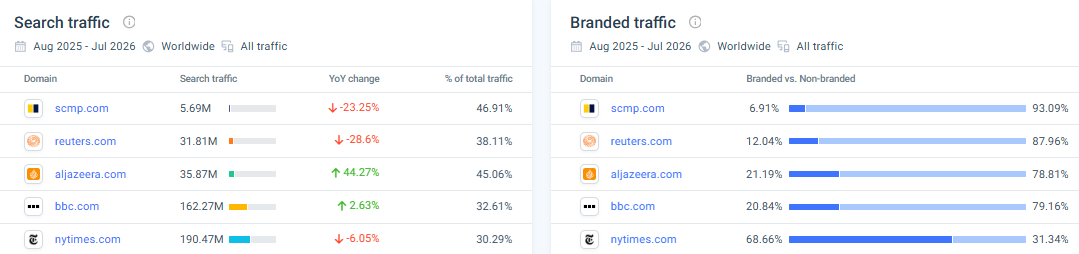
I often look at branded search volume and direct traffic to specific site sections as indicators of real user demand. These metrics help you understand where you actually hold authority in the eyes of the algorithms. While AI systems currently struggle to filter out all the noise and spam, that gap is closing. Relying on the current inefficiency of AI filters is a losing strategy.
The tradeoff here is between short term "hacks" and long term entity stability. Many people try to trick systems with keyword density, but the real win comes from establishing a verifiable identity. The decision you need to make is whether you want to spend your time chasing fluctuating algorithms or building a permanent digital footprint that is resistant to updates.
The Unique Case of News SEO
News is a fascinating edge case because of how users behave. When people search for news, they typically use short tail entities. They aren't typing long queries; they are searching for a specific person, a sudden event, or a place they just heard about in a headline. This makes the search behavior relatively "lazy" and highly focused on the entity.
For news publishers, the "Top Stories" carousel is the ultimate goal, and that space is dominated by entities. To win there, your headlines, opening paragraphs, and images must provide a clear focal point. You have to tell the crawler exactly what the story is about as efficiently as possible.
The risk in news is that Google's crawling system may only give you one chance to get it right during the initial spike of demand. If your first pass is ambiguous or inaccurate, you lose the window. the type of content you consistently produce defines your brand entity. If a publisher spends all their time creating low value content for specific niches, like horse racing for betting purposes, they may inadvertently signal to Google that they are a betting site rather than a reputable news organization, which can damage their broader authority.
A Tactical Framework for Entity Management
You don't need to be a global brand like the New York Times to care about this. In fact, smaller brands and personal brands need to be more diligent because they don't have the inherent "entity weight" to overcome simple errors. If someone misspells your brand name across the web, it matters more to you than it does to a household name. This connects with search visibility when the same signal needs a clearer operating decision.
The most effective way to approach this is to focus on the properties you actually control. I've seen too many SEOs waste time trying to turn every single mention into a backlink, which is often a fruitless exercise. Instead, focus your energy on your owned properties. The following framework is designed to clean up the ambiguity and establish a "source of truth."
Own: Establishing Control
Start by auditing every asset you own and can edit. This includes your About Us pages, Contact pages, privacy policies, and footers. Don't overlook the technical side, such as structured data and the sameAs attribute, which tells search engines that two different URLs refer to the same entity.
If you have a Wikipedia or Wikidata entry, ensure those are accurate. Your NAP (Name, Address, Phone Number) and the details of your leadership and contributors should be identical across all platforms. This is essentially "entity hygiene." While cleaning up these details might not lead to an overnight surge in traffic, it removes "entity drift", the gradual divergence of how you are described across the web.
The practical takeaway here is to treat your owned assets as the definitive record. If there is a conflict between your website and a third party directory, the system has to decide which one to trust. By making your owned assets flawless, you provide a clear anchor for the system.
Describe: Making Relationships Explicit
While "owning" is about the brand level, "describing" happens at the page level. You need to ask if each page explicitly targets the correct entity and if the surrounding content supports that target. This involves using a header structure that answers related questions and maintaining consistent anchor text for internal and external links.
This is about building a web of relationships between words, authors, and brands. Organization schema should define the brand, while Article and Person schema corroborate the details of the specific page. On larger sites, internal linking is the primary tool for signaling these relationships to a crawler.
The tradeoff here is between writing for humans and writing for machines. The key is to realize that the most "human" way to write, being clear, direct, and answering questions, is also the most "machine friendly" way to define an entity. You aren't optimizing for a bot; you are reducing the friction of understanding.
Prove: Establishing Credibility
You cannot simply claim to be an expert; you have to prove it through verifiable identity. Every key person associated with your brand, founders, writers, and executives, needs a consistent digital footprint. This means an author page that links to a real LinkedIn profile, a verifiable publication history, and a bio that explains why they are trustworthy.
If a writer has a Masters in Economics or a decade of experience at a major firm, that information should be explicit. These are the small wins that signal authority to information retrieval systems. Highlighting your research methodology is another way to prove the validity of your entity.
The decision to make this public is often a matter of product marketing. Some brands prefer to stay quiet, but in the era of E-E-A-T, anonymity is a liability. You must decide if the privacy of your team is more valuable than the visibility of your brand. The same pattern also shows up in to Get Cited & Stay Visible, where the practical question is how the signal becomes visible.
Earn: Corroborating Salience
You do not have total control over your entity because the rest of the internet gets a vote. Mentions on Reddit, YouTube, or industry forums contribute to how LLMs perceive you. This is why "earning" quality mentions is critical. You cannot fake this sustainably; the breadcrumbs will eventually lead back to the truth.
There are two types of corroboration to track:
- Entity Corroboration: This is the basic "who are you?" It involves accurate brand mentions and consistent descriptions in directories and associations.
- Topical Corroboration: This is the "what are you known for?" It involves expert commentary, citations, and bylines that consistently link you to your claimed area of expertise.
A Spreadsheet Audit (Paid)
You can, of course, build an entity audit and framework based on this article. A consistent brand "Source of Truth." A full asset inventory split into coverage and consistency. An entity corroboration vs topical corroboration checklist. The practical read is that brand signals need to be consistent enough for both people and AI systems to form a stable view of the company, its expertise, and its trust signals.
The practical value is in connecting the idea to an observable signal. That means deciding what should be checked, what would prove the issue is real, and where the team should make the smallest useful improvement first.
Comments
Comments are reviewed before they are published. Links are not allowed inside comments.