Google Documents Advance Notice for Significant Ranking Updates
/ 6 min read

Summary
Two types of changes that get notice are listed by Google in its page on staying informed about ranking updates. The first is. The practical question is what this changes for SEO, content quality, and AI search visibility.
According to a new ranking section released by Google on its Search Central website today, Google will provide advance notice of significant search engine ranking updates and actionable policy changes via the Search Status Dashboard. for each ranking update announced on the Search Status Dashboard, you can now provide Google with your thoughts through Search Console.
According to the main page of the new Ranking Hub section of Search Central, the purpose of these announcements is to give site owners "predictability and time to prepare" when it comes to how and when their rankings may be affected by a Google update. If a particular ranking update has the potential to cause major changes in search engine rankings within the United Kingdom, then advance notice regarding those types of updates follows UK governmental requirements placed upon Google in June (via the UK's Competition and Markets Authority, or CMA) requiring fair ranking practices, according to a second page.
When Google Gives Notice
Two types of changes that get notice are listed by Google in its page on staying informed about ranking updates. The first is actionable policy updates, which include updates to content policies, technical guidelines or eligibility rules. For search teams, the important part is not the headline movement by itself. It is whether the shift changes which communities, forums, video surfaces, or publisher pages now satisfy the query better than the old ranking pattern. The same pattern also shows up in Google Launches a Video Series, where the practical question is how the signal becomes visible.
The risk is usually hidden in the execution layer. A page can look fine to a human and still fail for an automated visitor if the form, call to action, rendering path, or confirmation step is not accessible enough for the agent to complete the task.
What The UK Rules Require
The CMA's rules set minimum notice periods for changes that reach UK users. According to the CMA's summary of the requirement, Google must give at least 30 business days' notice before changes where publishers could act to avoid or reduce. The practical question is what this changes in the system: the page structure, the evidence presented, the measurement habit, or the way the topic is connected to related work.
Feedback And Appeals
According to Google's feedback page, if you are a verified owner of your website, then you may submit feedback about a significant ranking change or a new actionable policy update listed in the Search Status Dashboard. Your feedback would. The measurement question is whether this signal changes a decision, not whether it adds another number to a dashboard. Useful reporting connects visibility, engagement, and business outcomes without pretending every AI influenced journey will produce a clean click path.
The reporting question is whether this signal changes a decision. If it only creates another number in a dashboard, it adds noise. If it helps separate profile activity, website visits, calls, bookings, and direction requests, it can make local performance easier to understand.
Ranking Principles
Google's principles page says AI Overviews and other result types are judged by the same criteria as web listings. Google wrote: "This means that web page listings and other results like AI Overviews, carousels, images, and videos are. The search implication is whether the section improves the evidence around the page, not simply whether it adds more wording. Clear entities, crawlable structure, internal links, and useful context are what make the topic easier to evaluate.
The useful check is whether this improves the system behind search performance, not only the words on the page. Internal links, crawlable content, clear entities, current evidence, and a sensible page structure all help the recommendation become easier to trust.
Why This Matters
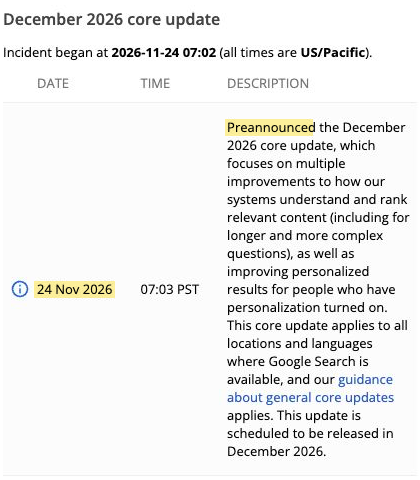
When you add the Search Status Dashboard's RSS feed to your monitoring, you will receive notification of a preannounced ranking update before your rankings change. The stay informed page on Google says to allow at least one week of. For search teams, the important part is not the headline movement by itself. It is whether the shift changes which communities, forums, video surfaces, or publisher pages now satisfy the query better than the old ranking pattern.
Looking Ahead
Dec. 17 is when the CMA requirement comes into force and the UK appeal link goes live. The December core update's start date will go on the dashboard when the rollout begins. Google also published two generative AI pages today, one on the. For search teams, the important part is not the headline movement by itself. It is whether the shift changes which communities, forums, video surfaces, or publisher pages now satisfy the query better than the old ranking pattern.
When Google Gives Notice in practice
Introduction According to a new ranking section released by Google on its Search Central website today, Google will provide advance notice of significant search engine ranking updates and actionable policy changes via the Search Status. For search teams, the important part is not the headline movement by itself. It is whether the shift changes which communities, forums, video surfaces, or publisher pages now satisfy the query better than the old ranking pattern.
What the visibility signal actually changes
What the visibility signal actually changes: google Documents Advance Notice for Significant Ranking Updates: the Practical Angle should be treated as a visibility signal, not a standalone headline. Introduction According to a new ranking section released by Google on its Search Central website today, Google will provide advance notice of significant search engine ranking updates and actionable policy changes via the Search Status Dashboard. This connects with Search Updates Aren’t Announced Right Away when the same signal needs a clearer operating decision. A useful companion note is Spam Updates Need to Happen, because it looks at a nearby part of the same system.
What the visibility signal actually changes: the practical question is whether the page, brand evidence, and surrounding content make the answer easier to trust. If that support is weak, search systems can still understand the topic but fail to connect it confidently to the brand.
What the visibility signal actually changes: that is why the response should begin with an audit of the evidence already on the site before creating a new asset. The fastest improvement is often a clearer page, a better internal link, or a stronger explanation of why the brand belongs in the answer.
Where the evidence needs to be tested
Where the evidence needs to be tested: a single study or ranking observation should not become a strategy by itself. It should become a diagnostic prompt: which source is being trusted, which query pattern is affected, and which part of the site would make that trust easier to earn?
Where the evidence needs to be tested: that keeps the response grounded. The goal is to improve the evidence chain around the topic rather than publish another summary that repeats what every other page already says.
Where the evidence needs to be tested: the important distinction is between a useful signal and a fashionable talking point. A useful signal changes the brief, the page structure, the linking plan, or the measurement view.
How to avoid overreacting to one data point
How to avoid overreacting to one data point: for content teams, the strongest move is to map the claim to existing assets before creating anything new. The right page may already exist, but it may need clearer headings, stronger internal links, fresher proof, or a better explanation of why the brand belongs in the answer.
How to avoid overreacting to one data point: this is also where title rewriting matters. A title should not copy the source headline; it should frame the practical implication so readers immediately know why the topic deserves attention.
How to avoid overreacting to one data point: the same standard should apply to every section. Each heading needs to earn its place by moving the reader through the evidence, not by repeating the outline in a more polished voice.
Comments
Comments are reviewed before they are published. Links are not allowed inside comments.