Google Says Back Button Hijacking Policy Covers Social Visits
/ 6 min read

Summary
One FAQ question asks whether the back button hijacking policy covers people who arrive from a non Search channel, such as social. The practical question is what this changes for SEO, content quality, and AI search visibility.
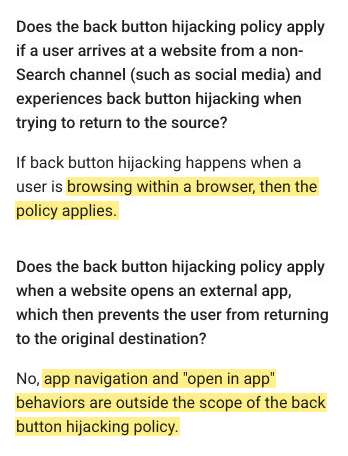
Google's back button hijacking policy applies whenever the hijacking happens in a browser, including on visits from social media rather than Google Search, according to an FAQ Google added to its spam policies today. Ad platform code is still allowed, the FAQ says, and Google acts only on pages that show the hijacking.
Google's Search Central changelog says the FAQ answers common questions it has received about the policy. I covered the policy when Google announced it in April, with enforcement set to start June 15.
Where The Policy Applies
One FAQ question asks whether the back button hijacking policy covers people who arrive from a non Search channel, such as social media, and then can't get back to where they came from. Google wrote: "If back button hijacking happens when. The strategic issue is whether automated visitors can understand, trust, and complete the same journey a human visitor can. Agent readiness is partly technical, but it is also about clear tasks, accessible flows, and reliable evidence. This connects with Microsoft Back Draft AI Agent Discovery Spec when the same signal needs a clearer operating decision.
The useful check is whether this improves the system behind search performance, not only the words on the page. Internal links, crawlable content, clear entities, current evidence, and a sensible page structure all help the recommendation become easier to trust.
Ad Platform Code
Google's April announcement said some back button hijacking "may originate from the site's included libraries or advertising platform," and asked sites to remove or turn off the code behind it. The FAQ asks whether Google is preventing. The practical question is what this changes in the system: the page structure, the evidence presented, the measurement habit, or the way the topic is connected to related work.
The risk is usually hidden in the execution layer. A page can look fine to a human and still fail for an automated visitor if the form, call to action, rendering path, or confirmation step is not accessible enough for the agent to complete the task.
Why This Matters
A back button test that starts from a Google results page doesn't cover every visit the hijacking policy applies to. Test pages that carry ad code by arriving from a social media link and pressing back, and repeat it from Discover when one. The practical question is what this changes in the system: the page structure, the evidence presented, the measurement habit, or the way the topic is connected to related work.
The practical value is in connecting the idea to an observable signal. That means deciding what should be checked, what would prove the issue is real, and where the team should make the smallest useful improvement first.
Looking Ahead
Google's FAQ also says users can report back button hijacking through its spam report form. Those reports go toward improving Google's spam detection systems, which gives people who hit hijacking on a social or Discover visit a way to flag. The measurement question is whether this signal changes a decision, not whether it adds another number to a dashboard. Useful reporting connects visibility, engagement, and business outcomes without pretending every AI influenced journey will produce a clean click path.
The reporting question is whether this signal changes a decision. If it only creates another number in a dashboard, it adds noise. If it helps separate profile activity, website visits, calls, bookings, and direction requests, it can make local performance easier to understand.
Where The Policy Applies in practice
Introduction Google's back button hijacking policy applies whenever the hijacking happens in a browser, including on visits from social media rather than Google Search, according to an FAQ Google added to its spam policies today. Ad. The measurement question is whether this signal changes a decision, not whether it adds another number to a dashboard. Useful reporting connects visibility, engagement, and business outcomes without pretending every AI influenced journey will produce a clean click path.
What the visibility signal actually changes
What the visibility signal actually changes: google Says Back Button Hijacking Policy Covers Social Visits: the Practical Angle should be treated as a visibility signal, not a standalone headline. Introduction Google's back button hijacking policy applies whenever the hijacking happens in a browser, including on visits from social media rather than Google Search, according to an FAQ Google added to its spam policies today. Ad platform code is still. A useful companion note is Robots.txt, because it looks at a nearby part of the same system. The same pattern also shows up in German Court Made Google Liable, where the practical question is how the signal becomes visible.
What the visibility signal actually changes: the practical question is whether the page, brand evidence, and surrounding content make the answer easier to trust. If that support is weak, search systems can still understand the topic but fail to connect it confidently to the brand.
What the visibility signal actually changes: that is why the response should begin with an audit of the evidence already on the site before creating a new asset. The fastest improvement is often a clearer page, a better internal link, or a stronger explanation of why the brand belongs in the answer.
Where the evidence needs to be tested
Where the evidence needs to be tested: a single study or ranking observation should not become a strategy by itself. It should become a diagnostic prompt: which source is being trusted, which query pattern is affected, and which part of the site would make that trust easier to earn?
Where the evidence needs to be tested: that keeps the response grounded. The goal is to improve the evidence chain around the topic rather than publish another summary that repeats what every other page already says.
Where the evidence needs to be tested: the important distinction is between a useful signal and a fashionable talking point. A useful signal changes the brief, the page structure, the linking plan, or the measurement view.
How to avoid overreacting to one data point
How to avoid overreacting to one data point: for content teams, the strongest move is to map the claim to existing assets before creating anything new. The right page may already exist, but it may need clearer headings, stronger internal links, fresher proof, or a better explanation of why the brand belongs in the answer.
How to avoid overreacting to one data point: this is also where title rewriting matters. A title should not copy the source headline; it should frame the practical implication so readers immediately know why the topic deserves attention.
How to avoid overreacting to one data point: the same standard should apply to every section. Each heading needs to earn its place by moving the reader through the evidence, not by repeating the outline in a more polished voice.
What this means for content and authority
What this means for content and authority: authority is becoming more contextual. It is not enough to be generally known in a category if the specific answer depends on a different source, a different index, or a different retrieval pattern.
What this means for content and authority: that means the content system should show consistent entities, related pages, credible references, and useful depth around the exact questions people and AI tools are asking.
What this means for content and authority: when the context is weak, AI systems can still mention the brand but describe it in the wrong frame. The fix is not more volume; it is cleaner evidence around the specific association.
Comments
Comments are reviewed before they are published. Links are not allowed inside comments.