How Google May ‘Understand’ Unique Content
/ 6 min read

Summary
Google has multiple public and leaked systems that appear to evaluate originality, effort, and unique contribution, see. The practical question is what this changes for SEO, content quality, and AI search visibility.

Thanks to Rand's excellent research and Barry's expletive laden ranting, we know that Google processes over 5 trillion searches each year. Per day, that's 13.7 billion.
There are some sizeable and growing caveats here: Only 32% of these end with a click. Only 66.61% of the subsequent 32% go to the open web.
How Does It Work In Practice?
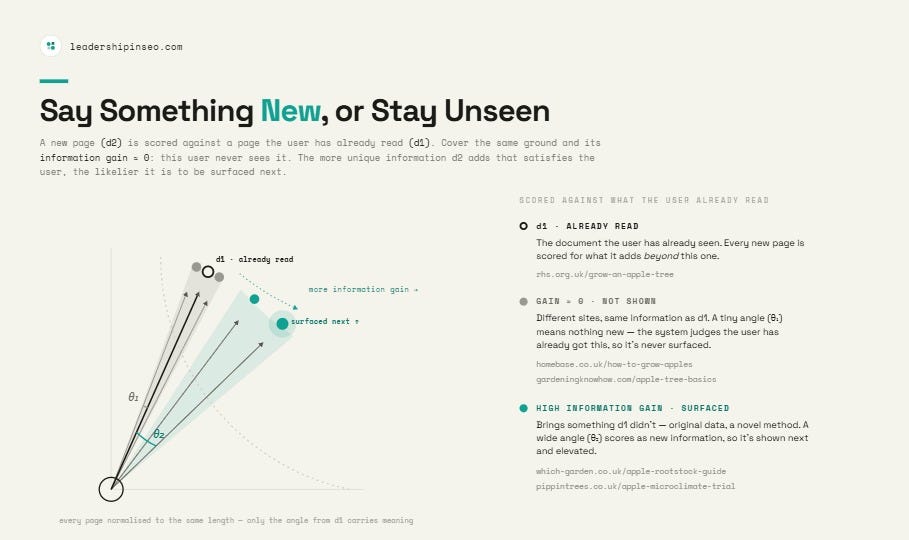
This patent is not about the information gain applied to the current set of search results. It's about the subsequent set of results, ranking the next set of search results based on wider user search behavior, personalization, and added. The strategic issue is whether automated visitors can understand, trust, and complete the same journey a human visitor can. Agent readiness is partly technical, but it is also about clear tasks, accessible flows, and reliable evidence.
Step By Step
A user reads a document about a certain topic, let's say, growing an apple tree. Google understands that the majority of users don't stop at one page here. It's a rich topic. When should I plant one? Where? What do I feed it? With 13. The practical read is that brand signals need to be consistent enough for both people and AI systems to form a stable view of the company, its expertise, and its trust signals.
How Important Is It?
I think uniqueness and standing out are more important than ever. Strip the patent out of the conversation. People or brands who publish content won't survive if they aren't memorable to people and, by proxy, search engines. So you've. The practical read is that brand signals need to be consistent enough for both people and AI systems to form a stable view of the company, its expertise, and its trust signals.
Google Is Building An Audience Loyalty Ecosystem
Don't take my word for it, take Barry's. Google has wanted to get rid of click chasing churnalism for years. Now it can. And it is, in most cases, I think, a positive. Publishers that can demonstrate they have an audience outside of SEO. The measurement question is whether this signal changes a decision, not whether it adds another number to a dashboard. Useful reporting connects visibility, engagement, and business outcomes without pretending every AI influenced journey will produce a clean click path.
The reporting question is whether this signal changes a decision. If it only creates another number in a dashboard, it adds noise. If it helps separate profile activity, website visits, calls, bookings, and direction requests, it can make local performance easier to understand.
Does Information Density Matter?
Yes and no. Long articles are not necessarily more effective at satisfying the user. Google has methods to normalize the length of an article to prevent additional keywords and semantically relevant phrases from ranking the document too. The practical question is what this changes in the system: the page structure, the evidence presented, the measurement habit, or the way the topic is connected to related work.
How Does It Affect AI Systems?
Well, traditional search ranking is still crucial in AI systems, whether that's how effectively you rank for the primary search, your inclusion in the training data, RAG, or suite of fan out searches run concurrently. And AI searches. The strategic issue is whether automated visitors can understand, trust, and complete the same journey a human visitor can. Agent readiness is partly technical, but it is also about clear tasks, accessible flows, and reliable evidence. This connects with Working Framework when the same signal needs a clearer operating decision. A useful companion note is Working Framework, because it looks at a nearby part of the same system.
How Can I Use This Effectively?
Make differentiated, non commodity content. It's really simple. Apply what we call information gain in this context to your own content, if you cannot add anything of value to the existing index, then don't bother. Being first on the. The measurement question is whether this signal changes a decision, not whether it adds another number to a dashboard. Useful reporting connects visibility, engagement, and business outcomes without pretending every AI influenced journey will produce a clean click path.
TL;DR in practice
Introduction Thanks to Rand's excellent research and Barry's expletive laden ranting, we know that Google processes over 5 trillion searches each year. Trillion. Per day, that's 13.7 billion. Per second, 158,000. There are some sizeable. The practical read is that brand signals need to be consistent enough for both people and AI systems to form a stable view of the company, its expertise, and its trust signals.
What the visibility signal actually changes
What the visibility signal actually changes: how Google May ‘Understand’ Unique Content: the Practical Angle should be treated as a visibility signal, not a standalone headline. Introduction Thanks to Rand's excellent research and Barry's expletive laden ranting, we know that Google processes over 5 trillion searches each year. Trillion. Per day, that's 13.7 billion. Per second, 158,000. There are some sizeable and growing caveats. The same pattern also shows up in Where Search Attention Is Going &, where the practical question is how the signal becomes visible.
What the visibility signal actually changes: the practical question is whether the page, brand evidence, and surrounding content make the answer easier to trust. If that support is weak, search systems can still understand the topic but fail to connect it confidently to the brand.
What the visibility signal actually changes: that is why the response should begin with an audit of the evidence already on the site before creating a new asset. The fastest improvement is often a clearer page, a better internal link, or a stronger explanation of why the brand belongs in the answer.
Where the evidence needs to be tested
Where the evidence needs to be tested: a single study or ranking observation should not become a strategy by itself. It should become a diagnostic prompt: which source is being trusted, which query pattern is affected, and which part of the site would make that trust easier to earn?
Where the evidence needs to be tested: that keeps the response grounded. The goal is to improve the evidence chain around the topic rather than publish another summary that repeats what every other page already says.
Where the evidence needs to be tested: the important distinction is between a useful signal and a fashionable talking point. A useful signal changes the brief, the page structure, the linking plan, or the measurement view.
How to avoid overreacting to one data point
How to avoid overreacting to one data point: for content teams, the strongest move is to map the claim to existing assets before creating anything new. The right page may already exist, but it may need clearer headings, stronger internal links, fresher proof, or a better explanation of why the brand belongs in the answer.
How to avoid overreacting to one data point: this is also where title rewriting matters. A title should not copy the source headline; it should frame the practical implication so readers immediately know why the topic deserves attention.
How to avoid overreacting to one data point: the same standard should apply to every section. Each heading needs to earn its place by moving the reader through the evidence, not by repeating the outline in a more polished voice.
Comments
Comments are reviewed before they are published. Links are not allowed inside comments.