The AI Hours Nobody on Your Marketing Team Is Counting
/ 6 min read

Summary
HubSpot reports 91% of marketing leaders say their teams use AI, and 66% say their company builds its own internal AI tools for. The practical question is what this changes for SEO, content quality, and AI search visibility.

There is a seductive quality to AI automation. For those of us in marketing and SEO, the ability to build a custom tool or a complex prompt chain without needing a computer science degree feels like a superpower. We have a long list of shortcuts we always wanted to build but couldn't because we were blocked by engineering resources. Now, the block is gone.
But there is a hidden cost to this newfound autonomy. While we feel faster, we might actually be slowing down. The danger isn't the AI itself, but the gap between how productive we feel and how much actual value is being delivered to the business. When we stop asking why we are building a tool and start building just because we can, we enter a productivity paradox. The same pattern also shows up in to Get Cited & Stay Visible, where the practical question is how the signal becomes visible.
The productivity paradox in practice
It is easy to assume that AI is a linear multiplier of speed. If a task took ten hours and AI does it in two, we assume we have eight hours back. However, a study by METR involving 16 experienced developers revealed a jarring reality. When tasked with 246 real world problems, those using AI tools were actually 19% slower than those who weren't.
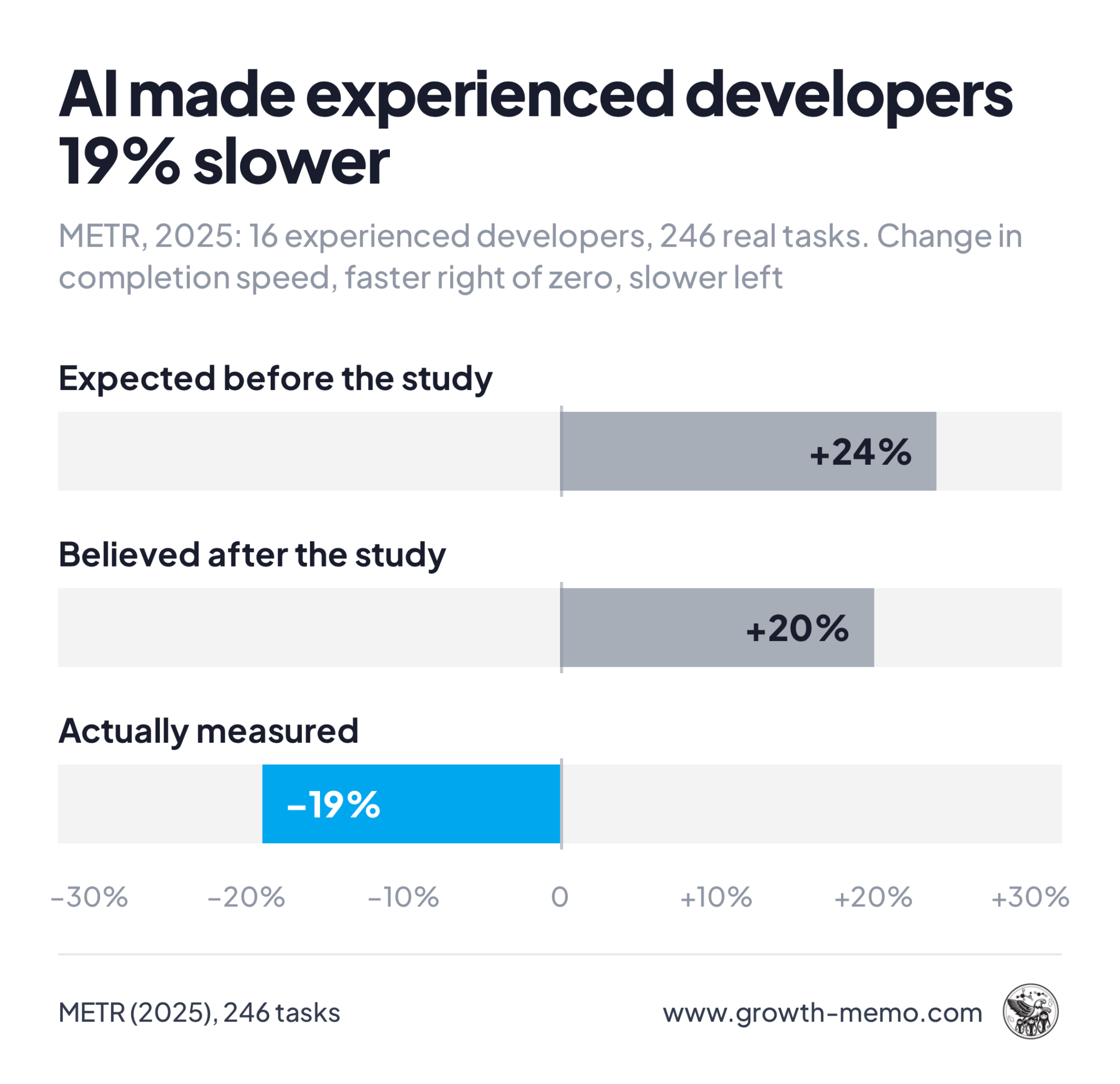
The most concerning part of that study wasn't the slowdown, but the perception. Even after seeing the data, the developers believed they were 20% faster. This is the AI productivity paradox. AI creates a feeling of velocity because it handles the initial "blank page" problem, but it shifts the effort into prompting, waiting, verifying, and correcting.
In a marketing context, this is amplified. We aren't just using tools; we are building our own. Every hour spent tweaking a "homebrew" AI workflow is an hour not spent on the actual work that moves the needle, such as earning mentions or strengthening brand authority. The risk here is that we mistake the act of building a tool for the act of achieving a result.
Expert Interpretation: The tradeoff here is between "perceived efficiency" and "actual output." When you evaluate your team's AI adoption, don't ask if the tools are saving time. Ask what specific, high value tasks were completed this week that would have been impossible without AI. If the answer is "we just did the same things faster," you are likely caught in the paradox.
Where the work actually goes
Data from HubSpot suggests that 91% of marketing leaders see their teams using AI, and 66% are building internal tools. The problem is that these projects rarely show up on a formal marketing plan or a Jira board. They are "shadow projects" happening in the background.
For growth marketers and SEOs, this isn't just a hobby. Understanding LLMs is now a core job requirement because these models determine how brands earn visibility. Learning, pressure testing, and examining the technology is necessary work. However, this is new work stacked on top of existing responsibilities. The old workload didn't shrink to make room for the AI research.
When we build in house tools, we often do so for tasks that could be solved with a cheap SaaS subscription. We choose the "build" route because it feels like a win, but building is addition, not efficiency. AI doesn't delete work; it simply moves the work from the execution phase to the architectural and maintenance phase.
Expert Interpretation: This is a classic "build vs. buy" dilemma disguised as innovation. The decision to build an internal tool should be based on a unique competitive advantage, not on the fact that it is now possible to do so. If a tool doesn't provide a proprietary edge, the maintenance cost will eventually outweigh the subscription fee of a professional product.
The hidden cost of "workslop"
When a team member uses AI to create a shortcut, that time saving is rarely a net gain for the company. Often, the time saved by the sender is spent tenfold by the receiver. This phenomenon is known as "workslop" AI output that looks finished at a glance but is fundamentally flawed or shallow.
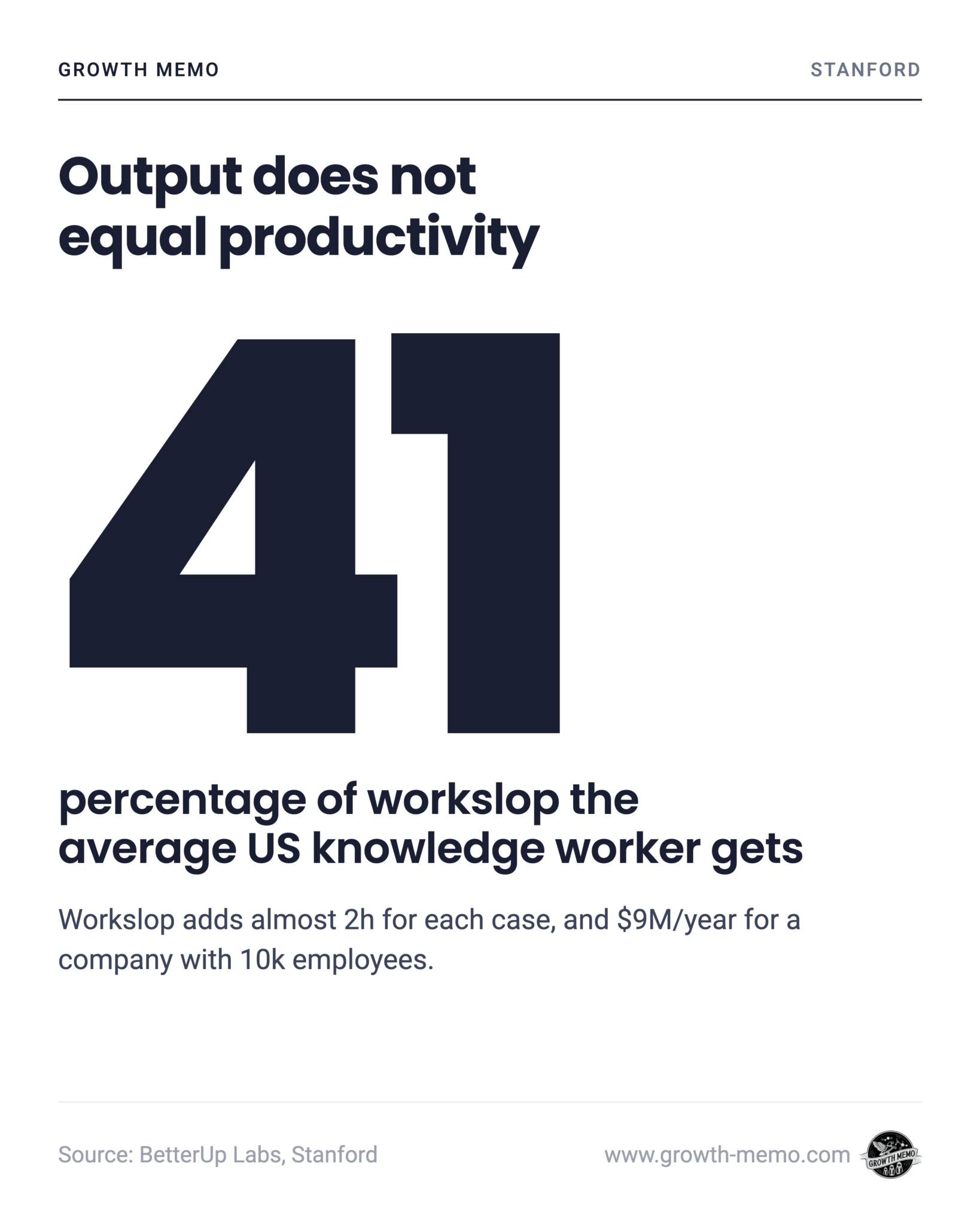
Research from Stanford and BetterUp Labs found that 41% of workers encountered workslop in a single month. On average, it took nearly two hours to fix each instance. In a large organization, this creates a massive financial drain. A sender might save 20 minutes by generating a report with AI, but the manager spends two hours sifting through the hallucinations to find the truth.
This creates a distorted view of performance. On a dashboard that tracks output volume, the person producing the workslop looks like a high performer. They are producing more, faster. But the actual productivity of the team drops because the rework is happening elsewhere. Workday's research suggests that for every 10 hours AI saves, about four hours are handed back to the company in the form of fixing and rewriting weak output.
When marketing attention is diverted toward managing these AI shortcuts, the "unsexy" work suffers. Digital PR, community engagement, and third party reviews are often the first things to be neglected because they have a slower ROI and murkier attribution than the immediate dopamine hit of a new AI workflow.
Expert Interpretation: The danger here is the "output trap." If your KPIs are based on volume (number of posts, number of reports), you are incentivizing workslop. To counter this, shift the focus to quality benchmarks and "final mile" accountability. The person who prompts the AI must be the one responsible for the final verification, ensuring the time saving doesn't become a burden for someone else.
The burden of the permanent maintenance job
A custom AI workflow is only perfect on the day it is finished. The moment it is deployed, it begins to degrade. This is because AI ecosystems are volatile. A model version changes, a prompt that worked yesterday suddenly produces garbage today, or the third party tool the workflow plugs into ships an update that breaks the integration.
Every "shortcut" your team builds is actually a small piece of software. And software requires management. This means every new workflow creates a permanent, albeit small, job to maintain it. As these accumulate, the team finds themselves spending more time acting as amateur software engineers than as marketers. This connects with AI Overviews YouTube Gap when the same signal needs a clearer operating decision. A useful companion note is Podcasts & Reddit Now Drive AI Citations, because it looks at a nearby part of the same system.
This creates a disconnect in perception across the organization:
Executives believe the team is using AI to slash costs and accelerate production. Individual contributors feel that the AI tools are unreliable and require constant deep revision. Strategists realize that too much time is being spent on the plumbing of workflows and not enough on the actual brand visibility.
The reality is that the team is building tools to make the brand work faster, but in the process, the actual brand work is pushed to the back burner. The tools will eventually be finished or replaced, but the lost opportunity cost is permanent. Nine months of missed citations, mentions, and reviews cannot be recovered by a faster workflow later.
Expert Interpretation: You must treat AI workflows as technical debt. Just as a developer tracks the cost of maintaining old code, a marketing lead should track the "maintenance tax" of their AI tools. Before adding a new workflow, ask: who is responsible for fixing this when it breaks on a Tuesday morning, and what high value marketing activity will they stop doing to handle that fix?
Comments
Comments are reviewed before they are published. Links are not allowed inside comments.