The Real Reason Growing Restaurant Chains Win at Local Search and AI Visibility
/ 6 min read

Summary
The most striking finding is also the most forward looking. Expanding chains are recommended by ChatGPT in about 20% of tested. The practical question is what this changes for SEO, content quality, and AI search visibility.
When we read about the restaurant industry lately, the narrative usually focuses on the macro. We see headlines about brands like Culver's and Texas Roadhouse aggressively opening new doors, while others like Wendy's or Pizza Hut are scaling back. The usual suspects for these shifts are the economy, shifting consumer tastes, or the influence of private equity.
But there is a quieter, more technical signal happening in the background. When you look at the digital footprint of these brands, a clear pattern emerges. The companies that are growing aren't just better at real estate or menu design, they are fundamentally different in how they show up when a customer searches for a place to eat. This isn't about a single review causing a store to close, but rather a reflection of operational discipline that manifests online. A useful companion note is AI Search Visibility, because it looks at a nearby part of the same system.
The widening gap in AI discovery
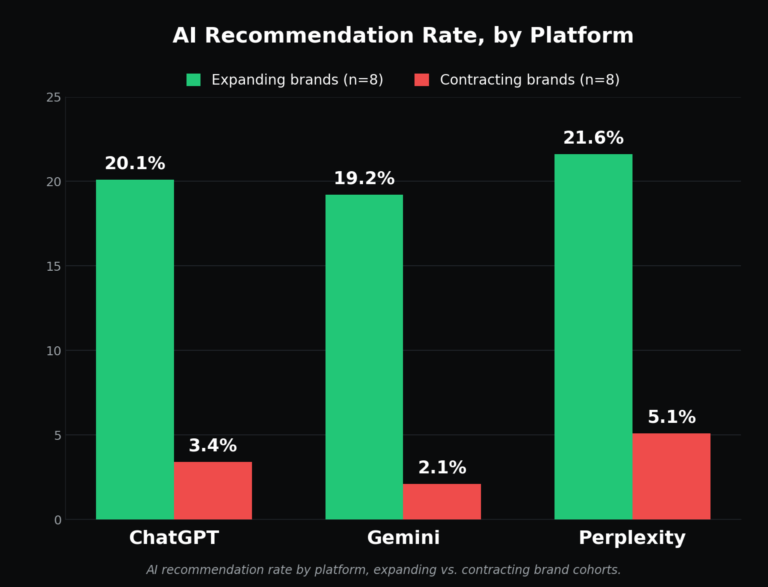
The most significant shift is happening in AI. We are seeing a massive disparity in how LLMs like ChatGPT, Gemini, and Perplexity recommend restaurants. Expanding chains are recommended by ChatGPT in roughly 20% of queries, while contracting chains only appear about 3% of the time. That is a six to seven times difference in visibility.
This gap exists because AI is far more selective than traditional search. While about 35.9% of locations might appear in a Google 3-Pack, only between 1% and 11% of locations are actually recommended by these AI platforms. To get an AI recommendation, a brand has to meet a much higher threshold of data accuracy, reputation, and unique content. The brands that are growing seem to be hitting that bar, while the ones shrinking are falling short.
From a strategic perspective, this matters because AI is no longer a niche experiment. It is becoming a primary discovery layer. The tradeoff here is between the ease of "set it and forget it" directory listings and the effort required to maintain the high fidelity data AI requires. If you are only optimizing for traditional keywords, you are likely invisible to the AI driven customer.
The link between search visibility and reputation
AI visibility doesn't happen in a vacuum. It is built on the same foundations that have always driven local SEO. The data shows that expanding chains appear in the Google 3-Pack for 35.3% of searches, compared to just 14.4% for those contracting. On Yelp, the growing brands secure the top organic ranking nearly twice as often as their struggling counterparts. The same pattern also shows up in New Rules of Visibility in 2027, where the practical question is how the signal becomes visible.
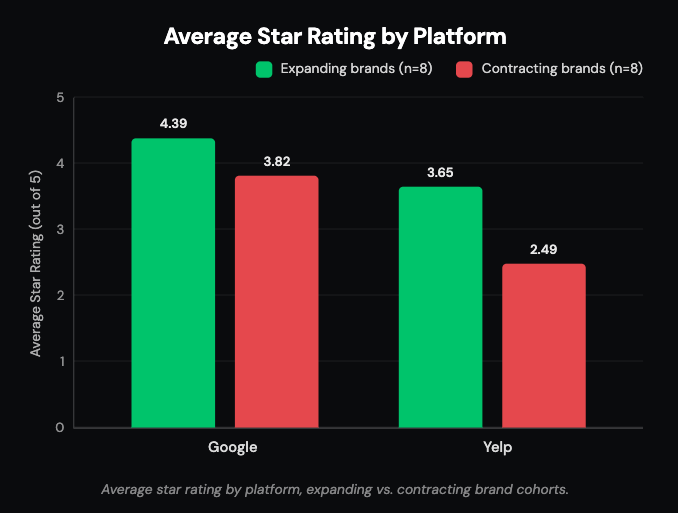
Then there is the reputation gap. Expanding brands maintain a Google rating of 4.39 and a Yelp rating of 3.65. Contracting brands lag behind at 3.82 and 2.49 respectively. The difference on Yelp is particularly stark, exceeding a full star.
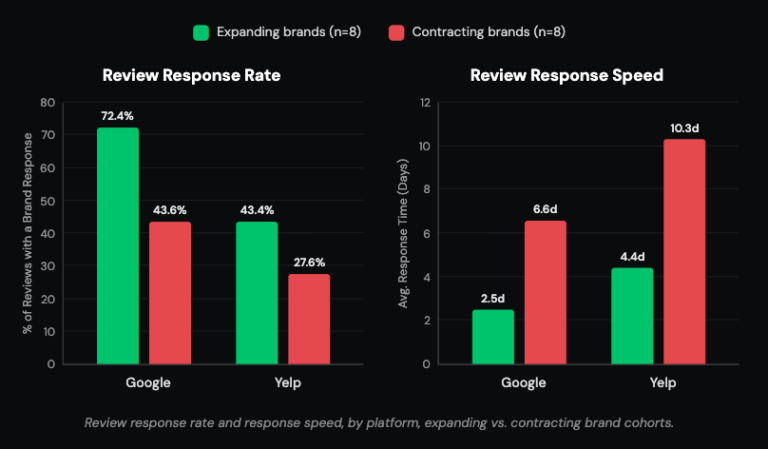
One of the most telling metrics, however, is the response rate. Growing brands respond to 72.4% of their Google reviews, while contracting brands only respond to 43.6%. More importantly, the growing brands respond two to three times faster.
This is a critical insight for any marketing lead. While a star rating takes years to build, a response rate can be changed in a few weeks. The fact that expanding brands respond more and faster suggests they treat local reputation as a core operational process rather than a passive monitoring task. The decision to make here is whether to treat reviews as "feedback" or as a "customer service channel" that requires a strict SLA.
The massive multiplier of local social engagement
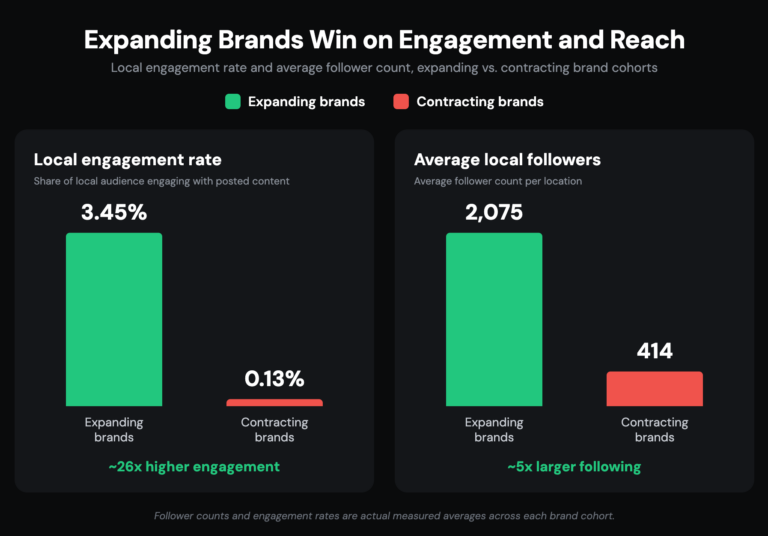
If the AI gap is wide, the social gap is a canyon. Expanding brands see a local social engagement rate of 3.45%, while contracting brands average a dismal 0.13%. That is a 26x difference in how users interact with their content. These growing brands also tend to have five times more local followers on average.
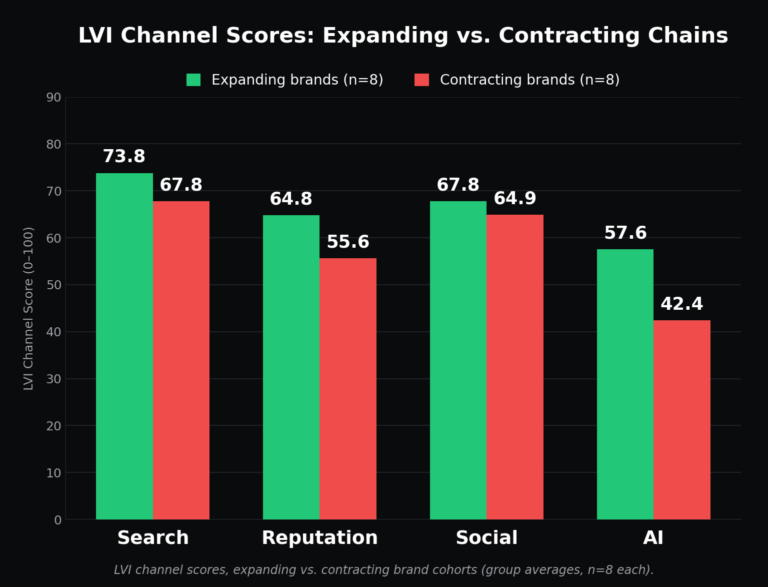
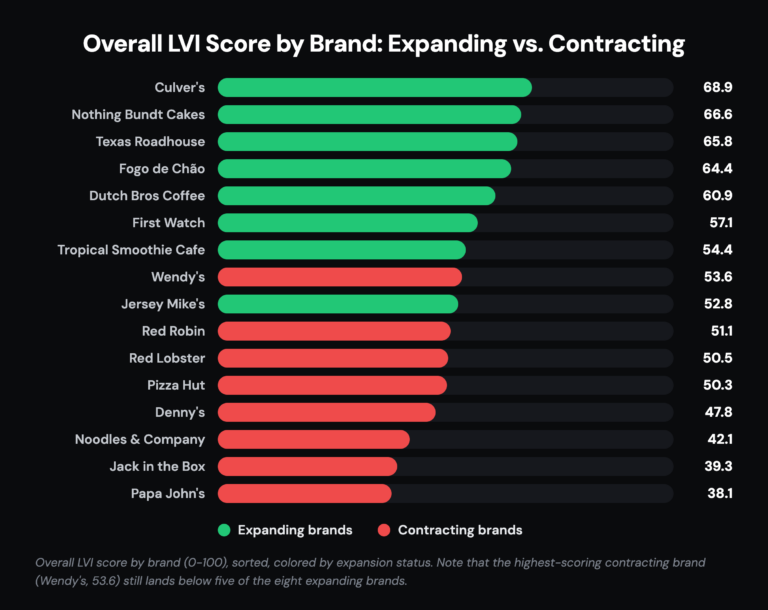
It is tempting to assume that the winners are simply posting more often, but volume isn't the driver. The real difference is the move away from "waterfall posting," where a corporate office pushes the same generic image and caption to every single location page. Expanding brands are creating content that actually resonates with the specific market it is served in.
Localized content drives engagement because it feels authentic to the neighborhood. The tradeoff is efficiency versus effectiveness. Waterfall posting is efficient for the corporate team, but it is invisible to the local customer. The decision for a brand is whether to prioritize the convenience of centralized control or the growth that comes from local relevance.
Turning these signals into a brand strategy
It is important to be clear: better digital visibility won't magically save a failing business model or a bad product. However, for those managing multi location brands, these patterns provide a blueprint for how to align digital presence with physical growth.
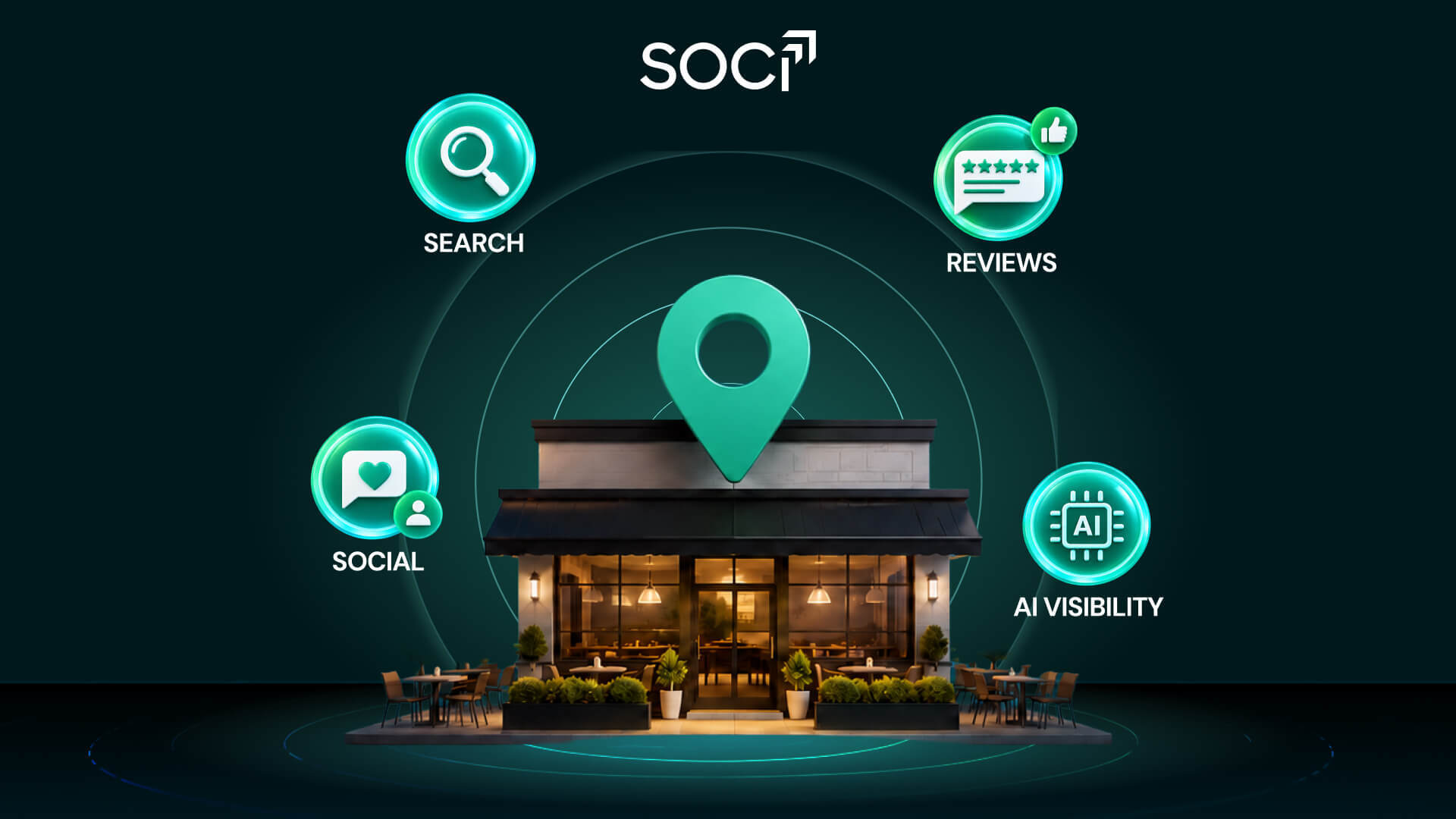
The brands that win treat local search, reputation, social, and AI as a single, connected ecosystem. They don't view them as four separate checklists. To move toward this model, there are a few specific areas to inspect.
First, treat data accuracy as infrastructure. Consistent business information across Google, Yelp, and Facebook is the baseline. It is the first thing an AI platform checks before it decides whether to recommend a location. If your data is fragmented, you are essentially opting out of AI discovery.
Second, systematize the review process. Because response speed and coverage are the primary separators between growing and shrinking brands, this is the fastest lever to pull. Moving from a passive monitoring state to an active response state can change the perception of a brand in a very short window.
Third, shift the social strategy toward localization. High engagement comes from relevance, not frequency. If the content is the same in New York as it is in Dallas, it is likely not resonating in either place.
Finally, specifically test your AI visibility. Many brands assume that because they rank well in traditional search, they are also appearing in AI recommendations. This analysis proves that is not the case. Testing how your brand appears in ChatGPT, Gemini, and Perplexity is the only way to uncover this specific blind spot.
The AI gap is the widest, and the newest
The most striking finding is also the most forward looking. Expanding chains are recommended by ChatGPT in about 20% of tested queries, compared with roughly 3% for contracting chains, a 6 to 7x gap. Gemini and Perplexity show the same. The practical read is that brand signals need to be consistent enough for both people and AI systems to form a stable view of the company, its expertise, and its trust signals.
The operational question is whether the public business data is complete enough to support the query. Hours, categories, services, reviews, photos, and page content need to reinforce each other so Google can understand the business in a specific situation, not only as a generic listing.
Search and reputation tell the same story
The AI gap doesn't exist in isolation. It's built on the same local search fundamentals that have long mattered: Search visibility: Expanding chains appear in Google's 3-Pack for 35.3% of tracked searches, compared with 14.4% for. The practical read is that brand signals need to be consistent enough for both people and AI systems to form a stable view of the company, its expertise, and its trust signals. This connects with New Google Business Profile Playbook when the same signal needs a clearer operating decision.
Comments
Comments are reviewed before they are published. Links are not allowed inside comments.