Why Product Feeds Now Belong in SEO Strategy
/ 8 min read

Summary
At last year's Search Central Live, Google had a running joke about this. You add a standard to unify the standards, only to end. The practical question is what this changes for SEO, content quality, and AI search visibility.

The product feed has historically been firmly in the domain of PPC teams, and for good reason. After all, for decades, feeds have been the basis for Shopping and the Paid side of this equation is where the biggest spend and revenue sit.
For an SEO, it was enough to check Google Search Console Shopping Results, and Bob's your uncle. Product feeds have (not so) quietly become one of the most structurally important data assets in ecommerce, for paid, organic, and now agentic. They shape how Google interprets product pages across channels, how discrepancies between different product and category points get resolved, and increasingly, how AI evaluates and surfaces products to users.
The Unholy Trinity: 3 Systems, 1 Goal
At last year's Search Central Live, Google had a running joke about this. You add a standard to unify the standards, only to end up with an even bigger mess. Rather than one unified system for understanding your products, Google is actually managing three distinct layers of data that have different rules, different structure, and, of course, different teams managing them on the organizational end.
First, you have the Product Feeds. These are the manual files you push to: The Google Merchant Center (GMC) contains your core attributes like titles, GTINs, and prices. The Manufacturer Center containing richer, more detailed product information This is a parallel data structure that exists entirely independently of your website.
The Unholy Trinity: 3 Systems, 1 Goal sits between marketing and implementation. A brand can have strong positioning, but if agents cannot crawl, interpret, or complete the journey, visibility may fail before analytics records the demand.
When It All Goes Wrong
Anyone working in ecommerce has seen a long list of issues that arise from this unholy trinity. Some are easier to fix than others because they fall into a shared mental load between the teams. One excellent example of this is feed product titles.
Time and time again, PPC managers use SEO optimized titles to tweak their product feeds using rules or supplemental feeds. They understand that the SEO team has spent hours doing keyword research and tweaking the meta to fit search intent. That kind of informal knowledge sharing works well when the asset already sits within both teams' remit.
When It All Goes Wrong keeps the domain question in proportion. Punctuation rarely explains performance by itself, so crawlability, relevance, trust, page quality, internal links, and intent match should be checked first.
Schema, Feed & Website Misalignment
There are attributes that are nice to have and can help your products perform better on organic and paid listings. For example, let's say you are an ecommerce shop that also sells striped women's dresses. On those products, you could use g:pattern in your feed and an equivalent Pattern Schema.org Property within Product schema type.

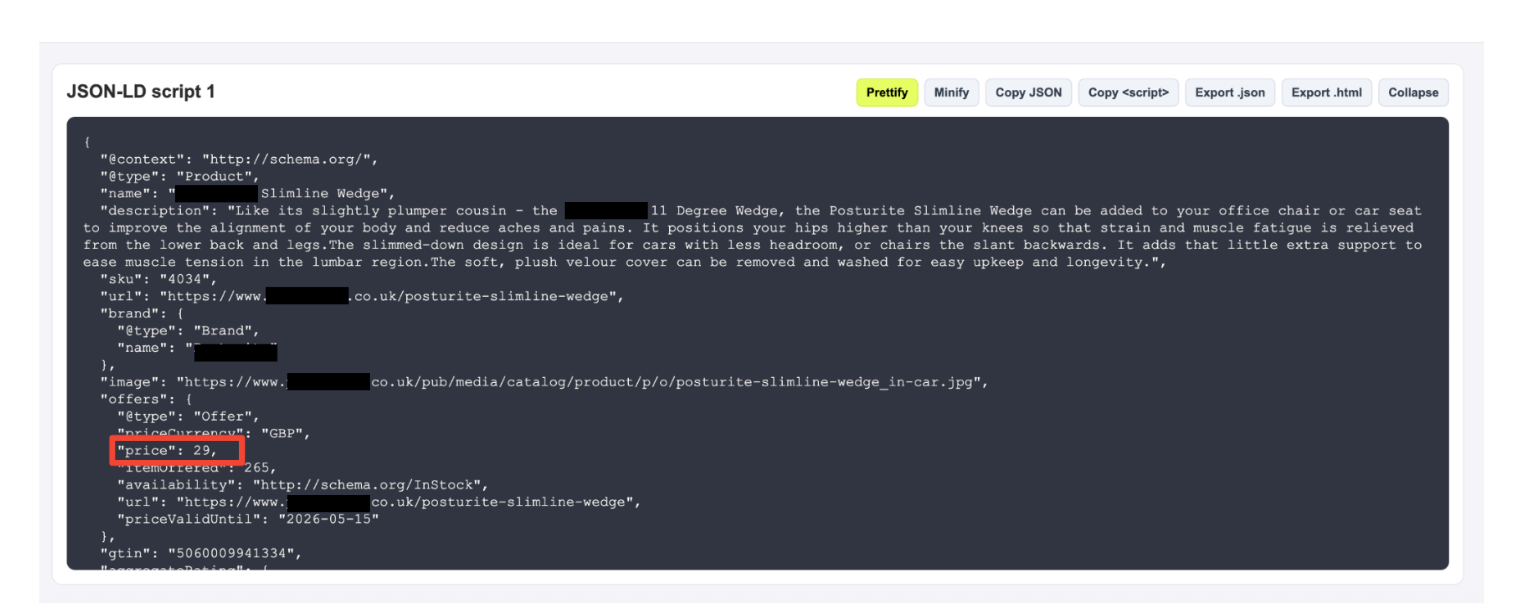
Adding it to both might help you a bit when appearing for searches such as [striped women's dress]. Or you might appear for those searches anyway. It's likely that your website or feed/schema titles have some data on the pattern in the text anyway.
Schema, Feed & Website Misalignment shows why average content is becoming easier to ignore. Pages need sharper judgment, clearer examples, and more specific reasoning so they do not collapse into the answer a model can produce without visiting the site.
Infrastructure Failure
Price mismatches and schema conflicts are frustrating, but at least they're visible. You can audit them, find the discrepancy, and fix it. An infrastructure failure is different and, in some ways, more alarming because everything in your data can be perfectly aligned, and products will still disappear. This connects with SEO. Don’t Let Claude Do SEO. when the same signal needs a clearer operating decision. A useful companion note is Working Framework, because it looks at a nearby part of the same system.
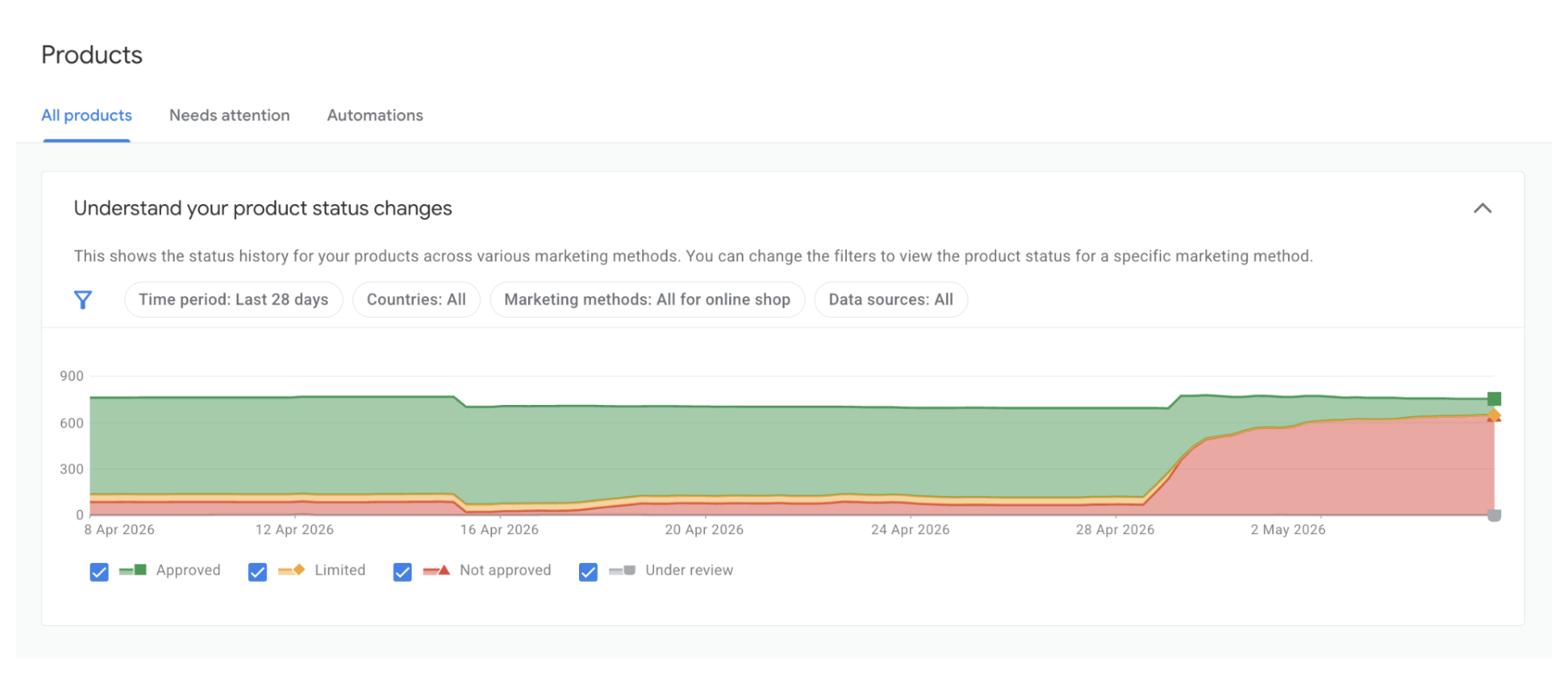
In one recent case, we saw a client's products move from approved to not approved at scale almost overnight. The website was fine. But a configuration change to the client's CDN security settings had inadvertently begun blocking Google's crawler.
Infrastructure Failure is really about permission and control. Publishers are trying to separate ordinary discovery from dataset extraction, and that distinction is becoming harder to ignore as AI systems depend on large public web archives.
SEO Case For Shared Feed Ownership
The old logic was simple: Merchant Center is primarily Paid Shopping, Shopping is PPC, therefore the feed is a PPC problem. This type of thinking is increasingly outdated. Merchant Center handles paid and free listings, feeds impact rich results, the Google Shopping Graph, and now agentic ecommerce.
It's the infrastructure for your entire product presence. But infrastructure is only as good as the data running through it, and right now, too many feeds are riddled with issues. Shared ownership isn't a redistribution of credit.
Feed Data Is Written For Databases, Not For Searchers
When SEOs aren't involved in feed management, the feed stays as whatever the platform exports. And, that's not always driven by search behaviors. Way too often, what the various feed plugins spit out are generic titles, approximate categorizations, and thin attributes.
This is the failure that doesn't show up in the Merchant Center. At best, PPC teams are quietly patching this with feed rules or supplemental feeds, both legitimate tools in the right context, with their own optimization logic, but neither designed to compensate for a primary feed that was never built with search intent in mind. The feed is technically healthy, but if not dealt with, it's also commercially invisible.
Structured Data Is The Hidden Variable Across Paid, Organic & Free Listings
When our clients' price mismatch surfaced, my PPC team could see the disapproval. What they couldn't see was why, because the answer was in the schema, and schema isn't a PPC domain. The blast radius also doesn't stop at paid.
The same schema error affects free listings, where Google pulls directly from GMCIn a GMC feed, Google accepts four standard values and applies the same validation logic. And it affects organic rich results, price, availability, review count appearing in standard SERPs, which are driven by on page structured data and carry no disapproval mechanism to flag when something is wrong. Incorrect information just surfaces silently.
Structured Data Is The Hidden Variable Across Paid, Organic & Free Listings keeps the domain question in proportion. Punctuation rarely explains performance by itself, so crawlability, relevance, trust, page quality, internal links, and intent match should be checked first. The same pattern also shows up in We Earned 1, where the practical question is how the signal becomes visible.
Feed Quality Is Increasingly A Signal, Not Just A Campaign Requirement
Google has been explicit that Merchant Center feed quality affects more than Shopping ad eligibility. The overall health of a Merchant Center account (things like: disapproval rates, missing attribute warnings, policy compliance…) contributes to how Google evaluates a merchant's trustworthiness as a data source. A feed with widespread attribute gaps or recurring disapprovals is a signal about data quality at scale, affecting eligibility and display across all Google surfaces.
The feed is being read as a proxy for how reliable you are as a data source. Google has also formalized this through the Shop Quality program, which evaluates merchants against each other across signals, including approval rates, shipping data completeness, and return policy clarity. Performing well here has a direct, visible impact on listings, with the Top Quality Store badge appearing on placements in both paid and organic results.
The Organic Stakes Are Changing
Organic Shopping has never been invisible to SEOs. We've worked on optimizing for organic shopping using strategies such as structured data and on page elements, and reported on it via Google Search Console. We just didn't pay much attention to the Merchant Center or the feed.
And yet, this is what also powers those results. SERP itself is also quietly restructuring around us. The severity of this shift is brilliantly illustrated by ecommerce SEO expert Brodie Clark, who notes that Google's search results are increasingly feeling like a product detail page in their own right.
The Organic Stakes Are Changing is useful because attention data can expose weak ordering, unclear proof, and market specific scanning behavior. That makes the page experience part of the SEO decision, not a separate design concern.
Agentic Commerce Changes What 'Discoverable' And 'Purchasable' Mean
This is the part that's easiest to underestimate, and where the stakes of feed neglect shift from significant to structural.
Agentic Commerce Changes What 'Discoverable' And 'Purchasable' Mean sits between marketing and implementation. A brand can have strong positioning, but if agents cannot crawl, interpret, or complete the journey, visibility may fail before analytics records the demand.
Discovery Is No Longer Only Human Led
AI powered surfaces like AI Overviews increasingly draw on Merchant Center data to surface products in response to commercial queries. A product with thin feed attributes and minimal structured data starts from a significant disadvantage at the discovery phase. Not just in Shopping, but in the AI layer being built on top of it.
This is no longer speculative. Google's UCP documentation states explicitly that merchants should use their existing GMC account shopping feeds to capture high intent customers during discovery, with UCP unlocking access to surfaces like AI Mode in Search and Gemini. Google is already extending this further by introducing conversational commerce attributes in Merchant Center, such as compatibility, substitutes, related products, specifically designed to feed AI modes and reduce hallucinations.
Purchasability Is A Technical Problem, Not A Content One
Visibility is also only half the problem. If an AI agent then attempts to actually buy that product, it relies on a machine readable representation of your site, the raw HTML, the accessibility tree, and rendered screenshots. The accessibility tree is particularly interesting here.
Your tree is a high fidelity map distilling the page into the roles, names, and states of interactive elements. Non semantic HTML, i.e., soups where a should be, means your "Add to Cart" CTA can't be interpreted or actioned by the agent. Layout instability and elements hidden behind overlays compound this even further.
Comments
Comments are reviewed before they are published. Links are not allowed inside comments.