Winning the AI Decision Layer: from AI Discovery to Agentic Commerce
/ 6 min read

Summary
Agentic commerce readiness follows a sequential path. Start by making sure AI engines can find your brand, then progress through. The practical question is what this changes for SEO, content quality, and AI search visibility.
The next battleground for brands is being chosen by AI. Every day, AI engines and autonomous agents decide which brands to recommend, compare, cite, and transact with on behalf of consumers.
Brands now need to become the trusted choice AI selects. This shift is already underway.
How to take your brand from found to actioned
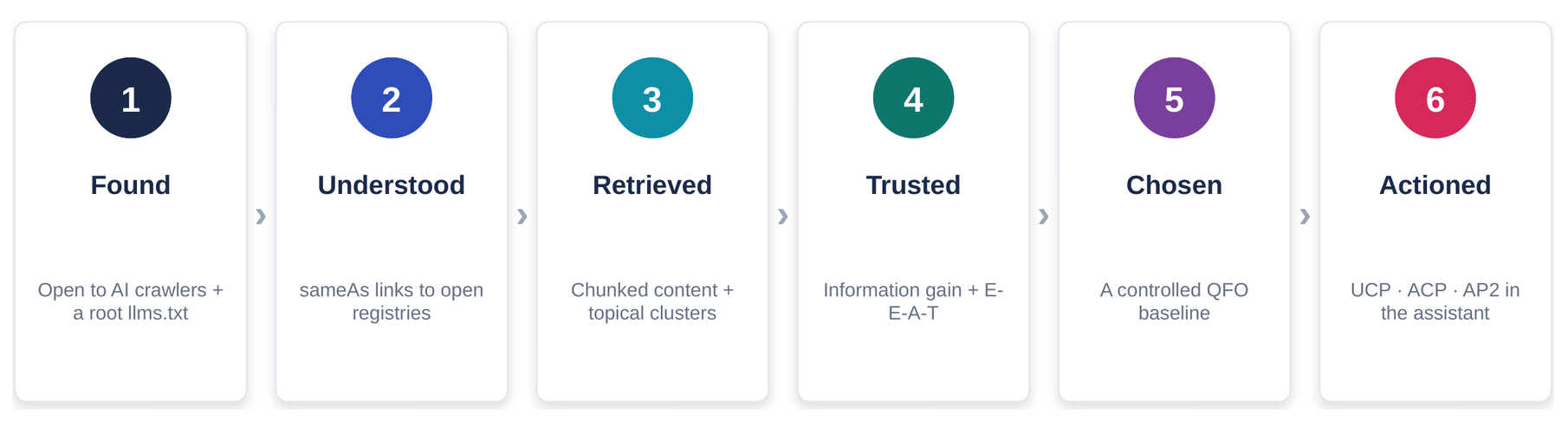
Agentic commerce readiness follows a sequential path. Start by making sure AI engines can find your brand, then progress through the remaining stages to enable agentic transactions. The practical read is that brand signals need to be consistent enough for both people and AI systems to form a stable view of the company, its expertise, and its trust signals. A useful companion note is Gemini Intelligence Signals a New Era, because it looks at a nearby part of the same system.
The risk is usually hidden in the execution layer. A page can look fine to a human and still fail for an automated visitor if the form, call to action, rendering path, or confirmation step is not accessible enough for the agent to complete the task.
Step 1: Get found by enabling AI discovery and access
Machine accessibility is the foundation of AI visibility. To enable AI discovery and access, prioritize technical hygiene and token efficiency. Start by allowing the right crawlers on your website. Google, OpenAI, Anthropic, and Bing must. The practical read is that brand signals need to be consistent enough for both people and AI systems to form a stable view of the company, its expertise, and its trust signals. This connects with Building a Brand Worth Finding when the same signal needs a clearer operating decision.
The operational question is whether the public business data is complete enough to support the query. Hours, categories, services, reviews, photos, and page content need to reinforce each other so Google can understand the business in a specific situation, not only as a generic listing.
Step 2: Be understood by building semantic clarity
To be understood by AI engines, you have to build entity authority. This allows AI engines to interpret who you are, what you offer, and why you matter. Structured data transforms web pages into machine readable knowledge that AI systems. The practical read is that brand signals need to be consistent enough for both people and AI systems to form a stable view of the company, its expertise, and its trust signals.
Step 3: Be retrieved by structuring content for AI extraction
Traditional search ranks pages, while AI search retrieves and cites passages. Brands win on relevance, clarity, authority, and freshness rather than content length. Original expertise, proprietary data, and real world experience stand out. The practical read is that brand signals need to be consistent enough for both people and AI systems to form a stable view of the company, its expertise, and its trust signals.
The useful check is whether this improves the system behind search performance, not only the words on the page. Internal links, crawlable content, clear entities, current evidence, and a sensible page structure all help the recommendation become easier to trust.
Step 4: Be trusted by building authority and grounding signals
Just because AI engines retrieve your content doesn't guarantee they'll recommend your brand. AI systems prioritize sources they can trust, making authority and credibility decisive factors. Google's experience, expertise,. The practical read is that brand signals need to be consistent enough for both people and AI systems to form a stable view of the company, its expertise, and its trust signals.
Step 5: Be chosen by earning machine and human preference
AI agents parse attributes, verify claims, and score confidence in milliseconds. That means a brand that can't make its value clear to AI is invisible at the decision point. But emotional preference still matters. Consumers readily. The practical read is that brand signals need to be consistent enough for both people and AI systems to form a stable view of the company, its expertise, and its trust signals.
Step 6: Enable agentic transactions
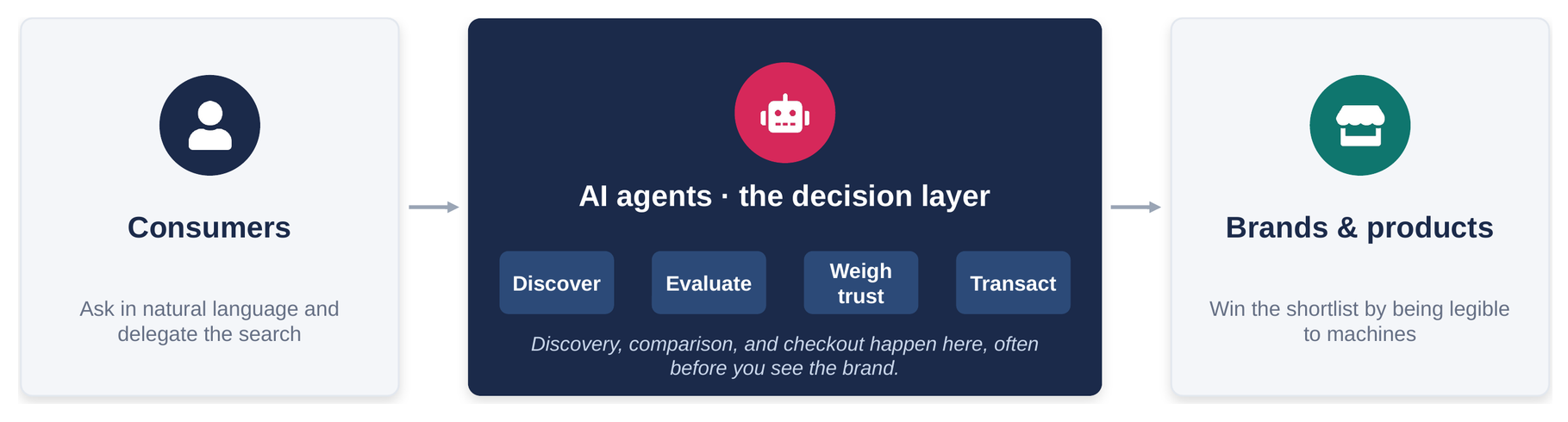
Recommendation is no longer the finish line for AI search. Discovery, selection, and checkout can happen entirely inside an AI assistant, all without the customer ever visiting your site. An agentic website is designed for AI agents to. The strategic issue is whether automated visitors can understand, trust, and complete the same journey a human visitor can. Agent readiness is partly technical, but it is also about clear tasks, accessible flows, and reliable evidence.
How to measure performance in the AI decision layer
Traditional search metrics like rankings, sessions, and clicks are still necessary to track. But they're no longer sufficient measures of success. Instead, track two new layers: Visibility: AI presence rate, AI share of voice, citation. The strategic issue is whether automated visitors can understand, trust, and complete the same journey a human visitor can. Agent readiness is partly technical, but it is also about clear tasks, accessible flows, and reliable evidence.
From SEO to decision architecture
SEO remains the foundation for winning search, but a deeper shift became concrete at Google I/O 2026. AI agents now parse raw HTML, distill the browser's native accessibility tree, and capture visual screenshots through vision models. The practical read is that brand signals need to be consistent enough for both people and AI systems to form a stable view of the company, its expertise, and its trust signals.
How to take your brand from found to actioned in practice
Introduction The next battleground for brands is being chosen by AI. Every day, AI engines and autonomous agents decide which brands to recommend, compare, cite, and transact with on behalf of consumers. Brands now need to become the. The practical read is that brand signals need to be consistent enough for both people and AI systems to form a stable view of the company, its expertise, and its trust signals.
The reporting question is whether this signal changes a decision. If it only creates another number in a dashboard, it adds noise. If it helps separate profile activity, website visits, calls, bookings, and direction requests, it can make local performance easier to understand.
What the visibility signal actually changes
What the visibility signal actually changes: winning the AI Decision Layer: from AI Discovery to Agentic Commerce: the Practical Angle should be treated as a visibility signal, not a standalone headline. Introduction The next battleground for brands is being chosen by AI. Every day, AI engines and autonomous agents decide which brands to recommend, compare, cite, and transact with on behalf of consumers. Brands now need to become the trusted choice AI. The same pattern also shows up in No AI Agent Reads It Yet, where the practical question is how the signal becomes visible.
What the visibility signal actually changes: the practical question is whether the page, brand evidence, and surrounding content make the answer easier to trust. If that support is weak, search systems can still understand the topic but fail to connect it confidently to the brand.
What the visibility signal actually changes: that is why the response should begin with an audit of the evidence already on the site before creating a new asset. The fastest improvement is often a clearer page, a better internal link, or a stronger explanation of why the brand belongs in the answer.
Where the evidence needs to be tested
Where the evidence needs to be tested: a single study or ranking observation should not become a strategy by itself. It should become a diagnostic prompt: which source is being trusted, which query pattern is affected, and which part of the site would make that trust easier to earn?
Where the evidence needs to be tested: that keeps the response grounded. The goal is to improve the evidence chain around the topic rather than publish another summary that repeats what every other page already says.
Where the evidence needs to be tested: the important distinction is between a useful signal and a fashionable talking point. A useful signal changes the brief, the page structure, the linking plan, or the measurement view.
Comments
Comments are reviewed before they are published. Links are not allowed inside comments.