A Working Framework for AI Models, 4 Signals: What 120K Mentions Reveal About Multi Location SEO
/ 8 min read

Summary
1. The Differences Between Each AI Model 4. Be a Local Role Model for All AI Models The practical question is what this changes for SEO, content quality, and AI search visibility.
For years, local SEO has been a game of proximity and keywords. But as more people turn to AI for recommendations, the goalposts are shifting. It is no longer just about appearing in a map pack; it is about being the business that an LLM actively recommends when a user asks for the best spot in town.
The question is whether these models follow the same logic as traditional search. After analyzing over 120,000 AI mentions across nearly 3,800 locations, the data shows that while AI models have distinct personalities, they all lean on a specific set of signals to decide who gets mentioned. Interestingly, market share is not one of them.
The Distinct Personalities of AI Models
A year ago, AI driven local search felt like a beta product. Results were often vague, lacked visual context, or suggested businesses that weren't even in the right zip code. That has changed. AI tools are now significantly more accurate and are being used more frequently for real world local discovery.
However, not all models behave the same way. Each has a "personality" that influences which businesses it surfaces:
Claude: The conservative choice. It tends to favor community focused and local businesses. Notably, it avoids naming specific healthcare providers, likely as a safeguard against providing medical advice. Gemini: The most diverse. Because it integrates live Google Maps data, it surfaces a much wider variety of options. In one study, it identified eight times more unique restaurants than ChatGPT. ChatGPT: The consensus seeker. It tends to produce a concentrated, "sticky" shortlist of popular options, though it also shows higher rates of hallucination across different industries. Grok: The journalist. It leans heavily into Instagram content and professional credentials. Its responses often read like food reviews, mentioning specific dishes, chef backgrounds, and historical context. Perplexity: The researcher. It cites sources and searches the live web, making it the most accessible model for businesses that already maintain a strong, current web presence.
Expert Interpretation: This variance means you cannot optimize for a single "AI algorithm." If your target audience uses Gemini, your Google Maps data is paramount. If they use Grok, your social storytelling matters more. The tradeoff here is effort versus reach; trying to win every model requires a diversified signal strategy rather than a single channel focus.
The BARS Framework: 4 Factors Driving AI Mentions
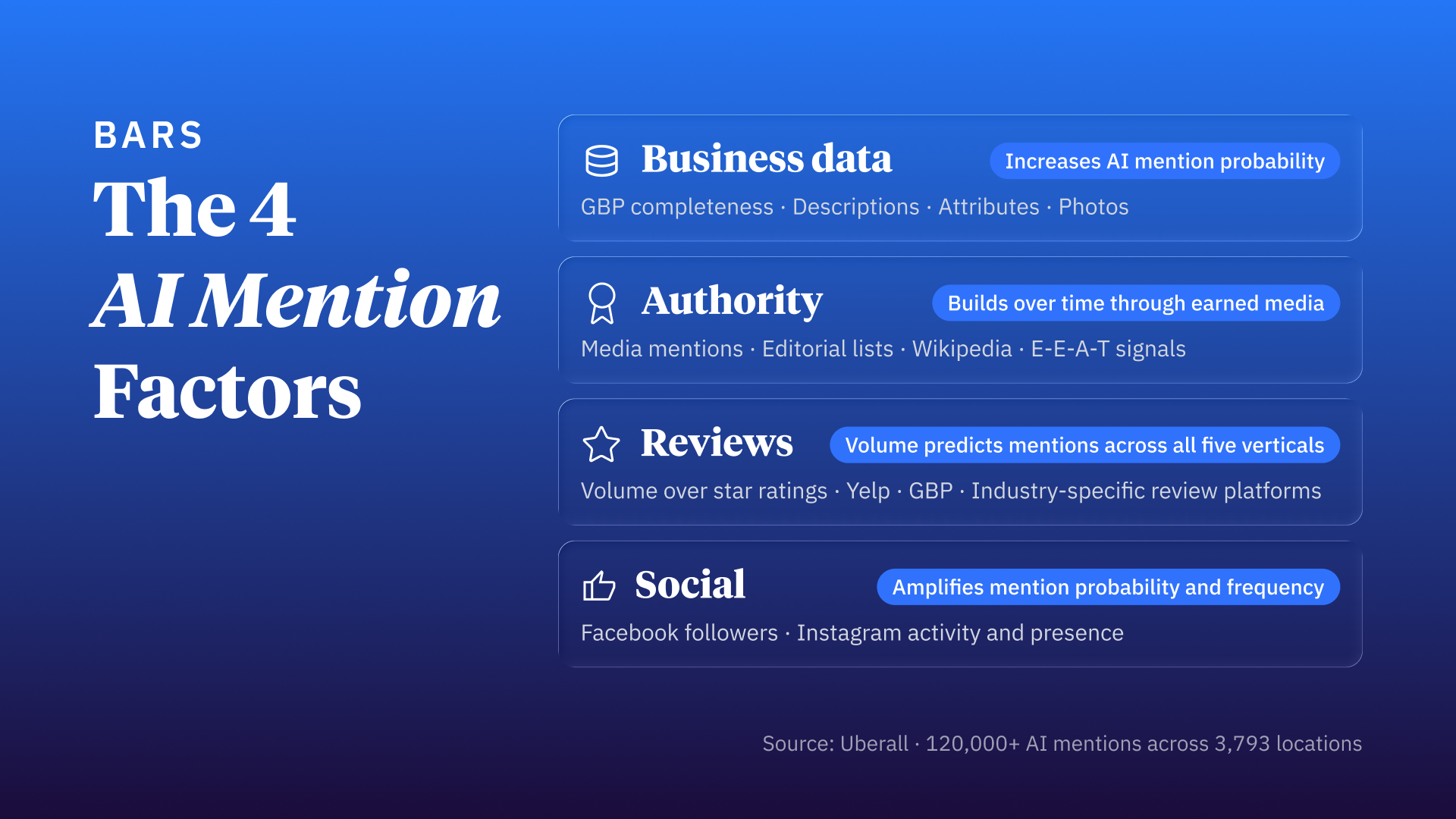
To simplify what these models are looking for, we can look at them through the lens of "BARS." These aren't exotic secrets, but for multi location brands, the challenge is executing these signals consistently across every single site.
Factor 1: Business Data
Business data acts as the entry requirement. It doesn't necessarily determine how often you are mentioned, but it determines if you are "mentionable" in the first place. While you cannot change the age of your business, you can control the richness of your Google Business Profile (GBP).
The data shows that completeness correlates directly with visibility. For grocery stores, a fully completed GBP description can triple mention rates. In the hotel sector, increasing the number of relevant attributes from a handful to 30 or 50 can jump mention probability from 22% to 94%.
Photos are perhaps the most critical data point. For restaurants, photo count is the strongest predictor of how often they are mentioned, with top mentioned spots averaging three times more photos than others. This trend extends to dental practices and banking as well.
Expert Interpretation: Think of business data as the "floor." If your profiles are incomplete, no amount of high end PR or reviews will save you because the AI doesn't have enough confidence to suggest you. The decision here is simple: audit your GBP completeness across all locations before investing in "authority" plays. This connects with AI Search Cites Reddit when the same signal needs a clearer operating decision.
Factor 2: Authority Signals
There is a common misconception that being a massive enterprise brand with huge market share guarantees AI visibility. The data suggests otherwise. While brand size helps chains get their foot in the door for grocery, banking, and hotels, it is a poor predictor of how often a brand is recommended.
In sectors like dentistry and dining, independent brands frequently outperform large chains. The real drivers of authority are external validations:
Media Mentions: In banking, brands with over 30 news mentions saw a 15 fold increase in mention frequency. For grocery stores, this level of media presence led to a 100% mention rate. Editorial Lists: Being featured on platforms like Michelin, Forbes Travel Guide, or Bankrate acts as a direct signal to the LLM. For example, Michelin recognition appeared in nearly 95% of Perplexity's restaurant responses. Wikipedia: This remains a strong positive signal for banks, hotels, and grocery stores, though it has less impact on dental practices.
Expert Interpretation: The tradeoff here is between "scale" and "prestige." You can have 1,000 locations, but if you aren't mentioned in editorial lists or news outlets, the AI views you as a commodity rather than an authority. Focus on earning a few high quality editorial mentions rather than just expanding your footprint. A useful companion note is Working Framework, because it looks at a nearby part of the same system. The same pattern also shows up in We Earned 1, where the practical question is how the signal becomes visible.
Factor 3: Review Signals
This is the most surprising finding: review volume is a far more powerful predictor of AI mentions than star ratings. In most categories, the actual score (e.g., 4.2 vs 4.8) is a weak signal.
Consider these examples:
Grocery Stores: Brands with high volume but lower ratings were mentioned 94.3% of the time, compared to only 60.6% for those with high ratings but low volume. Dentists: Star ratings didn't reach statistical significance at all. Banks: Interestingly, higher ratings on Yelp and TrustPilot sometimes correlated negatively with mentions. This isn't because AI likes bad reviews, but because the national giants (who get mentioned most) have so many customers that they naturally accumulate more complaints.
The only exception is the hotel industry, where GBP star ratings correlate more strongly with visibility than volume does.
Expert Interpretation: This shifts the operational priority. While maintaining quality matters for converting the human customer, the AI is looking for "social proof" via volume. If you are obsessing over moving a 4.3 to a 4.5, you might be wasting energy that should be spent simply increasing the total number of reviews.
Factor 4: Social Signals
Social media doesn't just provide "buzz"; it serves two distinct functions in the AI ecosystem. Facebook and Instagram play different roles.
Facebook is primarily about probability. A high follower count on Facebook helps a business get into the response in the first place. This is especially true for banks and dental practices, where mentioned businesses had significantly higher follower counts.
Instagram is about frequency. Once a business is in the conversation, a strong Instagram presence makes the AI talk about them more. For boutique hotels, Instagram is the single strongest predictor of AI mentions, even outweighing GBP data. This is particularly evident with Grok, which references Instagram content more than any other model.
Expert Interpretation: You have to decide which goal you are chasing. If you are a new or smaller location struggling to be noticed, Facebook's "reach" signals are more valuable. If you are already being mentioned but want to dominate the conversation and appear as a "must visit" destination, Instagram is the priority.
Immediate Priorities for Multi Location Brands
Winning in AI search requires a shift toward "Location Performance Optimization." This means moving away from a centralized brand strategy and focusing on the granular health of every single location profile. If you want to move the needle this month, focus on these three areas.
1. Audit and Complete GBP Profiles
If your profiles are thin, you are invisible. Completing descriptions, categories, and attributes can increase mention rates by 40 to 60 percentage points in certain industries. You cannot amplify a business that the AI doesn't believe fully exists. Ensure every location has a rich, detailed profile that leaves no field empty.
2. Shift Focus to Review Volume
Stop treating the star rating as the primary KPI for AI visibility. While you should never ignore poor service, the goal for AI optimization is volume. Implement systems to gather a higher quantity of fresh reviews across multiple platforms. The AI views a high volume of feedback as a signal of relevance and popularity, regardless of a few missing stars.
3. Aggressively Increase Photo Volume
Photos are a massive signal, particularly for restaurants, dentists, and banks. The goal should be to move beyond a few stock images. Aim for 100+ high quality, location specific photos per site. For those in the hotel or restaurant space aiming for top tier visibility, the target should be 2,000+ photos.
A critical detail: do not upload 2,000 photos in a single day. Upload them in steady increments. This signals to the AI that the business is active and evolving, rather than just performing a one time data dump.
Becoming a Local Role Model for AI
The "beta" era of AI search is over. We now have a clear understanding of the signals that drive visibility. The brands that will dominate the next few years are those that treat their local data with the same rigor they treat their national branding.
By meeting the models at the BARS, Business data, Authority, Review volume, and Social signals, multi location brands can stop relying on their size to carry them. The path to visibility is through long term data coherence, earning editorial respect, consolidating social proof, and visually documenting the customer experience across every single location.
Comments
Comments are reviewed before they are published. Links are not allowed inside comments.