Google Told CMOs to Stop ‘Top 10’ Listicles. Here’s Its Example
/ 6 min read

Summary
Kraham structures the article around three top priorities that he has heard from CMOs, which cover the "super empowered. The practical question is what this changes for SEO, content quality, and AI search visibility.
For years, the "Top 10" list has been the safety blanket of content marketing. It is easy to produce, easy to scan, and feels like a guaranteed win for traffic. But there is a growing gap between content that fills a page and content that actually proves a brand knows what it is talking about. The same pattern also shows up in Is AI Search Ghosting Your Brand? Here’s, where the practical question is how the signal becomes visible.
Recently, Google sent a blunt message to Chief Marketing Officers: if your brand has become invisible in search results, it is likely not because of AI, but because of the quality of your content. The shift is moving away from commodity information and toward verifiable, first hand expertise.
The Push for Specificity Over Generics
Brendon Kraham, Google's VP of Search and Commerce Global Ads Solutions, recently detailed this shift in a piece for Think with Google. His core argument is that brands need to stop relying on generic advice and start leveraging their unique, real world experience to establish authority. A useful companion note is State of Search 2027, because it looks at a nearby part of the same system.
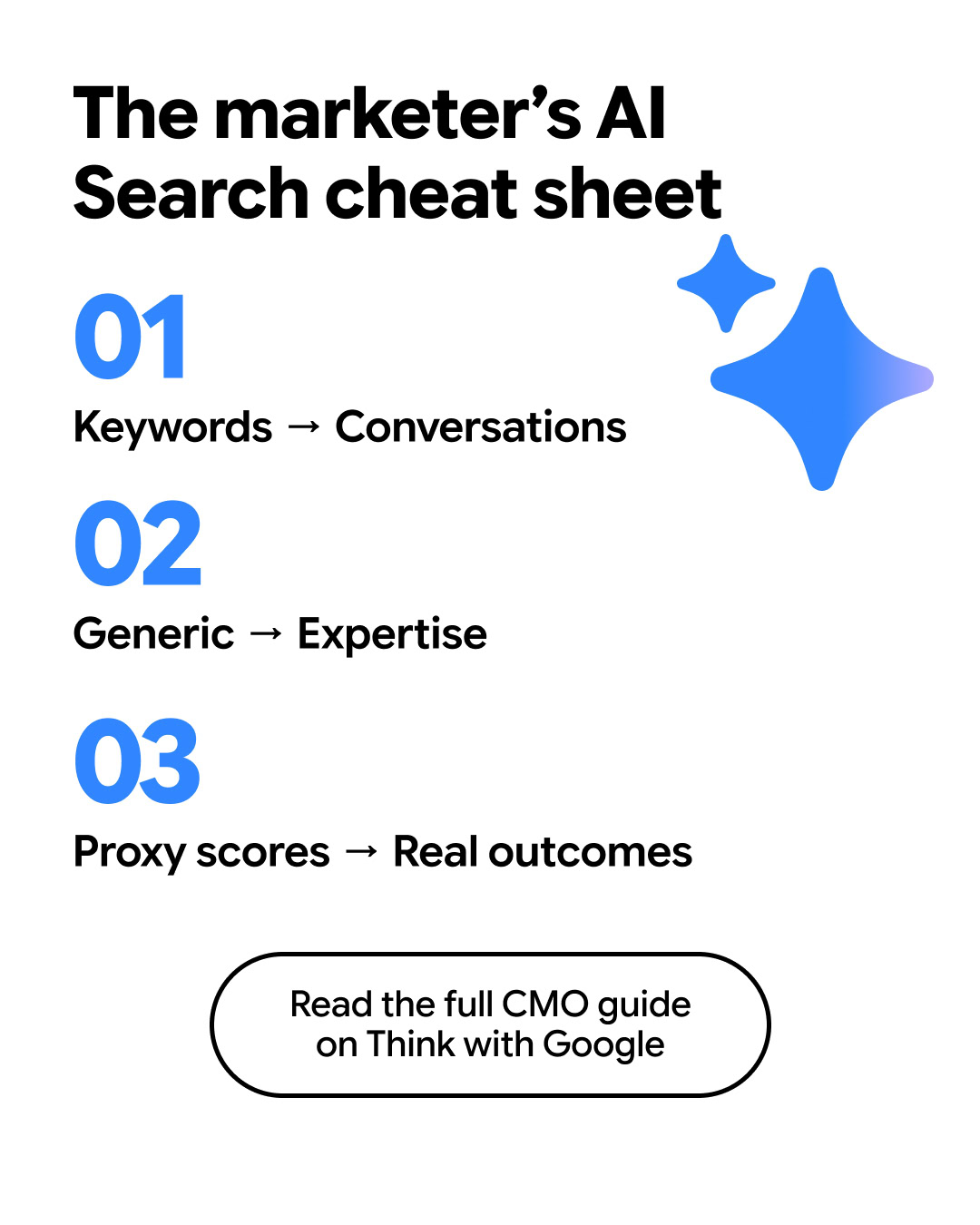
Kraham highlights three main priorities for CMOs: navigating the "super empowered consumer," building genuine authority in a specific niche, and focusing on measurable business outcomes.
The most striking part of his advice is the example he uses for a running shoe store. Instead of publishing a generic "Top 10 Things to Consider" when buying shoes, Kraham suggests creating a deep dive video that analyzes why a specific customer's shoes collapsed. The difference is the source of the information. A list of tips can be written by anyone with a search engine; a forensic analysis of a failed product requires actual expertise and a real world subject.
On the business side, he urges leaders to stop chasing proxy metrics and instead measure success through tangible goals like sales or leads.
Expert Interpretation: This is a move toward "Information Gain." If your content provides the same facts as ten other sites, you provide no new value to the ecosystem. The tradeoff here is efficiency. It is much faster to write a listicle than to conduct a case study or a product autopsy. However, the decision you need to make is whether you want high volume, low value traffic or low volume, high intent traffic that actually converts because you proved your expertise.
How the SEO Community is Interpreting the Shift
The SEO community has a nuanced take on this. There is a specific type of "best of" listicle where a company lists itself as number one. These self promotional lists have historically been a staple of corporate blogging.
Some analysts have noted that Google's AI Overviews have frequently cited these types of lists when recommending companies. This creates a tension between what Google's executives are telling CMOs and how the AI currently surfaces information. Eli Schwartz, a growth advisor, has been vocal about this, suggesting that "AEO visibility" (AI Engine Optimization) is not a real metric of success if it is based on sanitized PR content rather than genuine utility.
Other industry leaders, like Ross Hudgens of Siege Media, suggest that the "Top 10" lists Google is warning against are not necessarily the self promotional ones, but rather the generic, commodity style tips that offer no unique insight.
Expert Interpretation: There is often a lag between Google's public guidance and the behavior of its algorithms. Just because an AI Overview might currently cite a "Best X" list doesn't mean that is the sustainable path forward. The risk is relying on a loophole that could close at any moment. You should inspect your current "Best of" lists and ask if they provide actual value or if they are simply placeholders for a sales pitch.
Consistency Across Google's Documentation
This isn't an isolated opinion from one executive. Google's official guide for optimizing for generative AI features, released in May, echoes the same sentiment. The guide explicitly points to "7 Tips for First Time Homebuyers" as an example of commodity content because it relies on common knowledge that is available everywhere.
To contrast this, the guide suggests a piece focused on the specific, first hand experience of waiving a home inspection. One is a summary of what is already known; the other is a narrative of a specific event with a unique outcome.
It is worth noting that neither the CMO focused article nor the technical AI guide specifically targets the self promotional "best" lists. Their focus is squarely on the difference between common knowledge and first hand expertise.
Expert Interpretation: When the marketing arm (Think with Google) and the technical arm (Search Documentation) align on a concept, it is a strong signal. The common thread is the rejection of "commodity content." The tradeoff is that first hand content is harder to scale. You cannot outsource a first hand experience to a freelance writer who has never used your product. This requires a shift in resource allocation from "content production" to "knowledge extraction" from your internal experts.
The Practical Impact on Content Strategy
When this guidance reaches the C-suite, it changes the criteria for what gets approved in a content calendar. The goal is no longer to "rank for a keyword" but to "demonstrate a capability."
To apply this, you have to audit your planned content through a strict lens: does this post represent something we have learned firsthand, or is it simply a restatement of common knowledge? If the answer is the latter, the content is a commodity and is unlikely to provide a long term competitive advantage in an AI driven search environment.
For those who rely heavily on "best of" lists for lead generation, the focus should shift toward adding proprietary data or unique testing methodologies to those lists to move them out of the "commodity" category.
Expert Interpretation: The danger here is "pseudo expertise," where brands try to make generic content sound specific without actually having the data to back it up. Google's systems are increasingly designed to identify the difference between a polished summary and a genuine insight. The decision to make here is to stop valuing "polish" and start valuing "proof."
Staying Current with Search Evolution
The landscape is shifting quickly, and the move away from listicles is part of a broader trend toward rewarding authenticity and expertise. Google maintains a dedicated documentation updates page where major changes to Search are posted. This connects with Here’s the Fix when the same signal needs a clearer operating decision.
For those who want to avoid the noise of social media speculation, following the RSS feed of these official updates is the most direct way to see how Google's expectations for content are evolving in real time.
Expert Interpretation: Most marketers rely on third party interpretations of Google's updates, which adds a layer of bias. By going directly to the documentation, you can see the raw requirements. The tradeoff is that documentation is often dry and lacks the "how to" context, but it is the only source of truth for the technical constraints you are operating within.
What Kraham's Article Asks Brands To Do
Kraham structures the article around three top priorities that he has heard from CMOs, which cover the "super empowered consumer," establishing the brand as an authority in its area of expertise, and creating measurable business results. The practical read is that brand signals need to be consistent enough for both people and AI systems to form a stable view of the company, its expertise, and its trust signals.
The practical value is in connecting the idea to an observable signal. That means deciding what should be checked, what would prove the issue is real, and where the team should make the smallest useful improvement first.
Comments
Comments are reviewed before they are published. Links are not allowed inside comments.