Google Now Reports AI Search Impressions. Here’s How to Read Them
/ 6 min read

Summary
The Search report currently includes impressions from AI Overviews and AI Mode. Experimental Search Labs features are excluded,. The practical question is what this changes for SEO, content quality, and AI search visibility.
Google has finally separated generative AI visibility from the rest of the data in Search Console. On June 3, 2026, Google announced dedicated Generative AI performance reports for Search and Discover.
The announcement fell on my birthday, which felt briefly thoughtful until I realized the gift was all impressions and no clicks. The Search report shows impressions from AI Overviews and AI Mode, along with the URLs that appeared and breakdowns by country, device, and date.
What The Generative AI Report Includes
The Search report currently includes impressions from AI Overviews and AI Mode. Experimental Search Labs features are excluded, while generative features in Discover are covered in a separate report. Website owners can segment the data. The measurement question is whether this signal changes a decision, not whether it adds another number to a dashboard. Useful reporting connects visibility, engagement, and business outcomes without pretending every AI influenced journey will produce a clean click path. This connects with AI Agents Read Your Site & It’s Breaking when the same signal needs a clearer operating decision. A useful companion note is So Build What It Can Read, because it looks at a nearby part of the same system.
The reporting question is whether this signal changes a decision. If it only creates another number in a dashboard, it adds noise. If it helps separate profile activity, website visits, calls, bookings, and direction requests, it can make local performance easier to understand.
What Counts As An AI Impression
Google defines an impression as an instance in which a link to a website is shown to a user within a generative AI feature. The counting method changes according to the level of aggregation. In the chart, data is aggregated at the. The measurement question is whether this signal changes a decision, not whether it adds another number to a dashboard. Useful reporting connects visibility, engagement, and business outcomes without pretending every AI influenced journey will produce a clean click path.
AI Impressions Are Not Traditional Search Impressions
Both metrics are called impressions, but the user experiences are not equivalent. In conventional search, an impression usually means a discrete listing was presented for consideration. In AI Overviews and AI Mode, the principal product is. The measurement question is whether this signal changes a decision, not whether it adds another number to a dashboard. Useful reporting connects visibility, engagement, and business outcomes without pretending every AI influenced journey will produce a clean click path.
What The Report Can Help You Diagnose
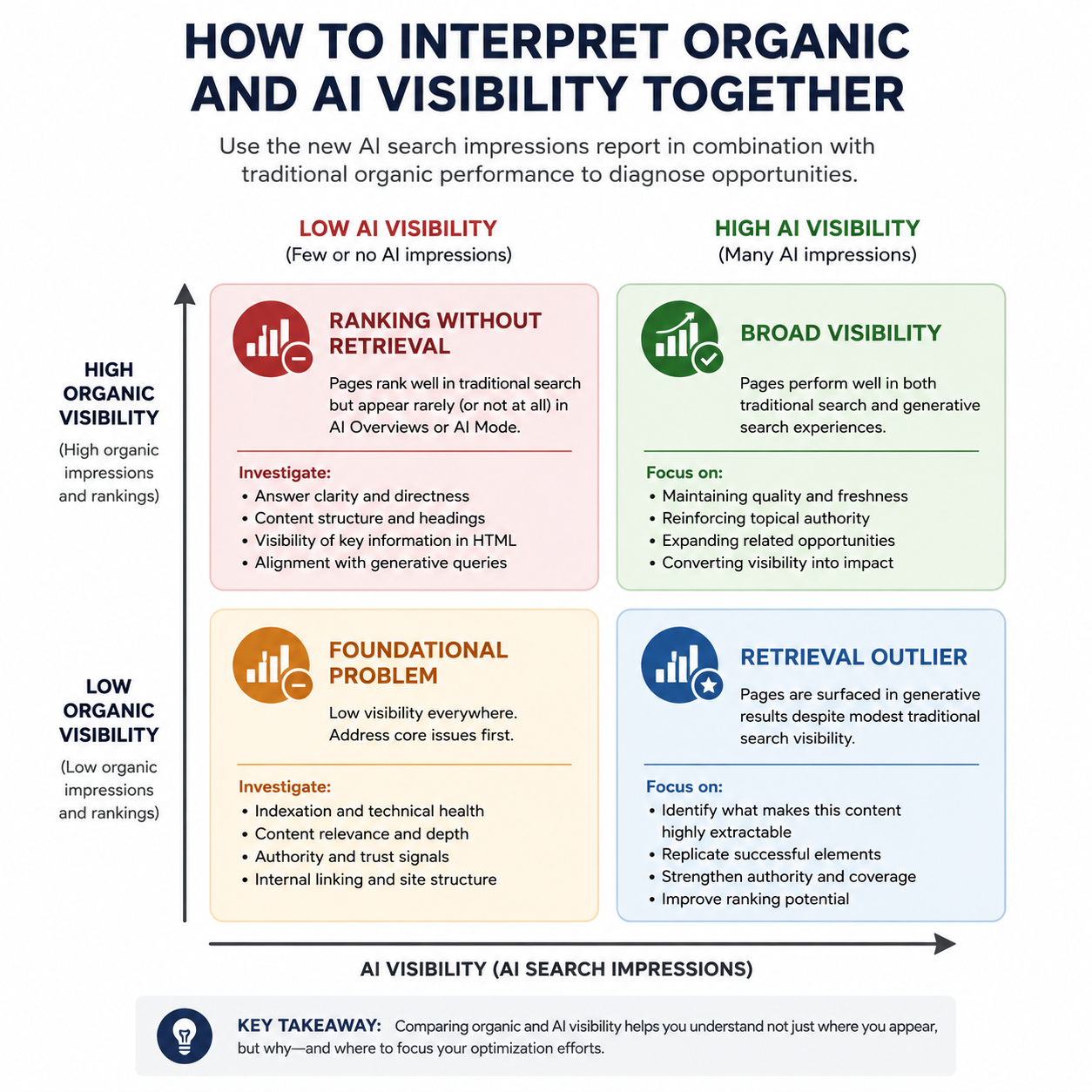
The real value of the report is not the total impression count. It is the ability to compare which pages Google uses in generative search with how those pages perform elsewhere. Several patterns are worth investigating. The measurement question is whether this signal changes a decision, not whether it adds another number to a dashboard. Useful reporting connects visibility, engagement, and business outcomes without pretending every AI influenced journey will produce a clean click path.
High Organic Visibility, Low AI Visibility
A page may rank well and receive substantial organic impressions while appearing rarely in the generative report. That does not automatically indicate a problem. Not every query triggers an AI response, and not every page type is useful. The measurement question is whether this signal changes a decision, not whether it adds another number to a dashboard. Useful reporting connects visibility, engagement, and business outcomes without pretending every AI influenced journey will produce a clean click path.
Modest Organic Visibility, High AI Visibility
The opposite pattern may be even more revealing. A page with modest conventional visibility may receive a disproportionate number of generative impressions because it contains a useful definition, statistic, comparison, or explanation. The search implication is whether the section improves the evidence around the page, not simply whether it adds more wording. Clear entities, crawlable structure, internal links, and useful context are what make the topic easier to evaluate.
The risk is usually hidden in the execution layer. A page can look fine to a human and still fail for an automated visitor if the form, call to action, rendering path, or confirmation step is not accessible enough for the agent to complete the task.
Visibility Concentrated In A Few Pages
If most generative impressions come from a handful of URLs, group those pages by topic, content type, author, template, and intent. Perhaps one template exposes content cleanly in HTML while another hides it behind scripts, tabs, or. The measurement question is whether this signal changes a decision, not whether it adds another number to a dashboard. Useful reporting connects visibility, engagement, and business outcomes without pretending every AI influenced journey will produce a clean click path.
Changes After Content Revisions
The report can also help you monitor whether meaningful revisions correspond with sustained changes in generative visibility. Adding a clear summary or definition. Making important content visible in HTML. Adding original evidence or. The measurement question is whether this signal changes a decision, not whether it adds another number to a dashboard. Useful reporting connects visibility, engagement, and business outcomes without pretending every AI influenced journey will produce a clean click path.
How To Work With The Data
You do not need a new 12 tool AI visibility stack to begin analyzing this report. You do need exports, consistent date ranges, sensible page classifications, and enough restraint not to confuse correlation with revelation. The measurement question is whether this signal changes a decision, not whether it adds another number to a dashboard. Useful reporting connects visibility, engagement, and business outcomes without pretending every AI influenced journey will produce a clean click path.
1. Export AI Visible URLs
Use a meaningful date range. Avoid drawing conclusions from a few days of rollout data. The practical question is what this changes in the system: the page structure, the evidence presented, the measurement habit, or the way the topic is connected to related work.
The practical value is in connecting the idea to an observable signal. That means deciding what should be checked, what would prove the issue is real, and where the team should make the smallest useful improvement first.
What the visibility signal actually changes
What the visibility signal actually changes: google Now Reports AI Search Impressions. Here’s How to Read Them: the Strategic Visibility Angle should be treated as a visibility signal, not a standalone headline. Introduction Google has finally separated generative AI visibility from the rest of the data in Search Console. On June 3, 2026, Google announced dedicated Generative AI performance reports for Search and Discover. The announcement fell on my birthday, which. The same pattern also shows up in I Tested DeepSeek’s New Search Api, where the practical question is how the signal becomes visible.
What the visibility signal actually changes: the practical question is whether the page, brand evidence, and surrounding content make the answer easier to trust. If that support is weak, search systems can still understand the topic but fail to connect it confidently to the brand.
What the visibility signal actually changes: that is why the response should begin with an audit of the evidence already on the site before creating a new asset. The fastest improvement is often a clearer page, a better internal link, or a stronger explanation of why the brand belongs in the answer.
Where the evidence needs to be tested
Where the evidence needs to be tested: a single study or ranking observation should not become a strategy by itself. It should become a diagnostic prompt: which source is being trusted, which query pattern is affected, and which part of the site would make that trust easier to earn?
Where the evidence needs to be tested: that keeps the response grounded. The goal is to improve the evidence chain around the topic rather than publish another summary that repeats what every other page already says.
Where the evidence needs to be tested: the important distinction is between a useful signal and a fashionable talking point. A useful signal changes the brief, the page structure, the linking plan, or the measurement view.
Comments
Comments are reviewed before they are published. Links are not allowed inside comments.