Google’s 404 Guide Says 410s Generally Get Crawled Less Often
/ 6 min read

Summary
Google's new guidelines have separated crawling of pages with 404 or 410 status codes from how they are indexed by Google. For a. The practical question is what this changes for SEO, content quality, and AI search visibility.

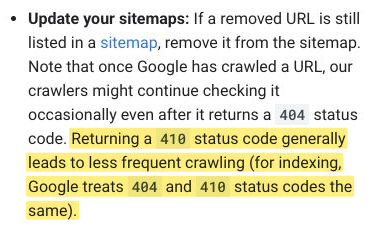
Returning a 410 status code for a removed page "generally leads to less frequent crawling," according to Google's updated guide to crawling errors. For indexing, Google treats 404 and 410 the same. This connects with Google’s Indexing API Docs No Longer Explain when the same signal needs a clearer operating decision. A useful companion note is Fix Conflicting Metadata, because it looks at a nearby part of the same system.
27 in a new section on deciding whether to fix 404 errors reported in Search Console. The documentation changelog says the section brings 404 guidance over from the Search Console Help Center into Search Central documentation, and the old Help page now redirects to the guide.
410s And Crawl Frequency
Google's new guidelines have separated crawling of pages with 404 or 410 status codes from how they are indexed by Google. For a URL that was crawled by Google but returned a 404 status code, Google's crawlers "might continue checking it. Local visibility depends on whether the details across pages, profiles, categories, reviews, photos, and service descriptions reinforce the same answer for a specific location based query.
The operational question is whether the public business data is complete enough to support the query. Hours, categories, services, reviews, photos, and page content need to reinforce each other so Google can understand the business in a specific situation, not only as a generic listing.
What Carried Over From The Help Center
The rest of the new section repeats points from the old Help page and from a Google video embedded in the guide. One of them is a warning against blocking 404 URLs in robots.txt, since Google has to crawl a URL to see its status code. The practical question is what this changes in the system: the page structure, the evidence presented, the measurement habit, or the way the topic is connected to related work.
The practical value is in connecting the idea to an observable signal. That means deciding what should be checked, what would prove the issue is real, and where the team should make the smallest useful improvement first.
Sitemap Guidance
For removed pages, the crawling errors guide says to take the URLs out of sitemaps. For live pages that shouldn't appear in Search, Google's sitemaps overview now says leaving a URL out of a sitemap "doesn't prevent Google from crawling or. Local visibility depends on whether the details across pages, profiles, categories, reviews, photos, and service descriptions reinforce the same answer for a specific location based query.
Why This Matters
Sites bulk removing pages, such as an archive of discontinued products, can use a documented crawl difference when deciding which pages should receive a 404 vs. a 410 for content that is permanently deleted. According to Google's crawling. Local visibility depends on whether the details across pages, profiles, categories, reviews, photos, and service descriptions reinforce the same answer for a specific location based query.
Looking Ahead
Google's guide doesn't specify how much less often URLs that return a 410 are crawled. A site that retires many pages can explore the impact in its server logs by returning a 410 for one group of similar removed URLs and a 404 for another. The practical question is what this changes in the system: the page structure, the evidence presented, the measurement habit, or the way the topic is connected to related work.
410s And Crawl Frequency in practice
Introduction Returning a 410 status code for a removed page "generally leads to less frequent crawling," according to Google's updated guide to crawling errors. For indexing, Google treats 404 and 410 the same. The line arrived on Nov. 27. Local visibility depends on whether the details across pages, profiles, categories, reviews, photos, and service descriptions reinforce the same answer for a specific location based query.
The reporting question is whether this signal changes a decision. If it only creates another number in a dashboard, it adds noise. If it helps separate profile activity, website visits, calls, bookings, and direction requests, it can make local performance easier to understand.
What the visibility signal actually changes
What the visibility signal actually changes: google’s 404 Guide Says 410s Generally Get Crawled Less Often: the Practical Angle should be treated as a visibility signal, not a standalone headline. Introduction Returning a 410 status code for a removed page "generally leads to less frequent crawling," according to Google's updated guide to crawling errors. For indexing, Google treats 404 and 410 the same. The line arrived on Nov. 27 in a new section on.
What the visibility signal actually changes: the practical question is whether the page, brand evidence, and surrounding content make the answer easier to trust. If that support is weak, search systems can still understand the topic but fail to connect it confidently to the brand.
What the visibility signal actually changes: that is why the response should begin with an audit of the evidence already on the site before creating a new asset. The fastest improvement is often a clearer page, a better internal link, or a stronger explanation of why the brand belongs in the answer.
Where the evidence needs to be tested
Where the evidence needs to be tested: a single study or ranking observation should not become a strategy by itself. It should become a diagnostic prompt: which source is being trusted, which query pattern is affected, and which part of the site would make that trust easier to earn?
Where the evidence needs to be tested: that keeps the response grounded. The goal is to improve the evidence chain around the topic rather than publish another summary that repeats what every other page already says.
Where the evidence needs to be tested: the important distinction is between a useful signal and a fashionable talking point. A useful signal changes the brief, the page structure, the linking plan, or the measurement view.
How to avoid overreacting to one data point
How to avoid overreacting to one data point: for content teams, the strongest move is to map the claim to existing assets before creating anything new. The right page may already exist, but it may need clearer headings, stronger internal links, fresher proof, or a better explanation of why the brand belongs in the answer.
How to avoid overreacting to one data point: this is also where title rewriting matters. A title should not copy the source headline; it should frame the practical implication so readers immediately know why the topic deserves attention.
How to avoid overreacting to one data point: the same standard should apply to every section. Each heading needs to earn its place by moving the reader through the evidence, not by repeating the outline in a more polished voice.
What this means for content and authority
What this means for content and authority: authority is becoming more contextual. It is not enough to be generally known in a category if the specific answer depends on a different source, a different index, or a different retrieval pattern.
What this means for content and authority: that means the content system should show consistent entities, related pages, credible references, and useful depth around the exact questions people and AI tools are asking.
What this means for content and authority: when the context is weak, AI systems can still mention the brand but describe it in the wrong frame. The fix is not more volume; it is cleaner evidence around the specific association.
Comments
Comments are reviewed before they are published. Links are not allowed inside comments.