I Blind Tested 3 Gemini Models on Real SEO Questions, Neon Won 5 of 6
/ 6 min read

Summary
Before I even finished reading the first round of blind outputs, one thing jumped out immediately: The answers were way too long. The practical question is what this changes for SEO, content quality, and AI search visibility.
It is easy to fall into the trap of assuming that the newest version of an AI model is automatically the best one for your specific workflow. In the world of SEO, where nuance and practical application matter more than generic summaries, that assumption can lead to inefficient prompts and wasted budget.
To get a real sense of performance, I looked at a blind test conducted by Marie Haynes. She compared Gemini 4 Neon, Gemini 4 Hydrogen, and Gemini 3.8 Flash using a private AI co pilot grounded in her own curated library of Search and AI research. By removing the brand names from the outputs, she could judge the quality of the answers without bias. A useful companion note is Questions That Reveal Your Real Search Performance, because it looks at a nearby part of the same system. The same pattern also shows up in AI Search Is Working., where the practical question is how the signal becomes visible.
The Hidden Danger of Over Eager AI
Before the actual blind test could begin, a significant issue surfaced during the initial runs. The outputs were far too long. The system was defaulting to a detailed mode without a word limit, which revealed a surprising behavior in Gemini 4 Hydrogen.
The API logs showed that Hydrogen was entering an over eager research loop. On average, it was reading 21 different knowledge files per question, taking about 68 seconds to respond, and producing essays of roughly 1,600 words. This didn't just hurt the user experience; it drove the cost up to $0.44 per prompt, making it more expensive than the higher tier Neon model.
Beyond the length, there was a quality issue regarding the language used. The model was leaking internal Google engineering jargon, mentioning terms like FastSearch and MAGIT. For a business owner trying to understand a drop in traffic, this technical noise is useless and distracting.
To fix this, three specific adjustments were made to the system before the final test:
The default was switched to a concise mode, targeting between 180 and 280 words to mimic a practical professional consultation. Tool lookups were capped at one or two targeted files per turn to maintain speed and focus. Internal Google patent codenames were banned unless specifically requested.
Expert Interpretation: This highlights a critical tradeoff between "comprehensiveness" and "utility." Many users assume that more data retrieval equals a better answer, but in practice, it often leads to "hallucinations of detail" or irrelevant technical jargon. When building an AI workflow, you must decide if you want a researcher or a consultant. A consultant provides the answer; a researcher provides the library. For most SEO tasks, the consultant approach is far more valuable.
Why Gemini 4 Neon Dominated the Results
Once the prompts were tightened and the model names were hidden, the test was re run across six real world SEO scenarios. These included complex topics like AI Overviews, traffic volatility, the decision to prune or rewrite informational content, and the handling of thin location pages.
The result was decisive: Gemini 4 Neon won 5 out of 6 prompts.
Interestingly, the victory wasn't based on the amount of factual data. All three models had access to the exact same knowledge files. Instead, the difference was in the communication style. Neon's responses felt less like a predictable AI pattern and more like a smart human thinking through a problem in real time. The answers were intuitive and easy to digest, reducing the cognitive load on the reader. This connects with Working Framework when the same signal needs a clearer operating decision.
Expert Interpretation: This suggests that we are moving past the era where "knowledge retrieval" is the primary differentiator between models. Since most professional setups now use RAG (Retrieval Augmented Generation) to provide the facts, the real value now lies in "reasoning" and "persona." The decision here is whether you prioritize raw data output or the ability of the AI to synthesize that data into a human like recommendation. Neon's win proves that synthesis is what actually drives user satisfaction.
Breaking Down the Actual API Costs
Performance is only half the equation; the other half is the budget. To understand if Neon is a viable choice, it is necessary to look at the cost per prompt in a concise mode environment, including thinking tokens.
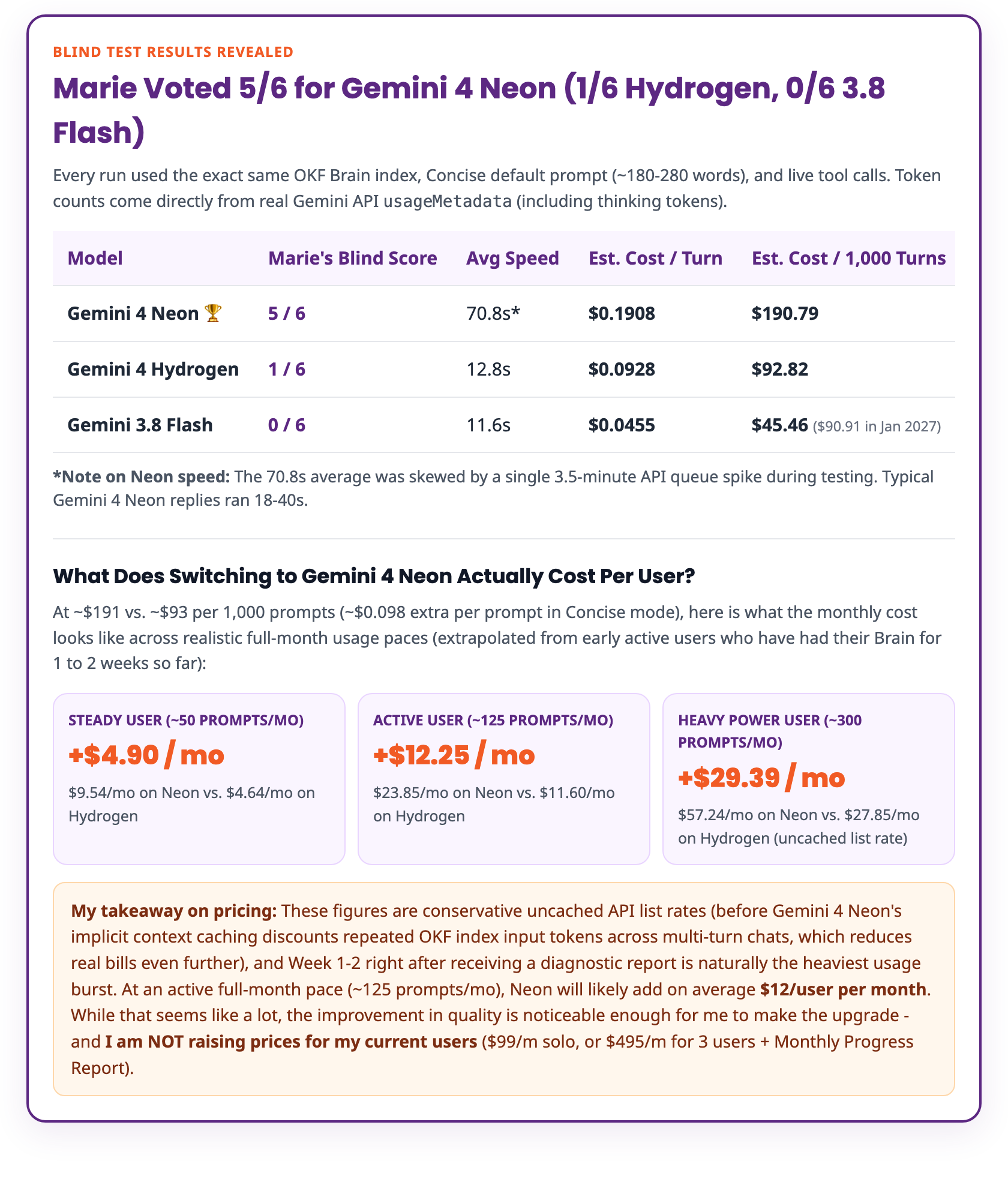
On a raw basis, the cost difference is noticeable. Running 1,000 prompts costs roughly $191 with Neon compared to $93 with the cheaper alternative. This is an increase of about 10 cents per prompt.
When you extrapolate this to monthly usage for different types of users, the price gap becomes clearer:
Steady users (approx. 50 prompts per month) would pay about $4.90 more per month for Neon ($9.54 vs $4.64). Active users (approx. 125 prompts per month) would see an increase of $12.25 per month ($23.85 vs $11.60). Power users (approx. 300 prompts per month) would pay roughly $29.39 more per month ($57.24 vs $27.85).
It is worth noting that these are conservative, uncached estimates. In a real world scenario, because the models often reference the same master index of tokens, implicit context caching can reduce the cost of repeated input tokens in multi turn conversations, likely bringing the actual bill down.
Regarding speed, while some tests showed a high average response time for Neon, this was largely due to a single API queue spike. Typical responses generally fall between 18 and 40 seconds, with text streaming as it generates.
Expert Interpretation: The financial decision here is a classic "quality vs. quantity" trade. For a casual user, a $5 monthly difference is negligible. For an enterprise scaling thousands of prompts, it is significant. However, the cost of a "wrong" or "robotic" answer in a client facing environment often outweighs the 10 cent premium per prompt. If the output requires less human editing, the higher API cost is actually a net saving in labor hours.
Surprise 1: Our First Test Exposed A Prompt Problem
Before I even finished reading the first round of blind outputs, one thing jumped out immediately: The answers were way too long. My Brain had been defaulting to Detailed mode with no word ceiling. When we checked the API logs, we. Local visibility depends on whether the details across pages, profiles, categories, reviews, photos, and service descriptions reinforce the same answer for a specific location based query.
The risk is usually hidden in the execution layer. A page can look fine to a human and still fail for an automated visitor if the form, call to action, rendering path, or confirmation step is not accessible enough for the agent to complete the task.
My Blind Result: 5 Out Of 6 For Gemini 4 Neon
With the model names hidden and the columns randomized, I read all 18 answers and picked a winner on every prompt. When I hit reveal, the result wasn't even close: What stood out to me about Neon wasn't that it had more facts, all three. The practical question is what this changes in the system: the page structure, the evidence presented, the measurement habit, or the way the topic is connected to related work.
The useful check is whether this improves the system behind search performance, not only the words on the page. Internal links, crawlable content, clear entities, current evidence, and a sensible page structure all help the recommendation become easier to trust.
What Does Gemini 4 Neon Actually Cost?
Of course, better answers only matter if the economics make sense. Here are the real numbers from our live Concise mode runs (using real Gemini API usageMetadata, including thinking tokens, at conservative uncached list rates): Note on. The strategic issue is whether automated visitors can understand, trust, and complete the same journey a human visitor can. Agent readiness is partly technical, but it is also about clear tasks, accessible flows, and reliable evidence.
Comments
Comments are reviewed before they are published. Links are not allowed inside comments.