The Real Reason Building Trust Through Real People Stands the Test of Time in SEO & AI Search
/ 7 min read

Summary
What I find interesting, looking back, is how consistent Google's guidance has been the entire time, if you read between the. The practical question is what this changes for SEO, content quality, and AI search visibility.
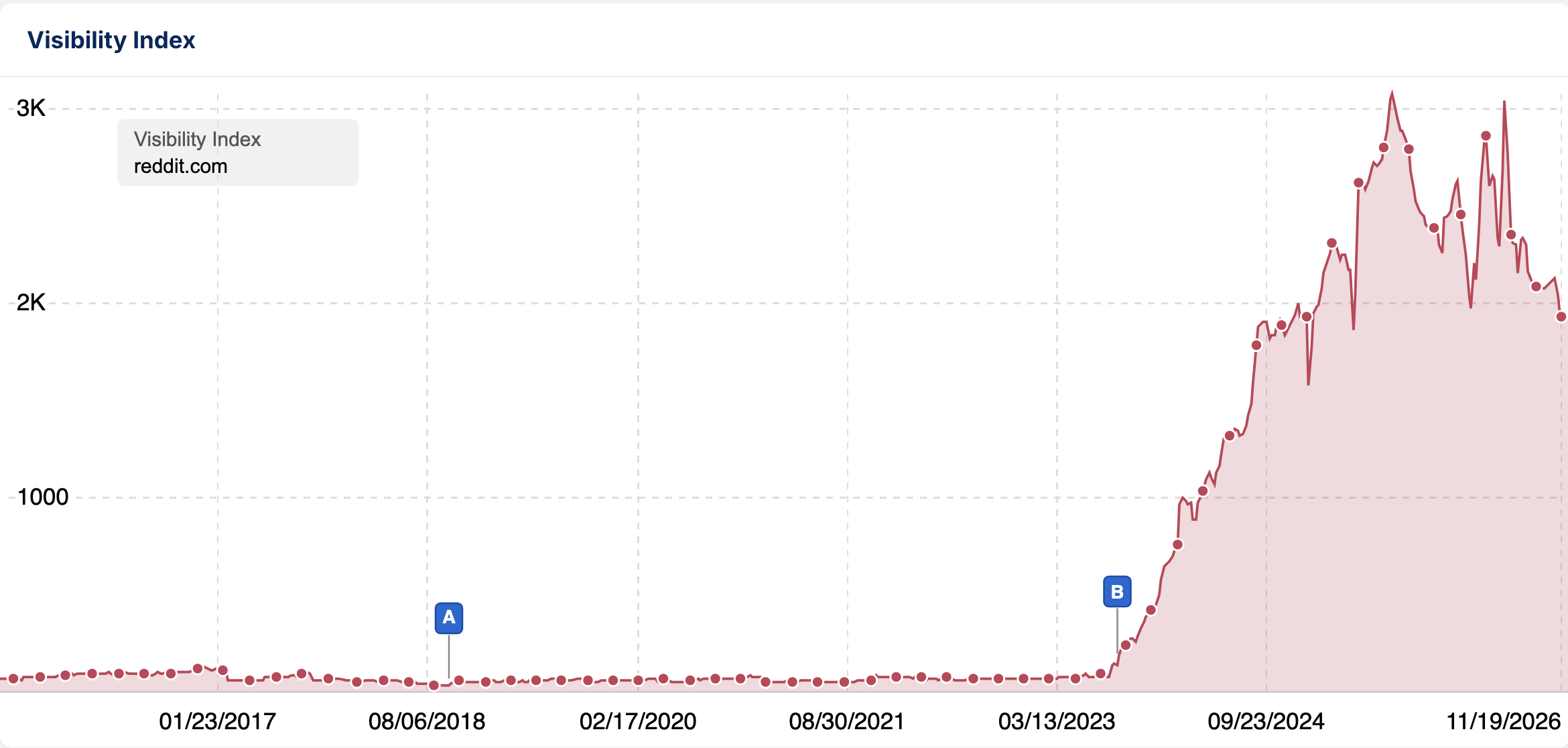
In the world of organic search, there is a recurring temptation to find the "loophole." We see a new tactic, whether it is programmatic pages, parasite SEO, or the latest AI generated listicle trend, and we treat it as a strategy. But a loophole is not a strategy; it is a countdown. Loopholes have expiration dates, and the time spent chasing them is usually time stolen from work that actually builds a foundation.
Anyone who has spent a decade or more in this industry has seen the cycle. We move from exact match domains to PBNs, and now to "inauthentic mentions" in the GEO era. These shortcuts work for a while, but when the inevitable crackdown comes from Google or Bing, the sites that relied on them don't just lose traffic, they often end up in a worse position than if they had never tried the shortcut at all. The recovery process can take years.
The Consistency of Search Guidelines
It is fascinating to look back at the history of search and realize that Google has been telling us the same thing for over two decades. If you dig into the Webmaster Guidelines from 2003, the core message was already there: create pages for users, not for search engines. Even twenty three years ago, Google warned against "cookie cutter" content and the pursuit of loopholes.
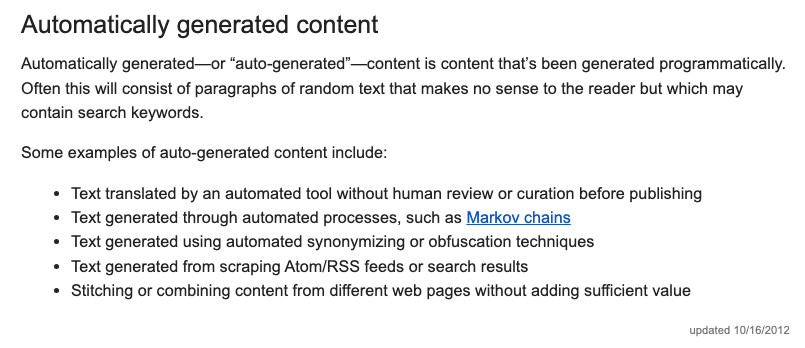
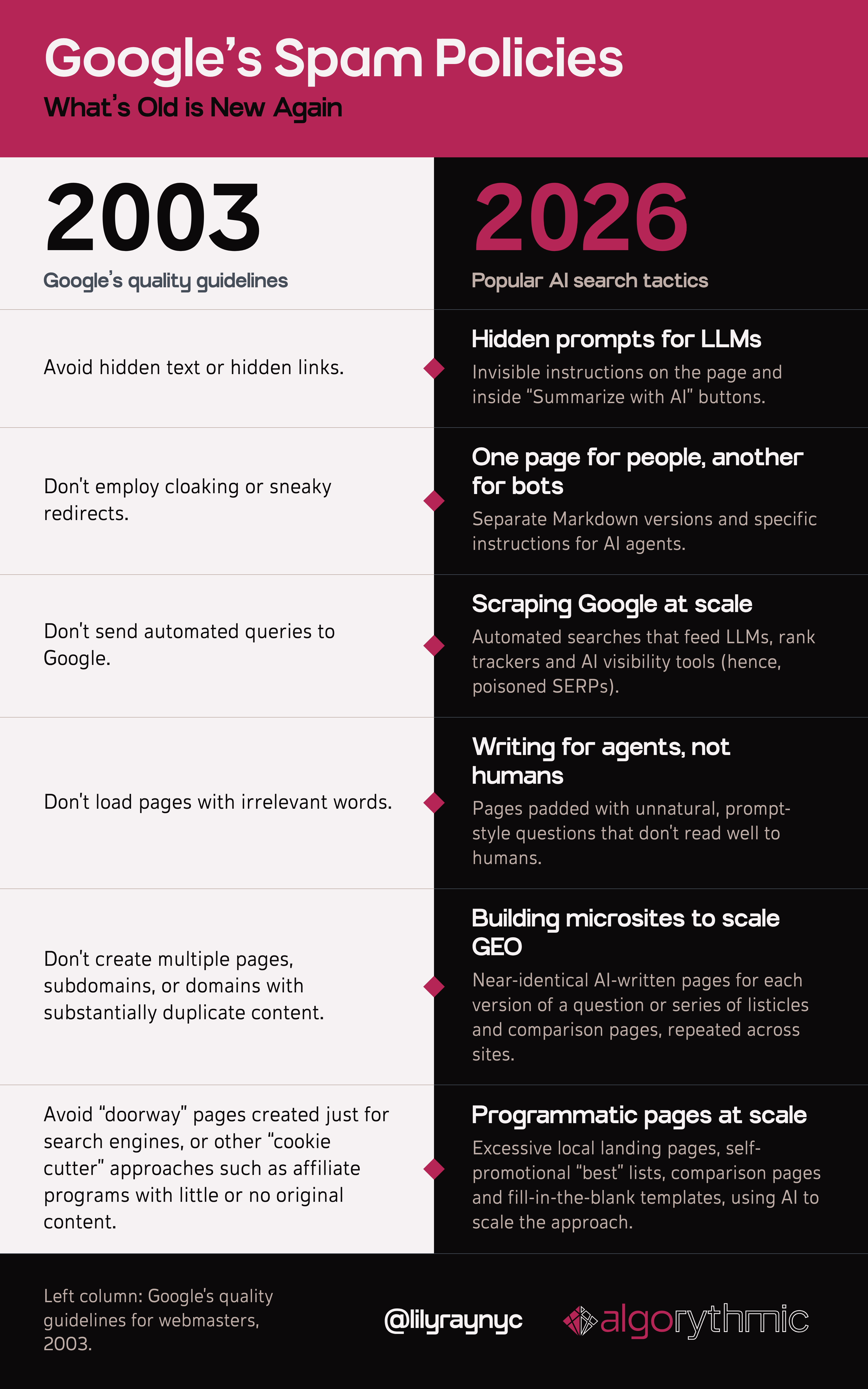

The fight against automation is not new. As far back as 2010, Google's own representatives warned that publishing raw output from tools like Google Translate without human curation could be flagged as auto generated content. By 2012, there were dedicated help pages warning against Markov chains and automated synonymizing.
Expert Interpretation: The tradeoff here is speed versus stability. Loophole based SEO offers a fast spike in visibility, but it carries a high risk of total collapse. When deciding on a content production method, you have to ask: "If the algorithm changes tomorrow to specifically target this method, does my business survive?" If the answer is no, you aren't building an asset; you're gambling.
E-E-A-T as a Strategic Framework
When Google introduced E-A-T in 2014 (which later evolved into E-E-A-T), it provided a way to move beyond the loop of shortcuts. While many treat E-E-A-T as a checklist or a single ranking factor, it is actually a framework for people first work. It is mentioned over a hundred times in the Search Quality Rater Guidelines for a reason. This connects with It Comes from Other People when the same signal needs a clearer operating decision.
Focusing on Experience, Expertise, Authoritativeness, and Trustworthiness is significantly harder than traditional SEO. It requires buy in from the actual experts within a company, not just the marketing team. It takes time and resources to extract knowledge from a subject matter expert and put it into the world. However, the return is far higher because it doesn't just help organic search, it improves conversions and brand trust across every channel.
Expert Interpretation: The common mistake is treating E-E-A-T as a "technical" requirement (like adding an author bio) rather than a "structural" one. The decision you need to make is whether you are willing to slow down your publishing cadence to ensure that the content is actually rooted in expertise. Quality that is verifiable is the only hedge against AI driven volatility.
Centering Humans in the SEO Approach
The shift toward a human centric approach often comes from learning the hard way. For example, scaling a library of health articles without visible credentials or human oversight is a recipe for disaster, especially in YMYL (Your Money or Your Life) niches. When the 2018 Medic update hit, it became clear that Google wasn't just looking for "good content," but for evidence of who was behind that content.
By making real humans the focal point, you move away from the "scaled" mindset. The goal is no longer to produce the most pages, but to produce the most authoritative perspectives. This is the core of a sustainable SEO and GEO (Generative Engine Optimization) strategy.
Expert Interpretation: The risk of the "scaled" approach is that it creates a hollow brand. When you prioritize the human, you are investing in a reputation that exists independently of any single algorithm. The tradeoff is that you cannot "scale" a human's reputation, it must be earned through consistent, public presence over time.
Defining "Real Humans" in a Digital Context
We hear phrases like "humanize your brand" so often they've become clichés. To be precise, "real humans" are practitioners with genuine, lived experience. This is the doctor who has treated the patient, the engineer who wrote the code, or the plumber who has spent twenty years in the field. These people earn their audience by sharing insights that are original, often opinionated, and based on real world application.
You can tell the difference between a real expert and a content marketer because the expert isn't there primarily to sell; they are there to share knowledge. Trust is the byproduct of that sharing, and the sale follows the trust. A useful companion note is from Crawling to Trust, because it looks at a nearby part of the same system. The same pattern also shows up in Real Reason SEO Isn’t Enough Anymore, where the practical question is how the signal becomes visible.
Expert Interpretation: Many companies try to "fake" this by hiring freelance writers to mimic an expert's voice. This is a dangerous tradeoff. AI can mimic a voice, but it cannot mimic the specific, nuanced "edge cases" that only a practitioner knows. You must decide if you will use your internal experts or continue to rely on synthesized expertise.
The Unique Value of Lived Experience
AI is excellent at summarizing existing information, but it has a fundamental limitation: it has never actually done the job. A real person brings pattern recognition that only comes from years in the trenches. They know what happens after the advice is followed, they know where things break and why certain products fail in the real world.
humans bring emotional resonance and lived experience. While an LLM can simulate empathy, it doesn't have feelings or a personal history. In a world flooded with AI generated content, these human elements become the primary differentiators.
Expert Interpretation: The value of a human expert is not in the "what" (the facts), but in the "how" and "why" (the nuance). When auditing your content, look for "generic" advice. If a piece of content could have been written by anyone with a search engine, it has no unique value. The goal is to inject the "only this person could say this" perspective.
The Digital Footprint of Authenticity
Real experts leave a trail. This footprint is what separates a genuine authority from a fake author profile created for SEO purposes. A real human has a detectable presence: photos from speaking engagements, podcast appearances, a history of social media interactions, and mentions in journalistic pieces.
Evidence suggests that search engines are increasingly capable of identifying these signals. Leaked documentation has indicated that Google tracks whether an entity mentioned on a page is actually the author of that page. A fake author has a sterile profile; a real expert has a messy, vibrant, and verifiable digital history.
Expert Interpretation: This means that "on page" SEO is no longer enough. You cannot simply optimize a bio page; you must encourage your experts to exist outside of your own website. The tradeoff is a loss of total control over the narrative, but the gain is a level of trust that cannot be manufactured.
The Shift Toward Real Voices in Search
Since the 2018 Medic update, search systems have evolved to reward the "trail" of expertise. Analysis of sites that survive and thrive through core updates shows a strong correlation with the use of real experts. Google's addition of the second "E" for Experience in E-E-A-T was a formal acknowledgment that first hand experience is a critical quality signal.
Search is essentially rebuilding itself to prioritize voices that can be verified as human and authoritative. This is a move away from the "information retrieval" model and toward a "trust retrieval" model.
Expert Interpretation: The decision here is whether to invest in "content" or "people." If you invest in content, you are fighting a losing battle against AI. If you invest in people, you are building a moat. The moat is the human's reputation, which is the only thing AI cannot replicate.
E-E-A-T Gave Us A Way Out Of The Loop
When Google started using the acronym "E-A-T" in 2014 (now called "E-E-A-T"), it finally gave us a framework that shows how to even do SEO work without getting caught up in the loopholes. Since then, E-E-A-T has been misunderstood,. The search implication is whether the section improves the evidence around the page, not simply whether it adds more wording. Clear entities, crawlable structure, internal links, and useful context are what make the topic easier to evaluate.
The useful check is whether this improves the system behind search performance, not only the words on the page. Internal links, crawlable content, clear entities, current evidence, and a sensible page structure all help the recommendation become easier to trust.
Comments
Comments are reviewed before they are published. Links are not allowed inside comments.