Introducing ‘YBYS’: Your Brand = Your SEO
/ 7 min read

Summary
Ever heard of Crayola? Probably. It is only a little ~$1 billion company, and the default answer most people think of when. The practical question is what this changes for SEO, content quality, and AI search visibility.
Most business meetings these days eventually circle back to two anxious questions. The first is about the missing Google clicks, and the second is about how to appear in the answers generated by Large Language Models. It is a state of constant uncertainty because the rules seem to change every few weeks. This connects with Working Framework when the same signal needs a clearer operating decision.
The answer to both questions is usually something that leadership does not want to hear because it requires patience and effort that cannot be automated. The answer is to build a brand. We have moved past the era where you could simply add a few more keywords or buy a handful of links to secure a permanent spot at the top of the page. While you can still try to manipulate search and answer bots, the chance that those tactics will provide consistent value over the long term is almost zero. The same pattern also shows up in We Earned 1, where the practical question is how the signal becomes visible.
This shift matters because we are moving from a technical game to a psychological one. For years, we treated SEO as a puzzle to be solved. Now, it is becoming a reputation to be earned. The risk of ignoring this is that you might still rank today, but you will be invisible tomorrow when the bot decides a different source is more trusted.
The gap between traffic and recognition
Consider the difference between a global giant like Crayola and a niche site like Monday Mandala. Crayola is a billion dollar company and the first name almost everyone thinks of when they hear the word crayons. On the other hand, Monday Mandala is a site run by a retired teacher, Inez Stanaway, focusing on printable coloring pages and activities.
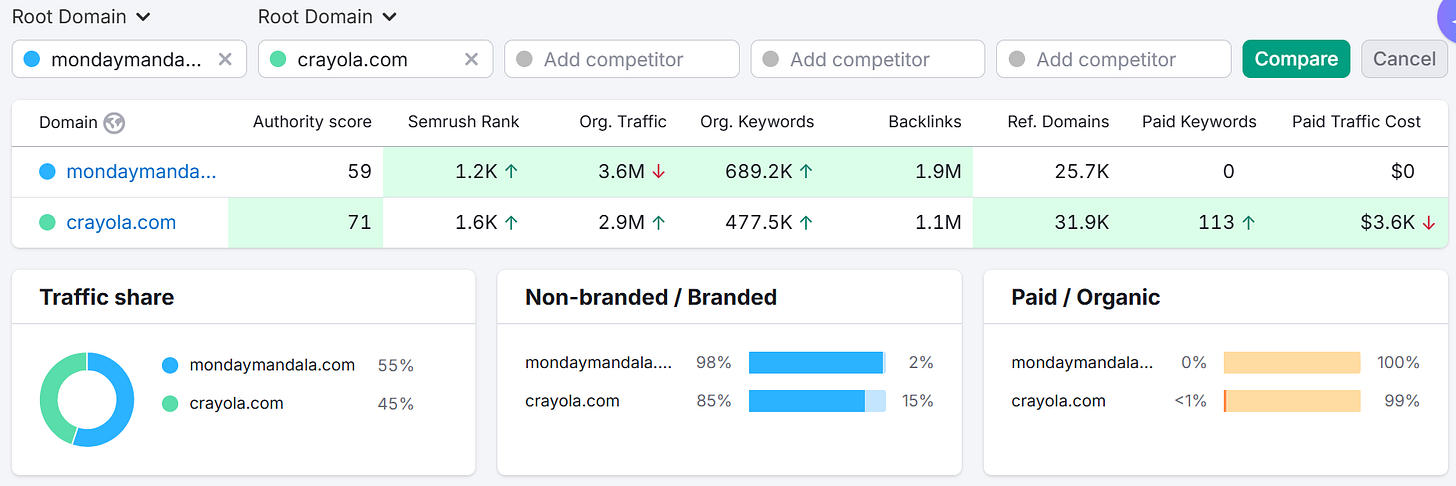
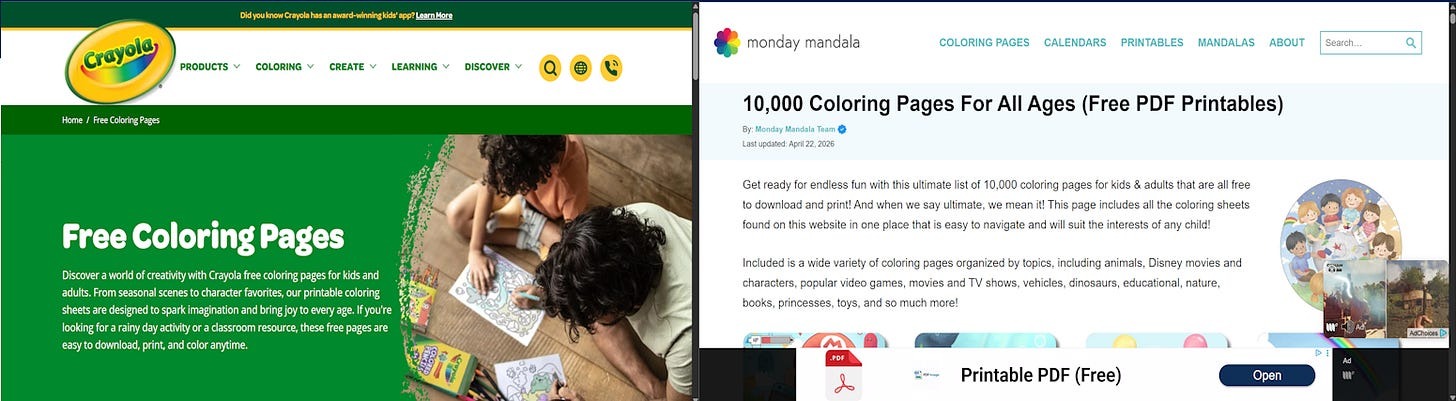
If you look at the data for coloring related searches, Monday Mandala often drives more traffic. This is because Google still values utility and usefulness. If a user wants a free coloring page, a dedicated resource site is often more useful than a corporate homepage. In the short term, utility wins the click.
But the dynamic changes the moment you move away from the search bar. If you asked ten random people to name a crayon company, nearly all of them would say Crayola. If you asked those same people to name a coloring page website, almost none would mention Monday Mandala. Traffic is a metric of visibility, but branding is a metric of memory. A useful companion note is Paid Brand Mention Problem in GEO, because it looks at a nearby part of the same system.
The expert interpretation here is that utility is a commodity. Anyone can create a useful tool or a helpful list, but that does not create a moat. The tradeoff is between immediate traffic and long term stability. If you only optimize for utility, you are at the mercy of the algorithm. If you optimize for brand, you create a demand that exists independently of the search engine. You should inspect whether your current traffic is coming from people searching for a solution or people searching for you.
A fragmented search landscape
For a long time, the path was linear. A user had a question, they typed it into Google, they clicked a link, and they landed on your site. Success was measured by the volume of those clicks and the actions taken once the user arrived. This led many business owners to believe they were entitled to a steady stream of free traffic.
The reality is that Google does not owe anyone traffic. While it is still possible to build a business based on search traffic, it is a much riskier strategy than it used to be. The search experience has fragmented. Answers are no longer confined to a single results page. They are happening in AI Overviews, ChatGPT, Perplexity, Reddit threads, and private conversations in Slack or Teams.
Users are no longer staying within a single ecosystem. They are gathering fragments of information from across the web. When the user never actually clicks through to a website because the AI provides the answer directly, the only thing that survives is the mention of a name. The website becomes a destination for validation rather than the primary source of discovery.
This matters because the traditional funnel is broken. The tradeoff is that you lose the ability to control the first touchpoint of the user journey. You can no longer rely on a landing page to do all the heavy lifting. The decision you need to make is whether you are investing in a website that acts as a trap for clicks or a brand that acts as a signal across multiple platforms.
The role of brand memory
People do not remember your title tags or your meta descriptions. They remember positive experiences, recommendations from friends, and repeated exposure to a trusted name. This is why brand has become the central answer to every executive question about AI and visibility. When a user moves between different platforms, they do not carry your URL with them, but they do carry their memory of your brand.
Reputation over metrics
Your actual reputation is what travels. This is distinct from domain authority, inbound link counts, or keyword density. It is not about your score on a third party SEO tool or your karma on Reddit. It is about the collective perception of your expertise and reliability in the real world.
The interpretation here is that we are seeing a shift from technical authority to social authority. The tradeoff is that social authority cannot be bought or hacked in a weekend. It requires consistent, high quality output over time. You should inspect your brand by searching for your company name in a private browser and seeing if the conversation around you is driven by your own marketing or by other people's genuine experiences.
Defining YBYS: Your brand is your SEO
To be clear, tactics are not dead. It is still possible to use specific methods to drive millions of organic sessions or to ride a sudden algorithm shift for a massive spike in visibility. Some businesses will continue to grow primarily through search traffic for a while. However, these wins are almost always temporary. Rankings shift and platforms evolve.
YBYS is not a movement against SEO. Instead, it is the evolution of it. Visibility is still a requirement because people need to be able to find you, but visibility without recognition is a wasted opportunity. Recognition ensures that they remember you after they leave the page. Trust ensures that they actually act on the information, and proof provides the validation they need to move past your own marketing claims.
The strategic interpretation is that tactics should be used to amplify a brand, not to replace one. The tradeoff is that brand building is slower and harder to measure than tracking keyword rankings. The decision to inspect here is your ratio of tactical work to brand work. If 90 percent of your effort is spent on loopholes and 10 percent on reputation, your business is fragile.
Existence beyond the website
Your homepage is no longer the definition of your brand. It is simply one piece of evidence that supports it. The signals that AI systems and search engines use to determine who deserves attention are now found in newsletters, LinkedIn presence, PR, podcasts, and community mentions.
These are no longer just nice to have additions to appease a bot. They are the primary ways that trust is established in a fragmented environment. When an AI model recommends a product, it is looking for a consensus of trust across the web, not just a well optimized page on a single domain.
This means your digital footprint must be wider than your own domain. The tradeoff is a loss of total control, as you cannot dictate every mention of your brand on a podcast or a forum. However, the benefit is a level of credibility that a self owned website can never achieve alone. You should inspect where your brand is being discussed when you are not the one doing the talking.
The uncomfortable truth about tools
There is a common tendency to blame tools when SEO strategies fail. People often point to programmatic SEO or AI content generators as the cause of penalties or traffic drops. But tools are rarely the problem. The problem is the intent behind their use.
AI can be used to create junk, and SEO can be used to manipulate rankings. It is possible to manufacture links and game prompts to get a short term spike in visibility. Some of these hacks will work for a while, but the shelf life of these tactics is getting shorter every year. Google is increasingly demanding actual authority, AI models are looking for memory, and consumers are demanding proof.
The companies that win in the long term are not the ones finding the next loophole in the code. They are the ones that people actually remember. Anyone can rank for a keyword if they have the right tool, but not everyone can be remembered by their customers.
The final interpretation is that the gap between ranking and being remembered is where the real value lies. The tradeoff is choosing the slow path of trust over the fast path of manipulation. The decision to inspect is simple: if your traffic disappeared tomorrow, would your customers still know how to find you?


Comments
Comments are reviewed before they are published. Links are not allowed inside comments.