Is Your Website Built to Be Cited by AI? the Audit
/ 9 min read

Summary
How to Run an AI Readiness Assessment on Your Website: A Practical Audit for Marketing Teams Structured Data’s Role In AI And AI. The practical question is what this changes for SEO, content quality, and AI search visibility.

Introduction
The key issue here is How to Run an AI Readiness Assessment on Your Website: A Practical Audit for Marketing Teams Structured Data’s Role In AI And AI Search Visibility How LLMs Interpret Content: How To Structure Information For AI Search Case Study: How Entity Linking Can. My read is to treat it as a decision point: what signal needs to become clearer, what part of the system is currently weak, and what evidence would show that the work is improving visibility rather than only adding activity. A useful companion note is What AI Says About Your Locations, because it looks at a nearby part of the same system. The same pattern also shows up in X Robots Tag, where the practical question is how the signal becomes visible.




That is the difference between reacting to a trend and building a useful search system. Connect this point back to the page template, internal linking, entity signals, content depth, crawl accessibility, and the way the brand is represented across the wider web before deciding what to change first.
We spend a lot of time talking about how to use AI to write faster. We spend almost no time talking about whether the AI can actually read what we wrote. There is a massive difference between using a generative tool to produce a blog post and ensuring that a tool like Perplexity, ChatGPT, or Google AI Overviews can actually find that post, understand its meaning, and cite it as a source.
Most of the current AI conversation is about production. But for those of us managing websites, the real challenge is structural. If your site is not built for machine readability, you are essentially invisible to the systems that are now mediating how users find information. This connects with to Get Cited & Stay Visible when the same signal needs a clearer operating decision.
Running an AI Readiness Assessment
Many marketing teams think they are AI ready because they have integrated a few LLMs into their content workflow. While automating a few tasks is helpful, it does not solve the fundamental problem of discoverability. An AI readiness assessment is not about your internal tools, but about the external accessibility of your data.
The goal is to determine if AI tools can extract your content and cite it with confidence. This requires looking at three specific pillars: schema markup, the way content is structured in your CMS, and the strength of your internal linking.
Expert Interpretation: This matters because AI search is not just about keywords, it is about confidence. If a model has to guess what your page is about, it will likely skip you in favor of a source that provides explicit, structured facts. The tradeoff here is between the speed of publishing and the effort of structuring. The decision you need to make is whether to keep pushing out high volumes of unstructured content or to slow down and fix the foundation so that content actually gets cited.
The Common Myth of AI Readiness
The biggest misconception is that AI readiness is an authoring problem. Teams spend thousands on editorial automation and translation workflows, which certainly help the people inside the company. However, they overlook the external side of the equation.
If the content produced by these fancy tools is published into a system with no structured data, the AI tools crawling the web still have to guess the meaning of the page. More than half of all websites lack structured data entirely. When high value content is trapped in a single rich text field without labels, it becomes a probabilistic guess for the AI rather than a verifiable fact.
Auditing Your Schema Markup
Schema markup is the bridge between what your content says and what it actually means. Consider the difference between a sentence that says "Dr. Sarah Chen, Director of Admissions" and a piece of code that explicitly labels that string as a Person with a specific job title and a verified profile link.
The first version is just text. The second version is a fact. When AI systems encounter schema, they do not have to fill in the blanks using probability, which reduces the risk of them ignoring your page. Google has been explicit about the importance of structured data for AI search, which is a clear signal for any site owner.
How to Verify Your Current Schema
You do not need to be a developer to check this. You can use Screaming Frog to crawl your site and flag which pages contain structured data. For a quick check on a single page, Google's Rich Results Test is effective, and the schema.org validator is useful for deeper debugging.
I suggest starting with your most important pages, such as the homepage, core service pages, and your highest traffic articles. If these are empty, you have a significant gap in your AI visibility.
The Essential Schema Foundation
You do not need every possible schema type, but a few are non negotiable. Author attribution is particularly critical. AI models look for credentials, professional associations, and linked profiles to decide if a source is trustworthy enough to cite. Treating Person markup as a foundation rather than an afterthought is a practical way to build that trust.
Expert Interpretation: Schema is the lowest hanging fruit in this audit. It is relatively cheap to implement and can be done in a single sprint. The tradeoff is that schema alone is not a magic bullet, but the decision to ignore it is a decision to let AI guess your identity.
Structured Content vs. Trapped Content
Many sites suffer from the "blob body field" problem. This happens when a page is built inside a CMS using one giant rich text editor. From the hero headline to the final call to action, everything is in one field.
To an AI model, this looks like one undifferentiated mass of HTML. It becomes very difficult for the system to distinguish between pricing, prerequisites, or outcomes because there are no labels separating these elements.
The Anatomy of Structured Content
Structured content breaks a page into labeled fields. Instead of one big box, a program page would have separate fields for the title, the cost, the duration, and the instructor. Each field is a distinct piece of information that an AI tool can pull independently.
This does more than just help AI. It makes the site more flexible across different channels and allows editors to work faster because they are filling in specific fields rather than fighting with a visual editor.
Identifying "Blob" Pages
The easiest way to spot this is to open your top five traffic pages in your CMS. If you see one massive WYSIWYG field containing the entire page, you have a blob. If you see multiple labeled fields with specific purposes, you have structured content. Counting the ratio of blob pages to structured pages on your high value content is a great starting point for an audit.
Expert Interpretation: This is where the real technical debt lives. The tradeoff is that moving to structured content requires a change in how you model your data in the CMS, which is more time consuming than adding schema. However, the decision to move toward structured fields is what separates a basic website from a machine readable data source.
Mapping Entity Relationships
Internal linking is no longer just about SEO, it is about teaching AI the relationship between entities. AI tools build a map of your brand by crawling how pages connect. A strong structure tells the model that a specific program connects to specific courses, which in turn connect to specific faculty members.
If your internal links are weak or fragmented, the AI sees a collection of isolated pages rather than a cohesive story. This is common in enterprise sites where taxonomies are inconsistent or links are broken.
Auditing Your Entity Map
Pick your most important entity, such as a flagship product or service, and map every page that should connect to it. Check if those links actually exist and if the anchor text is natural. Avoid generic phrases like "click here" and instead use language that describes the relationship.
For example, a graduate program page should link to its courses, those courses should link to the instructors, and the instructors should link back to the program. This creates a closed loop of information that an AI can easily parse.
Creating a Realistic Implementation Roadmap
Trying to fix everything at once usually leads to nothing getting finished. A phased approach is more sustainable.
In the first 30 days, focus on the basics. Implement schema on your homepage and top ten pages, audit your three highest intent pages for the blob problem, and set up GA4 tracking for AI referral traffic to establish a baseline.
In the next 90 days, move toward structural improvements. This involves restructuring content models for your most important types and building out the entity relationships you mapped earlier.
The Role of CMS Choice
While these principles apply to any platform, some are better suited for this work. Drupal, for instance, is built for this kind of complexity. It supports structured fields, entity references, and Schema.org integrations out of the box. Modules like Schema Metatag can automate much of the structured data work, making it easier to organize content in a way that AI systems can actually use.
The Technical Layer of AI Visibility
The industry is moving toward a world where structured data defines the data layer for AI. Concepts like the Model Context Protocol are emerging to help LLMs better understand digital content. When you treat structured data as an enterprise strategy, you are essentially building a machine readable layer that allows AI to determine the context and authority of your brand.
LLMs interpret web content by looking for specific patterns. They prefer logical heading hierarchies, short and self contained paragraphs, and predictable formats like tables and lists. They also look for semantic cues and a lack of "noise" or irrelevant filler text. Frontloading key insights helps the model identify the value of the page quickly.
Research into retrieval shows that if content is not structured for meaning, it often fails to show up in AI results, even if the information is present on the page. This is why structure matters more than the actual word count.
Case Study: Local SEO and Entity Linking
A practical example of this is Brightview, which had to scale hyperlocal SEO across more than 47 communities. The challenge was ensuring that AI and search engines could distinguish between different locations and services without confusion.
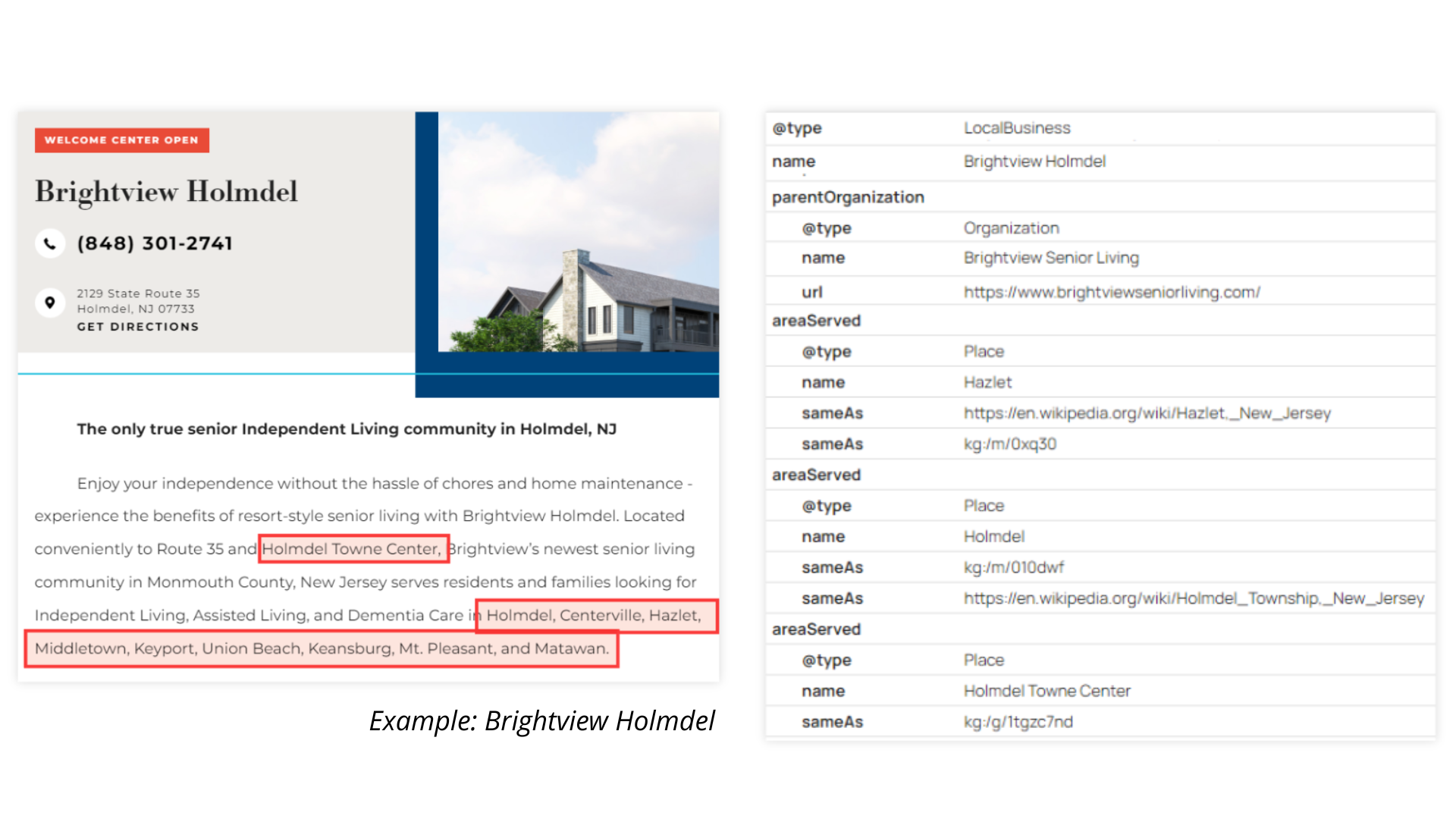
The solution was a combination of place based and topical entity linking. They focused on three areas: disambiguating place names so the AI knew exactly which community was being discussed, mapping key services as distinct entities, and scaling this linking across all content types.
The result was a significant increase in non branded search performance and higher discoverability for community pages. Even as general industry click through rates declined, their CTR remained stable because the search interpretation was more accurate.
To apply this strategically, you should first identify the entities that define your authority. Then, build a connected content knowledge graph. If you have multiple physical locations, prioritize place based entity linking to ensure AI does not confuse your branches.
Comments
Comments are reviewed before they are published. Links are not allowed inside comments.