Microsoft Is Showing Where AI Search Indexes Are Headed
/ 7 min read
Summary
A practical view on Microsoft Is Showing Where AI Search Indexes Are Headed, focused on the signal to inspect, the risk to avoid, and the decision it should change.
The Search Index Is Evolving
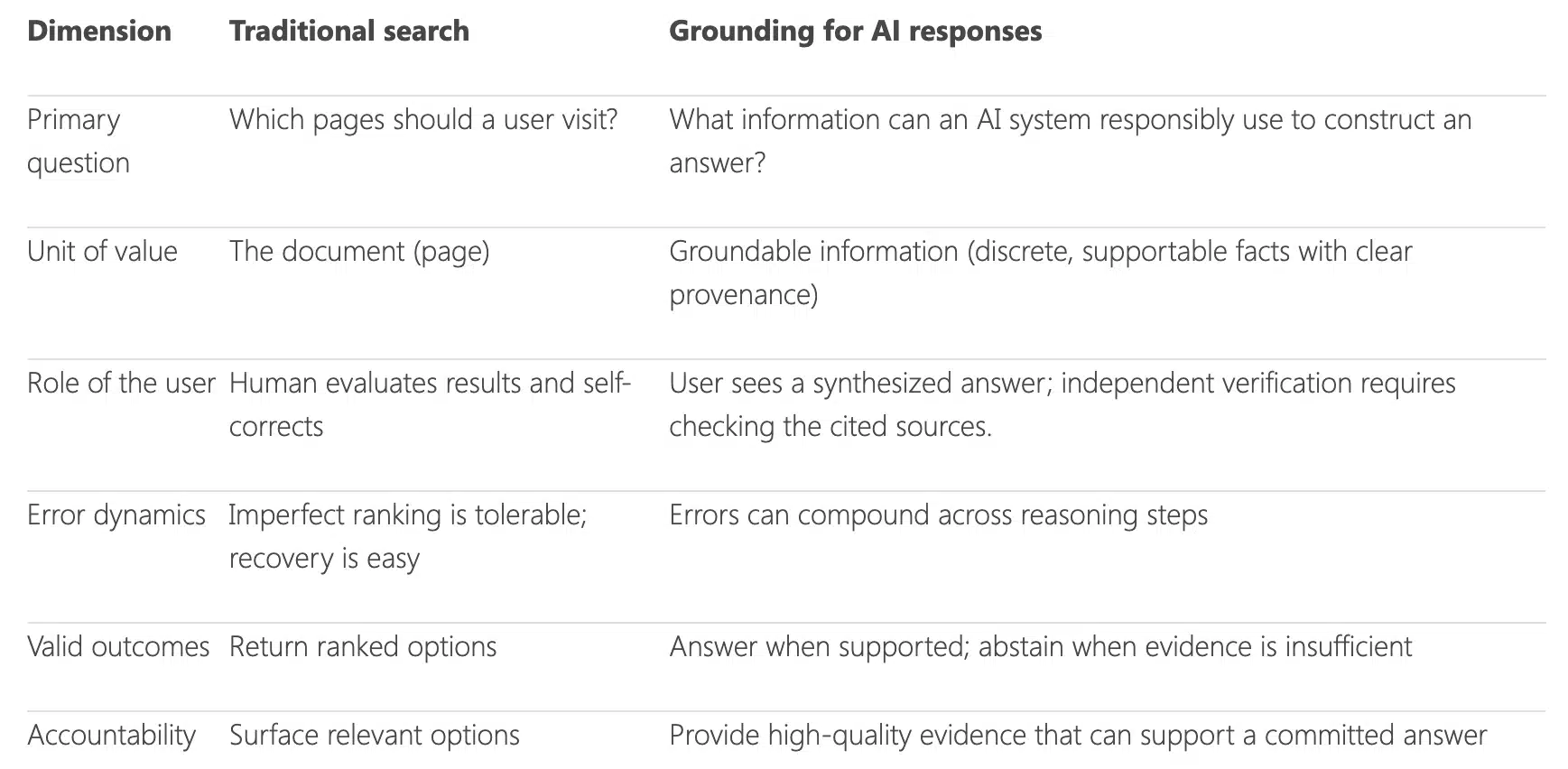
Microsoft Bing traditional search vs. grounding systems Credit: original article.Traditional search vs groundingfor AI responses Credit: original article.
The search index is no longer just a tool for ranking web pages, it’s becoming the backbone of AI generated answers. In a recent technical blog post, Microsoft Bing outlined how their search infrastructure is shifting from traditional ranking models to a new system designed to support AI’s ability to generate confident, evidence based responses. This evolution isn’t just about improving search results; it’s about redefining how information is stored, accessed, and validated in the age of AI. For years, search engines have relied on algorithms to determine which pages to rank highest based on relevance, keywords, and user intent. But as AI models like Bing Chat and other generative systems become more integrated into search, the need for a different kind of index has become clear. Traditional search engines prioritize relevance, but AI systems require a deeper level of trust in the data they use to form answers. This shift has significant implications for SEO professionals, content creators, and anyone who relies on search to find accurate information.
Traditional Search vs. Grounding Systems
The core difference between traditional search and the new grounding systems lies in how they handle information. Traditional search engines operate on a model where users are expected to scan results, evaluate sources, and decide what to trust. This model works well for general information retrieval, but it has limitations when it comes to AI generated answers. AI systems don’t have the capacity to evaluate sources in real time, they need to be trained on data that’s already vetted for accuracy and reliability. Microsoft’s blog post highlights that grounding systems are built around supportable facts with clear sourcing. This means the index must not only store information but also track its origins, verify its accuracy, and ensure it’s up to date. For example, if an AI is asked, "What’s the current population of Tokyo?" it needs to pull data from a source that’s both recent and authoritative. Traditional search might return a list of pages with varying numbers, but a grounding system would prioritize the most reliable source and flag outdated or conflicting data. This shift toward grounding systems is a response to the inherent risks of AI generated answers. If an AI model is trained on a dataset that includes outdated or incorrect information, it could propagate errors. Grounding systems mitigate this by ensuring that the data used to form answers is not only accurate but also traceable. This is a critical step in building trust in AI driven search results, especially as these systems become more prevalent in everyday use.
The Role of Accuracy and Sourcing
One of the most significant changes in Microsoft’s approach is the emphasis on accuracy and sourcing. Traditional search engines optimize for relevance, which means they prioritize content that matches a user’s query, even if the information isn’t fully verified. Grounding systems, on the other hand, must assess whether the information is accurate, up to date, clearly sourced, and sufficient to support an answer. This means the search index needs to account for several factors: whether a page’s meaning survives chunking and transformation (i.e., can the content be broken down into smaller pieces without losing its original intent?), whether the information is fresh enough to use, and whether important facts are actually retrievable and groundable. For example, if a user asks for the latest data on climate change, the index must ensure that the sources used are recent, peer reviewed, and accessible. If the data is stale or the sources are unclear, the AI’s answer could be misleading. Microsoft’s blog post also highlights the importance of detecting disagreements between sources before generating an answer. In traditional search, users might encounter conflicting information, but they’re expected to resolve it themselves. With AI, the system must do this automatically. This requires the index to not only store information but also analyze its credibility and consistency across multiple sources. This level of scrutiny matters for ensuring that AI generated answers are both accurate and trustworthy.
Stale Content and Its Risks
Another key aspect of Microsoft’s new indexing approach is the handling of stale content. In traditional search, stale content might lower a page’s ranking, but it doesn’t necessarily prevent it from appearing in results. With AI, however, stale content poses a different risk: it can lead to incorrect or outdated answers. For example, if an AI is trained on data that includes a 2015 study about a medical treatment, it might provide advice that’s no longer valid. This is why grounding systems must prioritize freshness and relevance. Microsoft explains that stale content creates a unique challenge for AI search. Unlike traditional search, where users can scan results and choose the most up to date information, AI systems must rely on the data they’re trained on. If the training data is outdated, the answers could be misleading. This means that the search index must not only track the accuracy of information but also its timeliness. Pages that are no longer relevant or have been superseded by newer data should be flagged or excluded from the index altogether. This focus on freshness has implications for content creators and SEO professionals. It means that content must be regularly updated to remain relevant in AI driven search results. Static, outdated content is less likely to be used by AI systems, which could reduce its visibility in search results. This shift underscores the importance of maintaining up to date, high quality content that aligns with the evolving needs of AI search.
Implications for SEO and Content Strategy
The evolution of search indexes toward grounding systems has significant implications for SEO strategies and content creation. First and foremost, it reinforces the importance of authoritative, well sourced content. SEO professionals must prioritize creating content that is not only relevant but also backed by credible sources. This means incorporating citations, linking to peer reviewed studies, and ensuring that all claims are verifiable. Second, the focus on freshness means that content must be regularly updated. This could involve setting up content calendars, monitoring industry trends, and revisiting older content to ensure it remains accurate and relevant. For example, a blog post about SEO best practices from 2020 might still be useful, but it could be outpaced by newer strategies and tools. Regular updates can help maintain the content’s visibility in AI driven search results. Third, the emphasis on accuracy and sourcing suggests that content creators should be more transparent about their sources. This could involve including footnotes, references, or links to primary sources. By doing so, content becomes more trustworthy and aligns with the requirements of grounding systems. This transparency not only improves search visibility but also builds trust with users who rely on AI generated answers. Finally, the shift toward grounding systems highlights the need for content that is structured and easily retrievable. AI systems require data that can be broken down into smaller, manageable pieces without losing its original meaning. This means that content should be organized in a way that allows for clear, concise information retrieval. For example, using clear headings, bullet points, and structured data can make it easier for AI systems to extract and use relevant information.
Conclusion
Microsoft’s move toward grounding systems for AI search represents a fundamental shift in how information is indexed, stored, and validated. This evolution is driven by the need for AI generated answers to be accurate, up to date, and trustworthy. For SEO professionals and content creators, this means rethinking traditional strategies to align with the requirements of grounding systems. By prioritizing authoritative sources, maintaining content freshness, and ensuring transparency, we can position our content to thrive in the new era of AI driven search. As AI continues to integrate into search, the role of the search index will only become more critical. The shift from traditional ranking models to grounding systems is not just a technical update, it’s a redefinition of how we approach information retrieval in the digital age. By understanding and adapting to these changes, we can ensure that our content remains relevant, accurate, and valuable in the evolving landscape of search.
A practical view on Core Updates and AI Links Are Changing SEO Signals, focused on the signal to inspect, the risk to avoid, and the decision it should change.
A practical view on The GEO Metrics That Make AI Visibility Measurable, focused on the signal to inspect, the risk to avoid, and the decision it should change.
A practical view on Brand Authority Is Outgrowing Topical Coverage, focused on the signal to inspect, the risk to avoid, and the decision it should change.
A practical view on Managing AI Crawlers Without Blocking Real Opportunity, focused on the signal to inspect, the risk to avoid, and the decision it should change.
Comments
Comments are reviewed before they are published. Links are not allowed inside comments.



Comments
Comments are reviewed before they are published. Links are not allowed inside comments.