The Delegation Boundary Is the New Brand Selection Layer
/ 8 min read

Summary
Underneath the three mechanisms sits the same commercial truth that's been the point of search since Sergey Brin first. The practical question is what this changes for SEO, content quality, and AI search visibility.
For a long time, the relationship between a customer and a brand was mediated by a list of links. We typed a query, scanned a page, and made a conscious choice to click. But that dynamic is shifting. We are moving away from a world of "searching" and into a world of "delegating."
This matters because the moment a user stops searching and starts delegating, the criteria for which brand "wins" changes entirely. It is no longer just about visibility or keywords; it is about whether an AI engine has enough confidence in your brand to recommend it, or even transact on your behalf, without the user ever seeing a list of alternatives.
The ten gates of the AI pipeline
To understand how a brand actually wins in this new environment, it helps to look at the process as a pipeline of ten distinct gates. If you fail at any of these, you don't make it to the end. This connects with pipeline gates when the same signal needs a clearer operating decision.
The first five are what I would call the infrastructure gates: discovered, selected, crawled, rendered, and indexed. These are the technical prerequisites. If the bot can't find your page or render the content, you simply aren't legible to the machine. These are necessary, but they aren't where the competition happens.
The next four are the competitive gates: annotated, recruited, grounded, and displayed. This is where the algorithm actually evaluates your brand. It's deciding if your information is structured correctly, if you are a relevant candidate for the query, and if the facts are grounded in reality. This is the filter that determines if you are even an option for the buyer.
Finally, there is the tenth gate: Won. This is the only gate that actually generates value. "Winning" used to be simple, it was the click. A human looked at ten blue links and picked one. Today, "Won" has evolved. It could still be a click, but it could also be an assistive engine naming your brand as the best choice, or an AI agent completing a transaction on the user's behalf. The definition of victory has expanded, and the stakes have become much higher.
What hasn't changed: The point of search
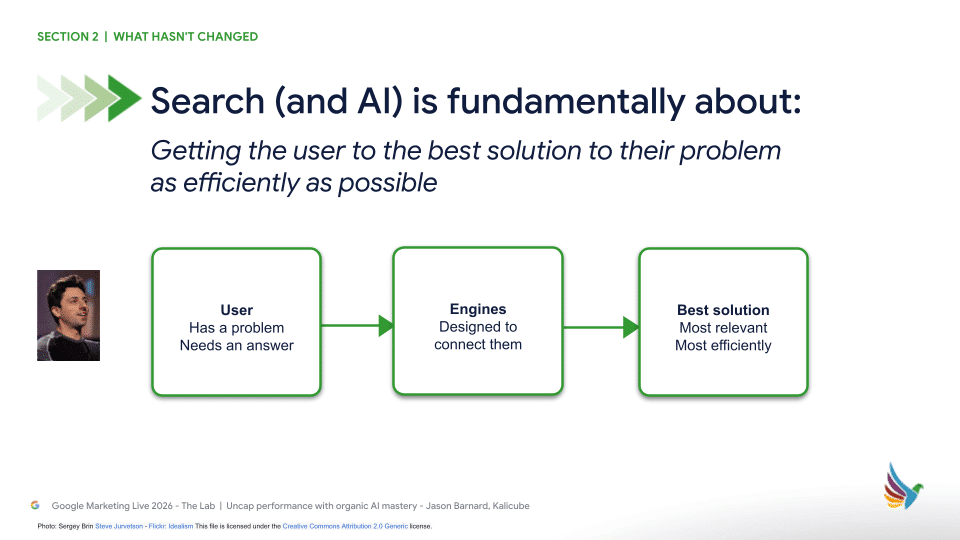
Despite the shift toward AI, the fundamental goal of search remains the same. Whether it's a 1990s directory or a 2026 AI agent, the objective is to get the user to the best possible solution for their problem with the least amount of friction.
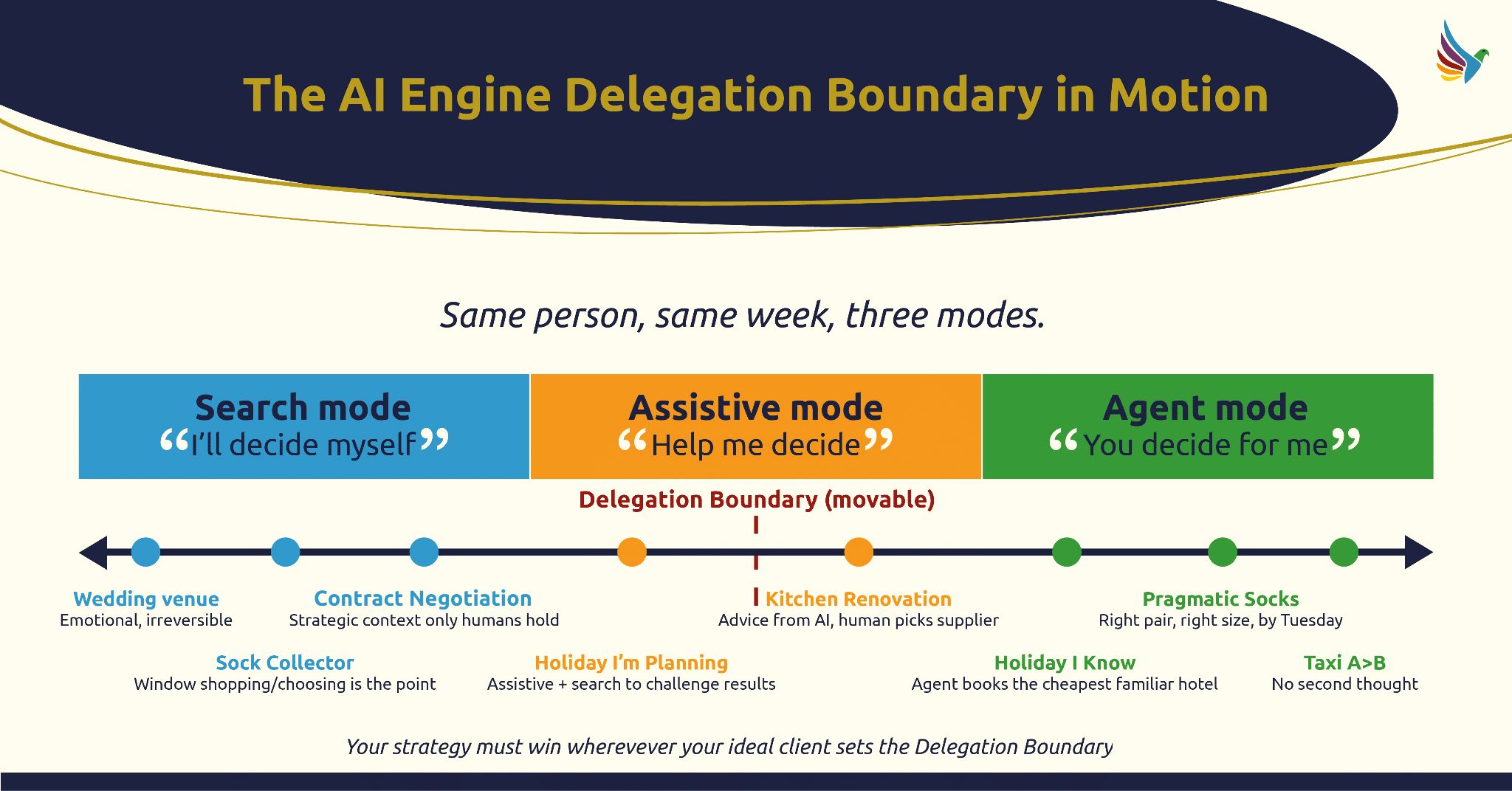
AI doesn't change this goal; it just accelerates the process. The "delegation boundary" is the line that separates what a user chooses to do themselves and what they hand over to the machine. When a user pushes that boundary toward the AI, the friction disappears. A journey that used to take a week of research, reading reviews, and comparing tabs can now be compressed into a few minutes of conversation.
From problem to purchase in 15 minutes
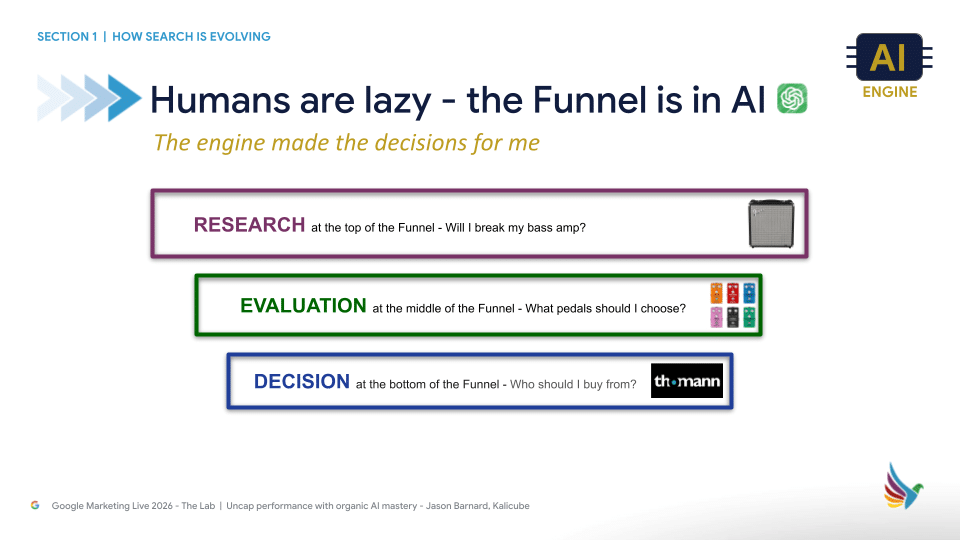
To see this in practice, consider a real world scenario. Imagine someone who is a professional double bass player but owns an old guitar they rarely play. They get a sudden opportunity for a solo gig and realize they have a guitar but no guitar amp. They don't want to spend a lot of money on a dedicated amp for one night, so they wonder if they can just use their bass amp.
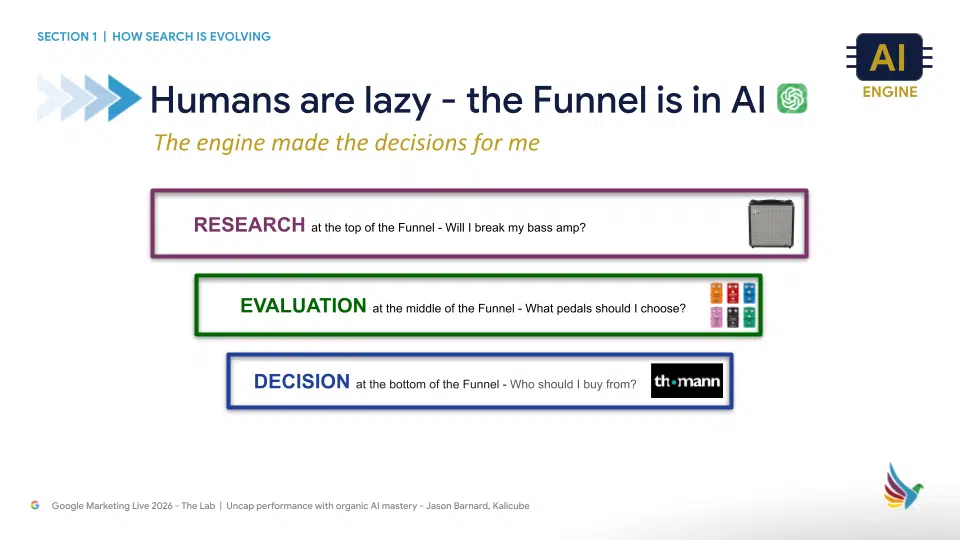
In a traditional search world, this would involve several queries: "Can I use a bass amp for guitar?", "Best cheap guitar pedals for bass amps," and "Where to buy guitar pedals with fast shipping."
With an AI like ChatGPT, the process is a streamlined conversation. The user asks if it's safe to use the bass amp; the AI confirms it won't break the equipment but warns that the sound will be poor. The AI then suggests three specific pedals, reverb, compression, and equalization, to fix the tone. When the user mentions they are a singer and want something cheap, the AI narrows the price point to $125. Finally, when the user specifies a hard deadline for Friday delivery, the AI recommends specific retailers like Thomann in Europe or Sweetwater in the US.
In this instance, the delegation boundary was pushed almost entirely to the AI. The engine handled the technical validation, the product shortlisting, the pricing filter, and the logistics check. The user didn't "search" in the traditional sense; they delegated the research and only stepped back in to make the final decision.
The death of the single mode assumption
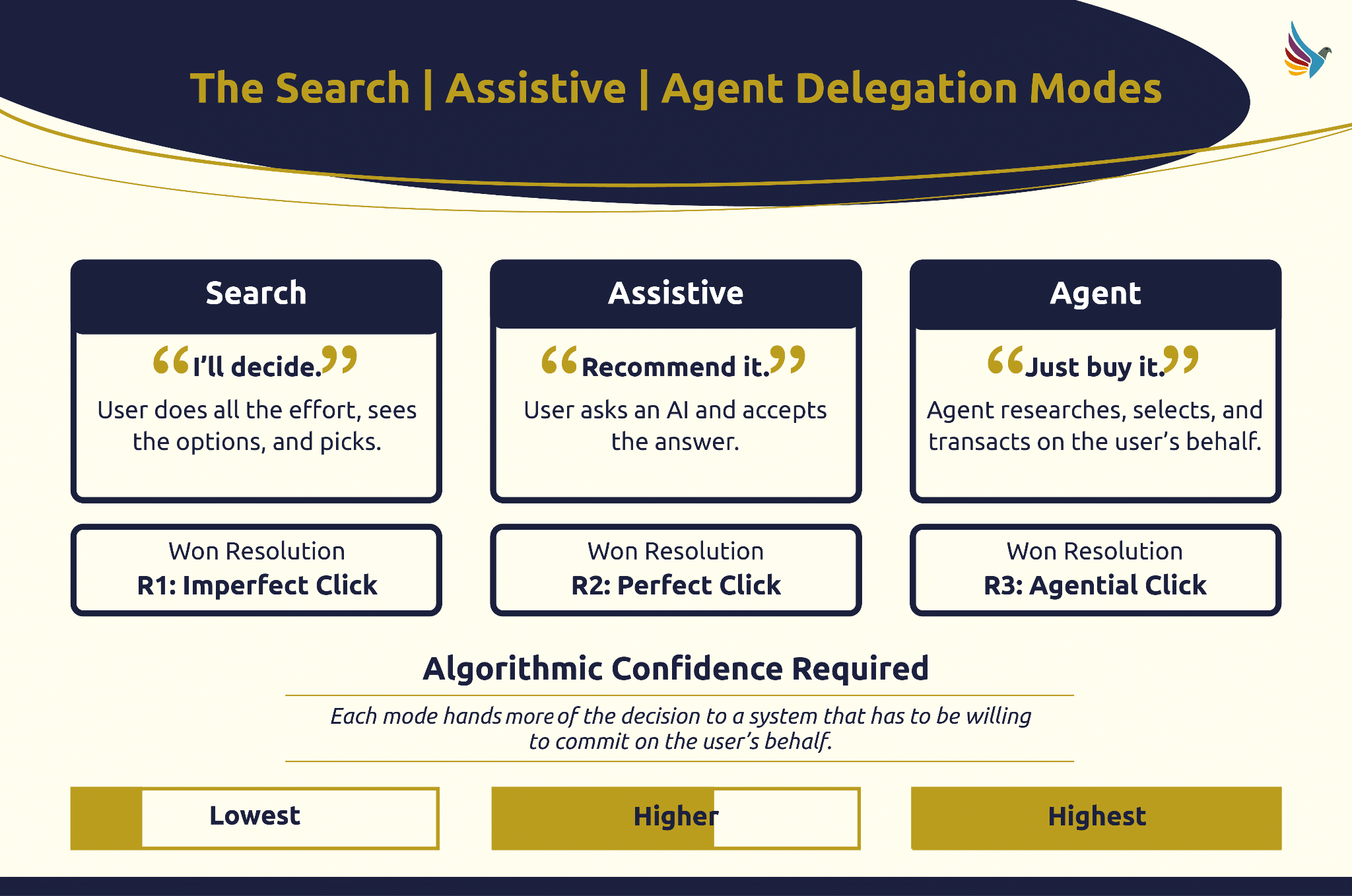
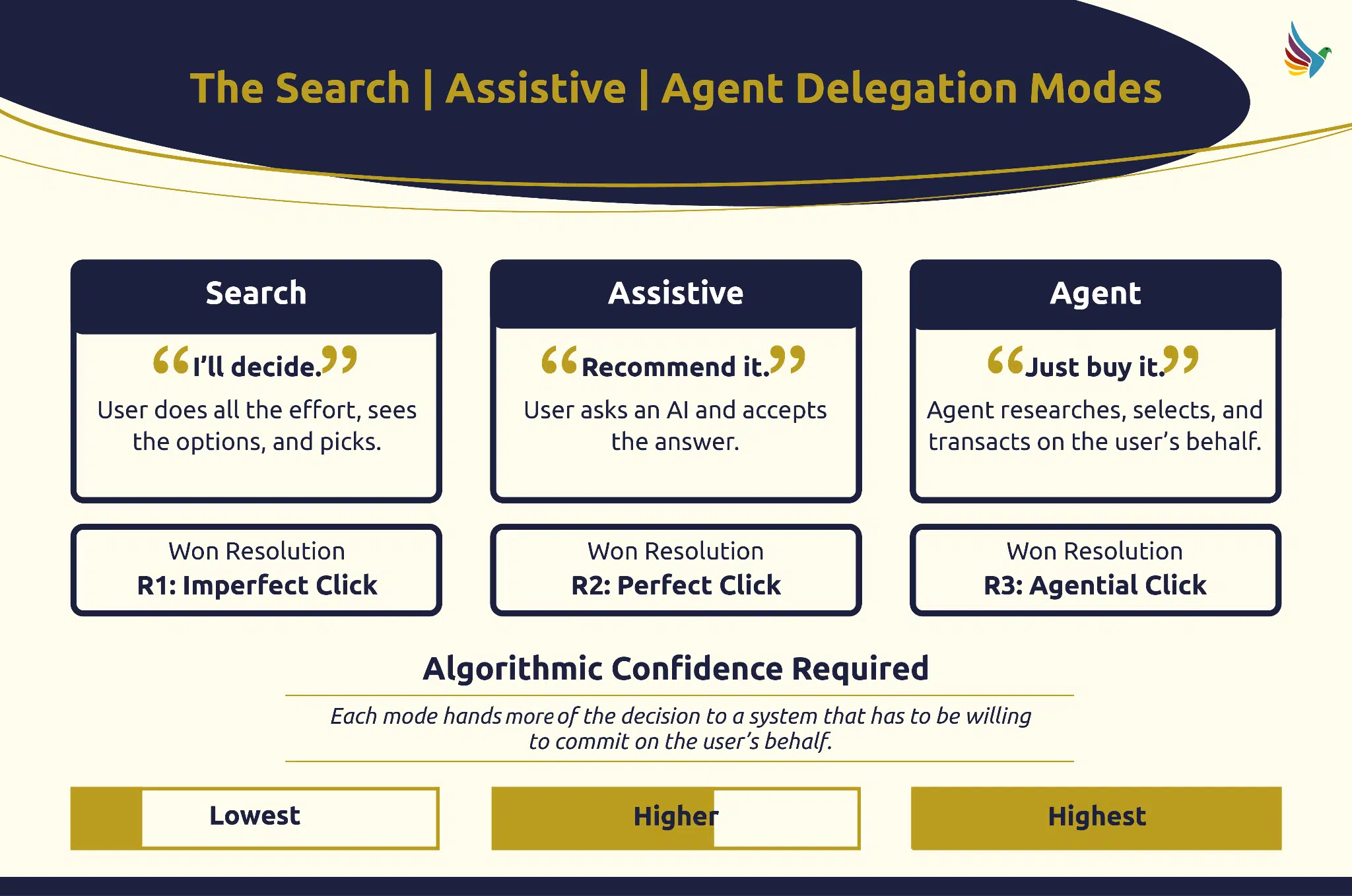
For two decades, the industry operated under a "single mode" assumption: optimize for search, get into the top ten results, and win the click. That approach is no longer sufficient because we now have three distinct modes coexisting in parallel: Search, Assistive, and Agential.
Search is the mode we know best. It is the most forgiving because the human is still doing the sorting. If a brand is a bit "fuzzy" or unclear, the user can usually figure it out through their own exploration.
Assistive mode is less forgiving. Here, the AI is making a direct recommendation. Because the AI's own credibility is on the line, it is much more selective about which brands it names. It won't recommend a brand it isn't sure about. A useful companion note is Which Brands Are Vanishing from AI Search?, because it looks at a nearby part of the same system. The same pattern also shows up in AI Recommendation Sets Leave Some Brands Out, where the practical question is how the signal becomes visible.
Agential mode is the most stringent. In this mode, the AI doesn't just recommend; it transacts. It might book the hotel or buy the product without the user intervening in the middle. In this scenario, there is zero tolerance for ambiguity. An agent will not risk a transaction on a brand that lacks absolute clarity and confidence in the system.
The fluidity of the delegation boundary
The delegation boundary isn't a fixed line; it moves based on the person, the culture, and the specific purchase. A single person might move across all three modes in a single week.
They might delegate a routine coffee order to an agent without a second thought. However, if they are planning a kitchen renovation, they might use an assistive engine to get advice and ideas, but they will almost certainly handle the final supplier selection themselves. Then, they might spend an hour manually window shopping for a piece of jewelry, enjoying the process of discovery.
The boundary is determined by the nature of the decision. A wedding venue, for example, sits firmly in the "Search" mode. The decision is emotional, high stakes, and irreversible. Most people would be uncomfortable delegating that choice to an AI.
Seven factors that define the boundary
If you want to know where your brand sits on the delegation spectrum, you can score your category against these seven factors:
Emotional Weight: Does the purchase touch on identity, family, or core values? The higher the emotion, the harder it is to delegate. Domain Expertise: Is the decision highly specialized? Users either delegate fully because they are clueless, or refuse to delegate because they believe they are experts. Price Relative to Income: A $5 latte is easy to delegate; a $30,000 car is not. Purchase Frequency: Habitual, repeat purchases are delegated readily. One off, rare purchases require scrutiny. Reversibility: Can the product be easily returned? Returnable goods are safer to delegate than non refundable services. Regulatory Context: Decisions involving medical, legal, or financial regulations often have a higher barrier to delegation due to risk. Urgency: The more urgent the need, the more likely a user is to delegate the search to find the fastest solution.
The user delegates, the engine commits
It is important to realize that the AI isn't simply taking over. The process is a tandem effort. Nothing happens without a mandate from the user. The user pushes the boundary by handing the engine a specific task, and the engine then acts within that mandate.
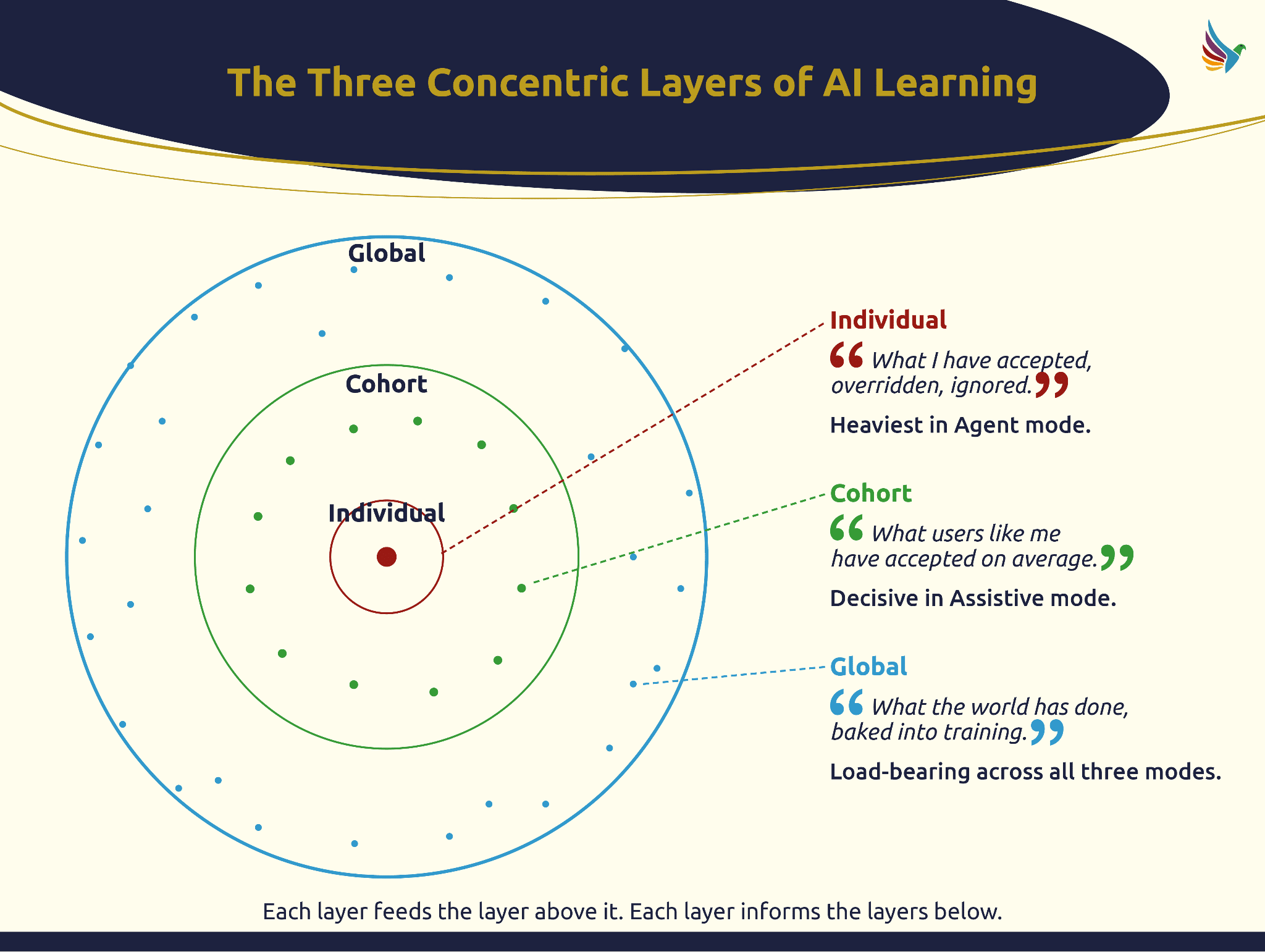
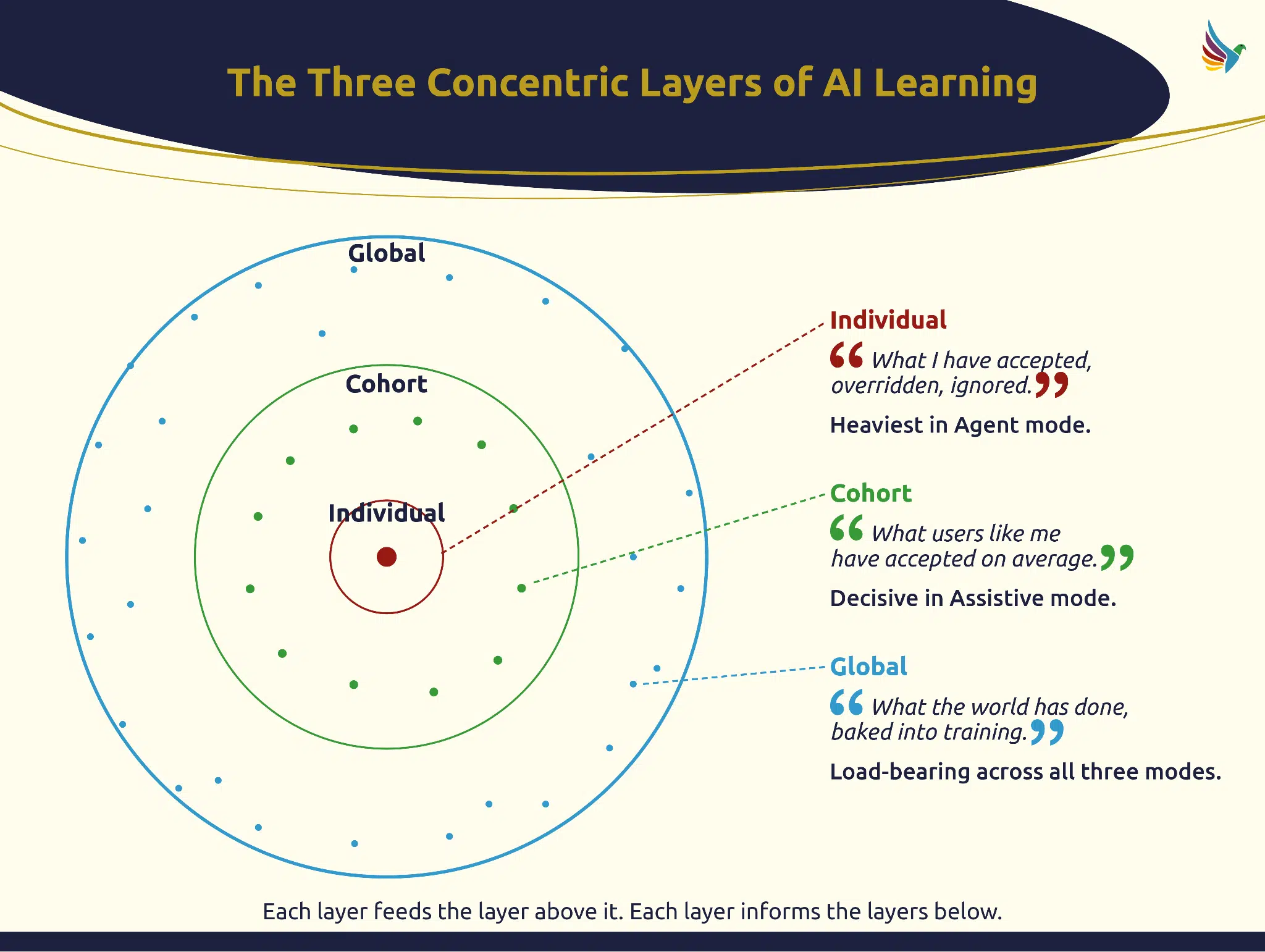
When we use search, we delegate the task of finding the ten best links. When we use an agent, we delegate the task of the outcome. In every case, delegation forces the engine to make a commitment. The engine must commit to a specific set of results or a specific brand to fulfill the user's mandate.
Breaking the cycle of incumbency
One might worry that AI engines will simply recommend the biggest, most established brands forever, creating a closed loop where incumbents always win. Fortunately, that isn't how these systems work.
While the "global priors", the general knowledge the AI has learned, are heavy, they aren't absolute. A challenger brand can break into the recommendation set by establishing a stronger, more specific claim than the incumbent. By influencing the cohort and global layers of the AI's knowledge, a smaller brand can move from being "indexed" to being "recruited" and eventually "won."
Confidence is the ultimate differentiator
At the end of the pipeline, the deciding factor is confidence. The algorithm asks: "How confident am I in this brand at this exact moment?"
Many brands focus on content and context. Content is what you publish; context is how well that content matches the user's intent. In the current landscape, these are table stakes. Every serious digital marketer has been focusing on content since the 90s. Neither content nor context alone is enough to win the "Won" gate.
Confidence is different. Confidence is the aggregate of trust, consistency, and grounding. It is the reason an AI feels safe recommending you over a competitor.
Training your AI employees
To win in this environment, you have to stop thinking about "SEO" and start thinking about "AI representation."
The practical path forward is to map your intent cohorts and score them against the seven factors mentioned above. Determine which mode (Search, Assistive, or Agent) each cohort is likely to use for different decisions. Once you have that map, you can treat the major AI engines, Google, ChatGPT, Perplexity, Claude, Copilot, Siri, and Alexa, as a distributed workforce.
These are essentially your AI employees. They are already working 24/7, and they are already talking to your customers. The only question is whether they have been "trained" with the accurate facts, positive sentiment, and consistent narrative required to recommend you. An untrained AI employee is a liability; a trained one is a revenue generator.
Comments
Comments are reviewed before they are published. Links are not allowed inside comments.