The Micro macro Shift: How to Measure AI Visibility Now That Precision Is Gone
/ 9 min read

Summary
The same economics versus economics distinction I drew earlier applies here: corner shop versus Bank of England, micro. The practical question is what this changes for SEO, content quality, and AI search visibility.
Introduction
The key issue here is The funnel query pathway (FQP), the cohort with intent tree you populate from the conversion node upward, is the measurement framework for AI visibility. Measuring the FQP every quarter produces a defensible strategic read you can actually act on. The shift. My read is to treat it as a decision point: what signal needs to become clearer, what part of the system is currently weak, and what evidence would show that the work is improving visibility rather than only adding activity. A useful companion note is Practical Way to Measure AI Search Visibility, because it looks at a nearby part of the same system.
That is the difference between reacting to a trend and building a useful search system. Connect this point back to the page template, internal linking, entity signals, content depth, crawl accessibility, and the way the brand is represented across the wider web before deciding what to change first.
For years, the comfort of search marketing came from the dashboard. We could track a keyword, watch a position move from seven to three, and feel a direct sense of control over our visibility. But that precision has vanished in the era of generative AI. When an LLM synthesizes an answer, there is no single rank to track, and often, there is no click to measure.
This shift is unsettling because it forces us to move from a micro view of the world to a macro one. To survive this, we need a new framework. I look at the Funnel Query Pathway, or FQP, as the primary way to handle this. It is essentially a tree of intent that you build from the point of conversion upward. By measuring this pathway every quarter, you get a strategic read that is actually useful, rather than a daily report of noise that you cannot act on.
Why the precision we once relied on has disappeared
The loss of precision is not a failure of our tools, but a change in the environment. It is similar to the difference between managing a small corner shop and analyzing the Bank of England. One is about micro instruments and immediate transactions, while the other requires macro instinct and systemic observation. Neither set of tools works in the other's world.
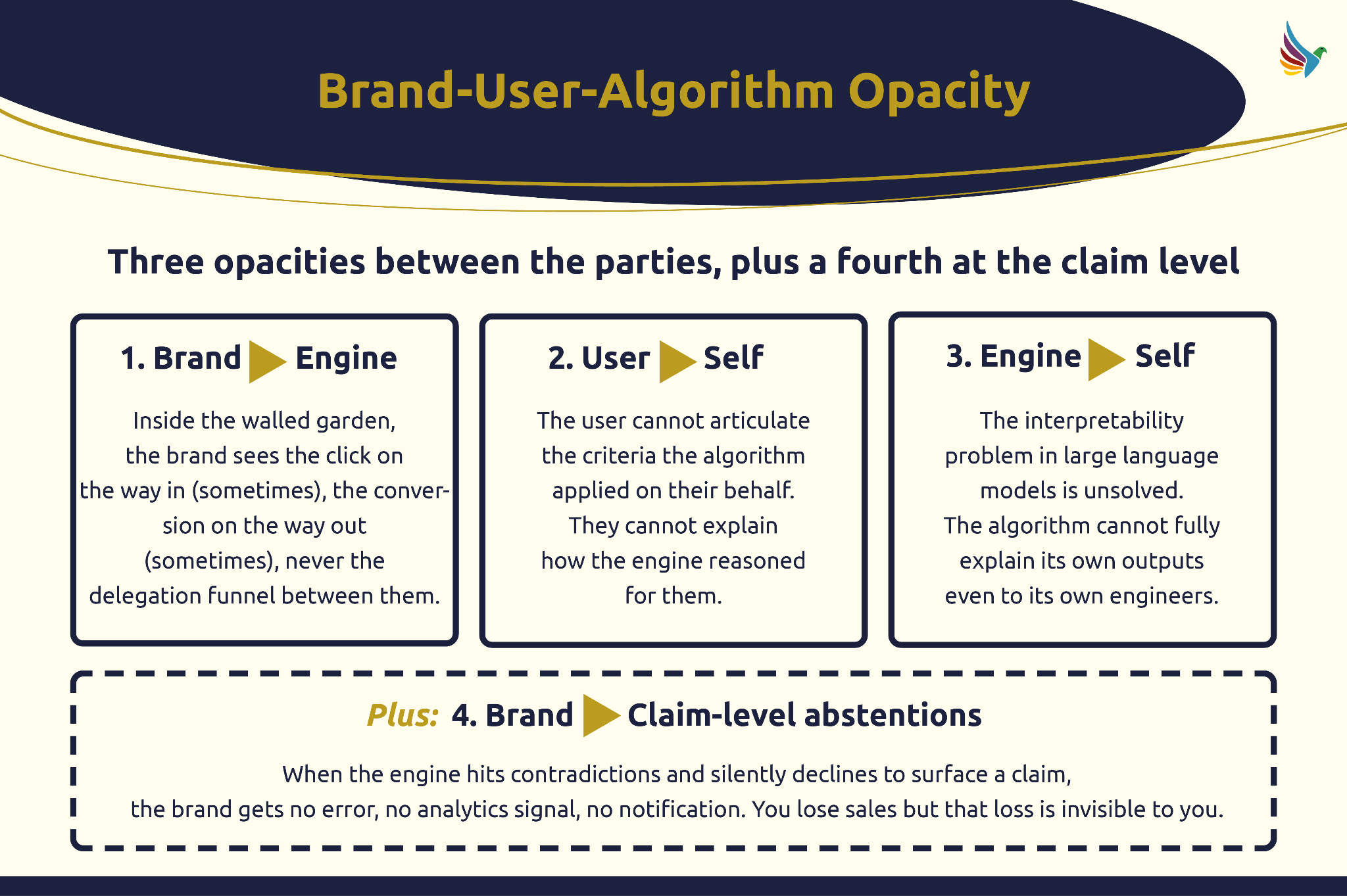
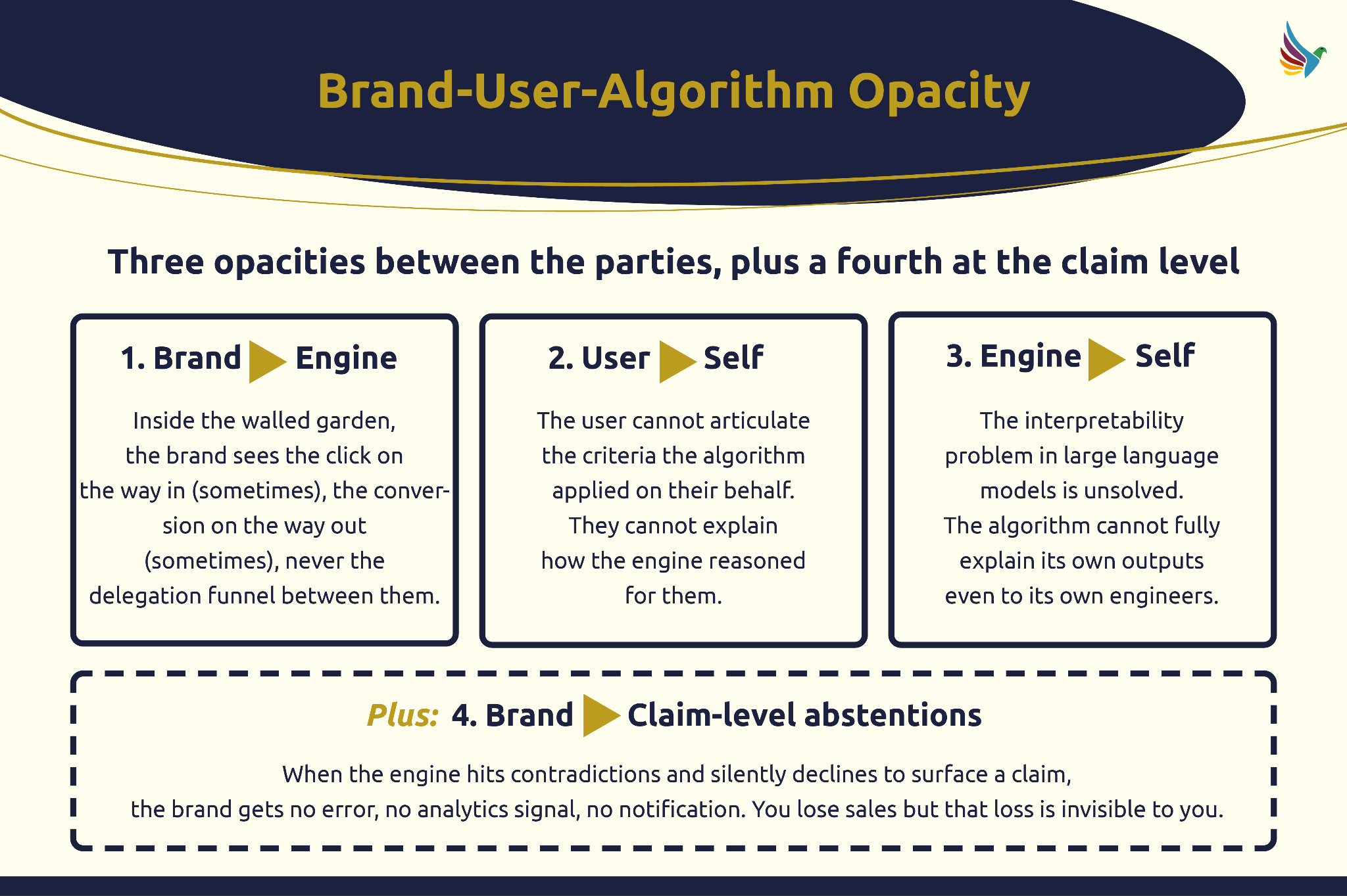
The core problem is something called Brand User Algorithm opacity, or BUA opacity. In the AI era, there are four layers of blindness that make micro measurement impossible. First, the brand is opaque to the engine within its walled garden. Second, the user is often unaware of how the engine actually reasoned to reach a conclusion. Third, the engines themselves are opaque because the interpretability of large language models is still an unsolved technical problem. Finally, the brand is blind to its own claim level abstention events, which happen when an engine finds a contradiction in the data and silently decides not to mention a specific brand claim.
When your conversion rate drops, you cannot simply look at a ranking report to see what happened. The contradiction that caused the engine to omit you is invisible. This is why the micro instruments of the search era fail on assistive and agential surfaces.
Expert Interpretation: The tradeoff here is between certainty and strategy. We are trading the "certainty" of a rank number for a "strategic" understanding of presence. The decision you need to inspect is whether your current reporting is still based on "rankings" for AI surfaces. If it is, you are measuring a ghost.
Distinguishing between micro and macro environments
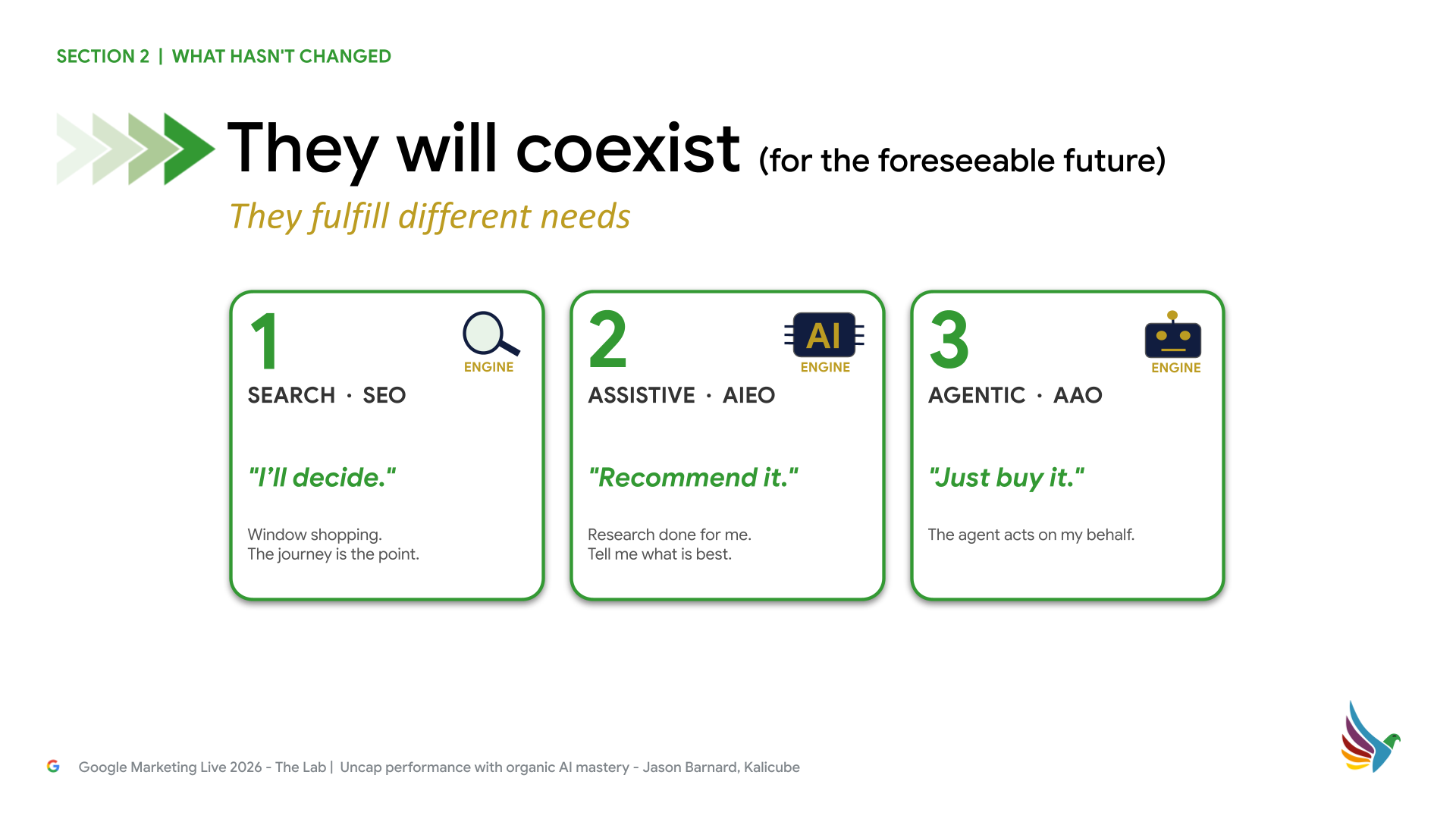
It is important to realize that micro and macro measurement still coexist. We are not moving entirely to one or the other. Instead, three different modes are operating in parallel. Search remains a micro environment, assistive AI is a macro environment, and agents are a hybrid of both.
Search and the illusion of control
Traditional search is where micro measurement still thrives. The process is linear: a user enters a query, the engine provides a list of options, and the user chooses one. Because the environment is transparent, brands can see the query, the position, the click, and the eventual conversion. If your customers are still using search surfaces, you should keep your micro strategies in place. There is no reason to stop measuring search the way we always have, though adding a macro layer on top of it provides a more complete picture.
Assistive AI and the narrowing of choice
Assistive engines like ChatGPT, Claude, or Perplexity operate differently. Here, the user asks for a recommendation, and the engine retrieves and synthesizes a few options. The brand is locked out of the process. You cannot see the retrieval phase, the synthesis, or the alternatives the engine rejected before it committed to a final answer.
You might see the final conversion in your analytics, but you cannot explicitly attribute it to a specific interaction. Because this happens inside walled gardens, macro measurement is the only option. Assistive AI is the most difficult area to track because the "middle" of the journey is completely hidden.
Agents and the removal of the decision
AI agents take this a step further by removing the human decision entirely. The user delegates a task, the agent executes it, and the brand simply receives an order. The transaction itself is a micro event: it is observable and attributable. You know the agent bought your product.
However, the reason why the agent chose you over a competitor is a macro mystery. The decision logic happened internally, based on reasoning and comparisons that the brand cannot see. The conversion is micro, but the pathway to that conversion is macro.
The reality of the buyer's journey
The biggest mistake a brand can make is assuming these three modes are separate silos. Buyers do not stay in one lane. They might start with a topical question in an assistive engine, move to a traditional search engine to compare prices, and then use an agent to finalize the purchase. The buyer chooses the surface, not the brand. Therefore, your measurement system must be flexible enough to handle a mix of all three. The same pattern also shows up in search visibility, where the practical question is how the signal becomes visible.
Expert Interpretation: This matters because most companies try to build a "ChatGPT strategy" or a "Search strategy." In reality, you need a "Buyer strategy" that acknowledges the surface is fluid. The decision to inspect here is your attribution model: does it account for the fact that the "influence" happens in a macro environment while the "transaction" happens in a micro one?
Defining your measurement methodology
Your methodology is defined by how you choose to measure. There is no single "correct" way to translate search era metrics into AI era metrics, but the way you define these translations becomes the foundation of your strategy. The Funnel Query Pathway is the tool that determines which queries you track and how you interpret the results.
Mapping the Funnel Query Pathway
I view the FQP not as a single tree, but as an orchard. Every specific cohort of customers with a specific intent represents one tree. As you identify more customer segments, you plant more trees. Each tree consists of three distinct parts: the trunk, the branches, and the twigs.
The trunk: Brand confirming moments
The trunk is the bottom of the funnel. This is the buying moment where the user includes your brand name in the query. For example, a query like "Men's red shirt from Uniqlo" is a trunk query. The goal here is to ensure the engine confirms the brand's value at the moment of purchase.
While a brand might have dozens of variants of these queries on an FAQ page, the measurement methodology focuses on one representative trunk query per tree. This provides a structural read on whether that specific customer cohort is actually reaching the conversion point.
Competitor queries as separate trunks
Many people mistake brand versus competitor comparisons for middle of the funnel research. I disagree. When a user asks an engine to decide between two specific brands, the buying moment is already happening. However, these should be tracked in a separate bucket from brand only queries.
Separating them allows you to measure recommendation bias, which brand the engine prefers, and sentiment bias, which is the tone used to describe you versus the competitor. It also allows you to see how the engine handles the "AI résumé" of each brand to see who is being represented more accurately.
The branches: Research and evaluation
Moving up the tree, we find the branches. This is the middle of the funnel. The user is still your ideal customer, and the intent is still to buy, but they have not yet committed to a brand. A query like "Best red shirt for men" is a branch.
The primary metric here is brand appearance. When the engine answers a research query, does your brand surface in the recommendations? If you are not appearing here, the engine does not consider you a candidate answer for that specific research question.
The twigs: Topical awareness
At the very top are the twigs. These are topical questions asked before the user even begins researching specific products. An example would be "Can men wear red shirts to work?"
At this level, brand surfacing is rare and usually not the goal. Instead, you measure topical answer accuracy and recruitment. You want to know if the engine is using your content to answer the topical question, even if it isn't explicitly recommending your product yet.
Expert Interpretation: The tradeoff here is effort versus insight. Tracking every possible query is impossible, but tracking one representative query per section of the tree is manageable. The decision to inspect is your "orchard" map: have you identified the actual cohorts that drive your revenue, or are you just tracking generic keywords?
The expansion of the upper funnel
There is a common fear that AI is shrinking the funnel by giving direct answers. In reality, the top and middle of the funnel have grown. AI makes research faster, and when research is faster, people do more of it.
We have moved into a model of visibility, influence, and transaction. The AI engines have become the world's most powerful influencers. The website is still where the transaction closes, but the influence happens elsewhere. If you measure AI visibility as a replacement for website traffic, you are measuring the wrong thing. The substitution is happening at the influence layer, not the transaction layer.
Closing the loop with analytics
The FQP tells you where you are being recommended, but analytics tells you if those recommendations actually lead to money. This is where the strategy becomes defensible to a board of directors.
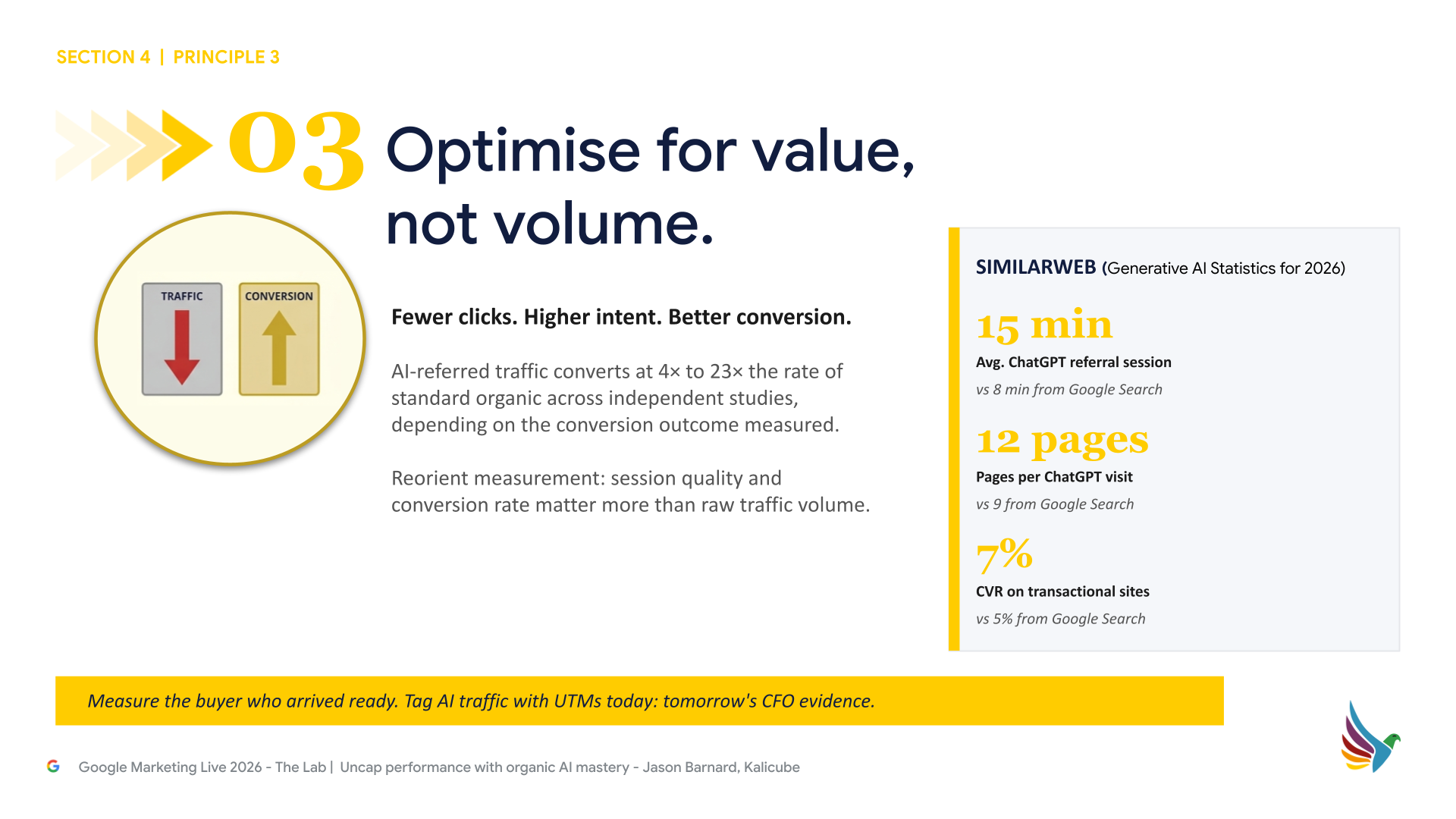
To do this, you must build an AI traffic cohort. You cannot rely on UTM tags because assistive engines do not pass them. Instead, you have to use referral signals and user agent strings to identify traffic from Gemini, ChatGPT, Perplexity, and Copilot. By shrinking the "Direct" traffic bucket and isolating these signals, you can finally see the correlation between your macro visibility and your actual revenue.
The hidden gain in agential commerce
At first glance, agents seem like a measurement nightmare. We lose all the human signals we used to cherish, such as scroll depth, mouse movements, and the way a user hesitated on a comparison page. Those behavioral cues are gone.
But they are replaced by something better: programmatic events. Every time an agent interacts with your infrastructure, it is a clean, data rich event. While we lose the "human" feel of the journey, we gain a level of programmatic precision in the transaction that humans never provided. The path is macro, but the event is perfectly micro.
The necessity of a slower timeline
Finally, we have to accept that macro measurement works on a slower clock. You cannot look at AI visibility on a daily or weekly basis and expect to find a pattern. The noise is too high.
Comments
Comments are reviewed before they are published. Links are not allowed inside comments.