The Funnel Query Pathway: a Framework for Measuring AI Visibility
/ 9 min read

Summary
The measurement question, as the industry currently frames it, uses the wrong reference discipline. Brands still hunting for the. The practical question is what this changes for SEO, content quality, and AI search visibility.
Introduction
The key issue here is The question I get asked most in 2026 is: How do we measure this? How do we measure whether our brand is showing up in ChatGPT? How do we measure whether Perplexity is recommending us? How do we measure whether the work we did last quarter on grounding for AI. My read is to treat it as a decision point: what signal needs to become clearer, what part of the system is currently weak, and what evidence would show that the work is improving visibility rather than only adding activity.
That is the difference between reacting to a trend and building a useful search system. Connect this point back to the page template, internal linking, entity signals, content depth, crawl accessibility, and the way the brand is represented across the wider web before deciding what to change first.
If you are managing a brand in the current AI landscape, you have likely hit a wall with measurement. The question usually sounds the same: "How do we actually know if ChatGPT is recommending us?" or "Did our grounding efforts last quarter actually move the needle?"
The frustration stems from the fact that we are trying to apply old search metrics to a fundamentally different medium. Most of the dashboards being sold right now are essentially sophisticated guesses. They offer snapshots of visibility that feel precise but lack a foundation in how these AI systems actually function. We are chasing a number in an environment where the number is no longer the primary signal of success.
The Gap Between the Question and the Answer
The desire to measure AI visibility is correct, but the expectation of a precise, singular KPI is where we go wrong. For two decades, search gave us stability: a finite set of rankings, a measurable click, and an observable journey. AI surfaces, assistive and agential, do not work this way.
Instead of looking for a new KPI, we need a new methodology. I view this through the lens of the Funnel Query Pathway. This isn't just a tracking sheet; it is an operational tool that merges strategy, measurement, and analysis into one artifact. We have to stop asking for a dashboard and start building a system that accounts for the opacity of the AI environment. A useful companion note is Measuring AI Search Performance, because it looks at a nearby part of the same system.
Expert Interpretation: This matters because relying on "snapshot" tools creates a false sense of security. The tradeoff is between the comfort of a clean chart and the utility of a complex methodology. The decision you need to make is whether to continue optimizing for a "rank" that doesn't exist or to start optimizing for a "pathway" that does.
AI Visibility as a Macro Measurement Problem
My background in economics and statistical analysis helps explain why this feels so difficult. We are seeing a clash of scales. In economics, there is a massive difference between microeconomics (the precise inventory of a corner shop) and macroeconomics (the central bank's attempt to measure inflation). Both are correct, but their instruments are not interchangeable.
AI visibility is a macro problem. We cannot measure it with micro instruments because of three structural hurdles: First, there is Brand User Algorithm (BUA) opacity. The user doesn't see the options the AI rejected, the brand can't see the journey inside the walled garden, and the algorithm itself cannot always explain its decision making process. Second, personalization means that no two users receive the same answer. Third, the system is dynamic, shifting based on context that we cannot fully observe. This connects with Micro macro Shift when the same signal needs a clearer operating decision.
Expert Interpretation: When you treat AI visibility as a micro problem, you waste budget chasing "ghost" keywords. The tradeoff here is precision versus accuracy. You lose the ability to say "we are #1 for this query," but you gain the ability to say "we are visible to this specific cohort." The decision is to shift your reporting from individual queries to cohort based trends.
Shifting the Unit of Measurement to the Cohort
A common mistake in keyword strategy is grouping queries by category rather than by intent. For example, a marketer might group all "Phuket hotels" queries together. But "Phuket hotels" is a destination, not an intent. The person searching for a "5-star hotel in Phuket" and the person searching for a "cheap hotel in Phuket" are in entirely different cohorts. They have different budgets, different decision criteria, and different conversion paths.
When you group by category, you average the performance of two different groups of people, which renders the data useless. Categories describe things; cohorts describe people. Since AI routing is fundamentally about predicting human behavior, the cohort must be our primary unit of measurement.
Expert Interpretation: This is the difference between "what" and "who." The tradeoff is that cohort based tracking requires more upfront intellectual work than simply exporting a keyword list from a tool. The decision point is whether you want to track "traffic" or "the right people."
Defining the Node: Cohort and Intent
To build a measurement framework, we have to define the "node." A node is the intersection of a cohort and an intent. A cohort is a group of people with a durable identity, such as "luxury travelers" or "parents shopping for kids." This identity persists regardless of what they are buying. An intent is the situational vector, the specific need at a specific moment, like "booking a hotel for next month" or "buying winter coats."
An intent spans many cohorts (many different types of people buy shirts), and a cohort has many intents (an XL man buys coats, gym gear, and wedding rings). The node is where these two overlap.
Expert Interpretation: Understanding the node allows you to stop guessing what users will ask. The tradeoff is that you can no longer rely on "high volume" as your primary metric. The decision is to prioritize the "logical" query over the "popular" query.
Identifying Legible Queries for Tracking
Not every query is worth tracking. A query only qualifies for the Funnel Query Pathway if both the cohort and the intent are legible within the phrasing. For instance, "Hotels in Bali" is an intent, but the cohort is hidden. Is it a honeymooner? A backpacker? A business traveler? Because the cohort is invisible, the query cannot function as a node; the people using it will behave in wildly different ways.
However, "cheap hotels in Bali" makes the budget cohort legible. "Men's red shirt from Uniqlo" makes both the cohort (men shopping for clothes) and the intent (buying a red shirt) clear, while also naming the commercial destination.
Expert Interpretation: This filter prevents "data noise." The tradeoff is that you will track fewer queries than you did in the SEO era. The decision is to accept a smaller, more legible data set over a massive, ambiguous one.
Building the Pathway from Conversion Upward
The Funnel Query Pathway does not track what users *actually* type, it tracks what a specific cohort *would* ask given a specific intent. We are not looking for empirical records of individual users; we are constructing a theoretical representative pathway.
This is the macro discipline in action. We don't start with search volume because we aren't looking for what is already happening. We are reasoning forward to build the ideal path a representative member of a cohort would take toward a purchase.
Expert Interpretation: This is a "bottom up" approach. The tradeoff is that it feels counterintuitive to marketers trained in top of funnel awareness. The decision is to stop hoping users "arrive" at conversion and instead engineer the path backward from the sale.
Example: The Uniqlo Pathway Tree
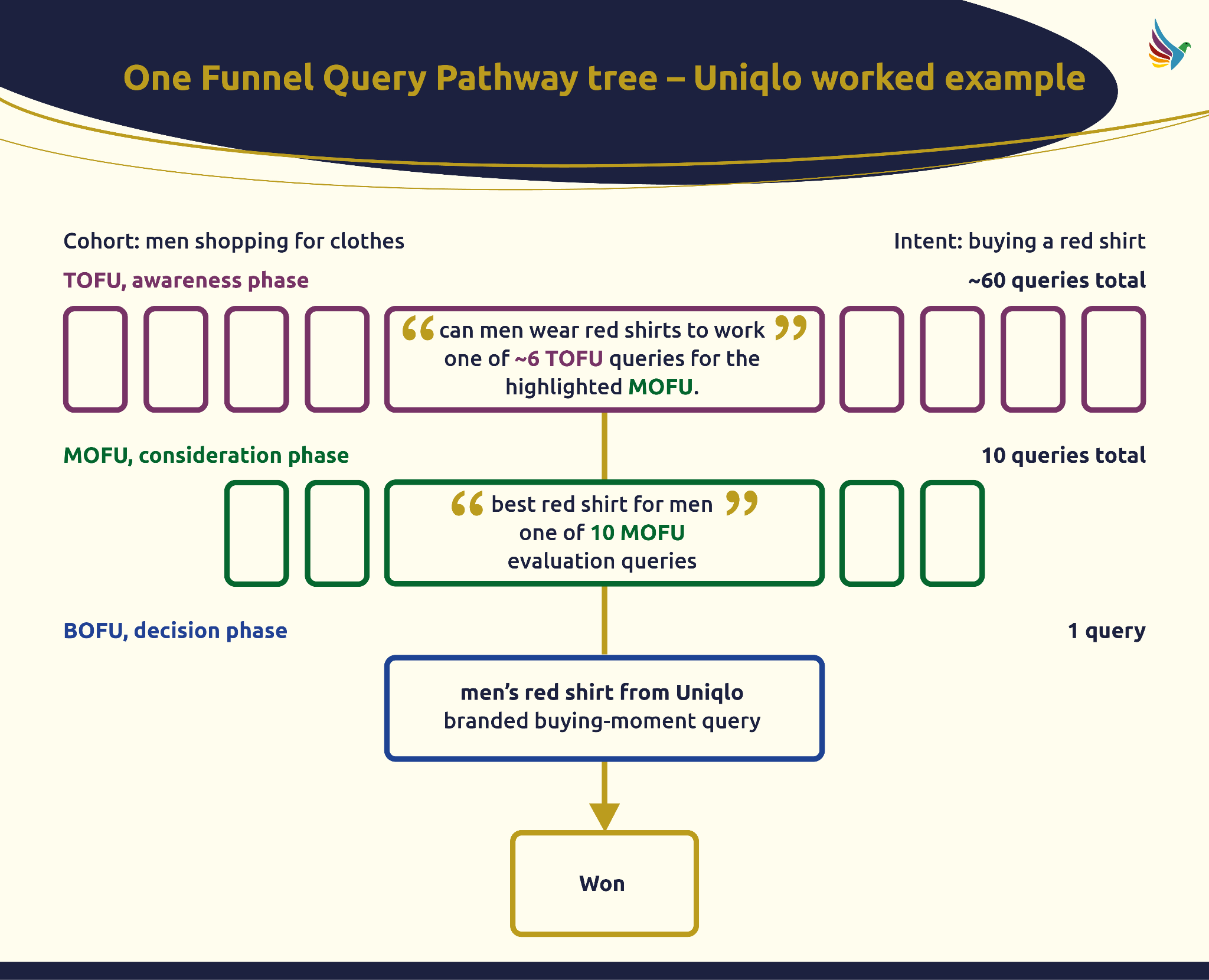
Consider Uniqlo. If our cohort is "men shopping for clothes," we have various intents: buying a shirt, buying winter outerwear, or buying gym kit. Each of these creates a separate tree.
If we take the "red shirt" intent, the conversion node (the bottom of the funnel) is "men's red shirt from Uniqlo." We don't need to track every single variation of this query; we just need a few representative examples that fit that specific cohort intent intersection.
Expert Interpretation: This simplifies the tracking process. Instead of 1,000 keywords, you have a few "representative" nodes. The tradeoff is a loss of granular "per word" data, but the gain is a clear view of the conversion chain.
The Logic of AI Routing and Google Ads
Conversations with engineers reveal that the math Gemini uses to route recommendations is remarkably similar to the math Google Ads uses for bidding. The system is essentially calculating the probability that a specific cohort, with a specific intent, will reach a conversion. It then picks the path most likely to result in that outcome.
In Google Ads, this calculation includes profit margin because the advertiser provides that data. In organic AI visibility, the engine doesn't know your margins; it only knows cohort, intent, and conversion rate. It optimizes for user satisfaction as a proxy for the "win." The same pattern also shows up in AI Is Merging Paid and Organic Visibility, where the practical question is how the signal becomes visible.
Expert Interpretation: This means AI visibility is a probability game. The tradeoff is that you cannot "buy" your way to the top with a high bid in organic AI; you must prove the probability of satisfaction. The decision is to focus on "satisfaction signals" rather than just "backlinks."
The 15 Gate Model of AI Visibility
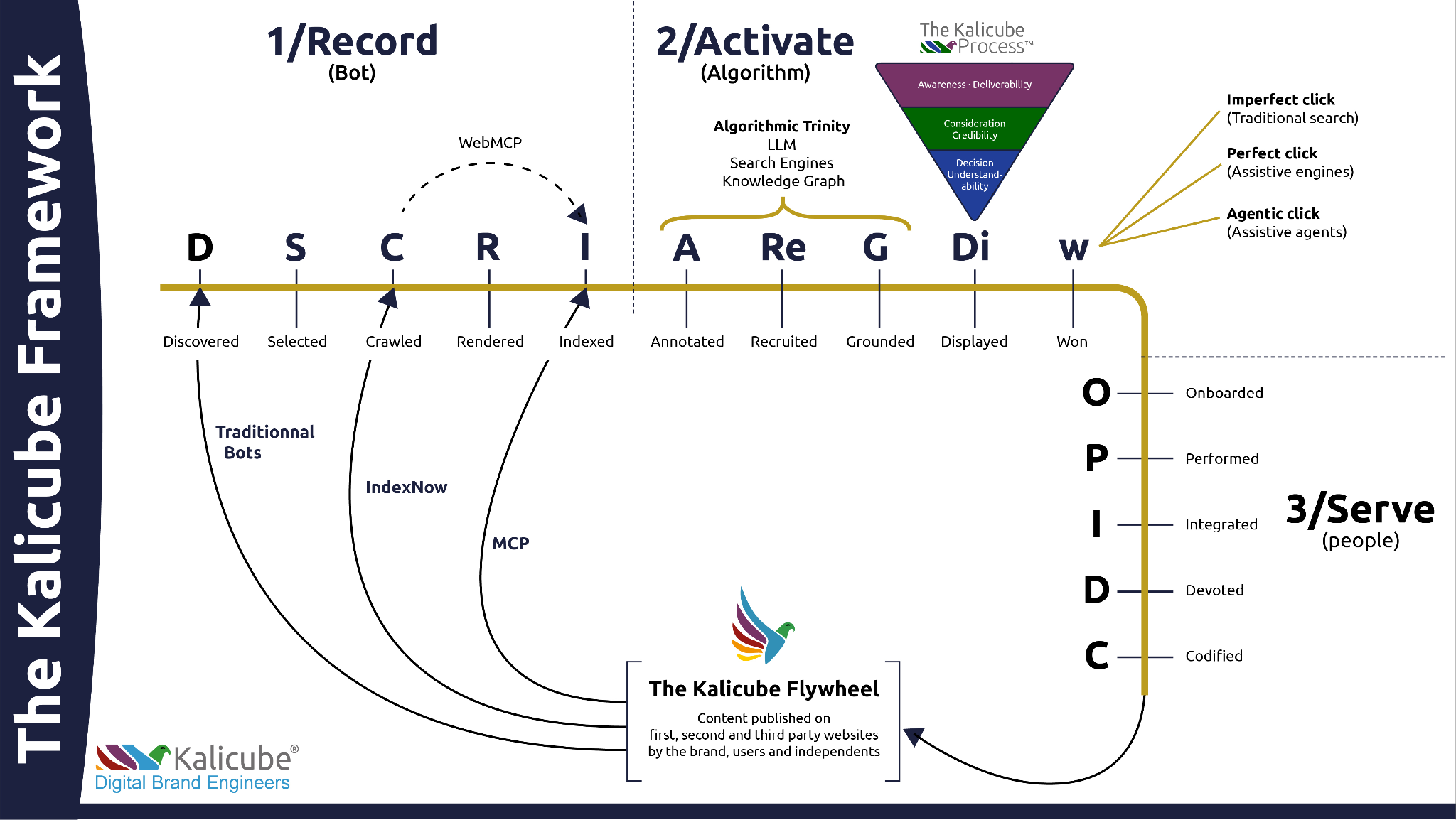
To measure this, I use a 15 gate model. The first ten are binary checkpoints: 1. Discovered, Selected, Crawled, Rendered, and Indexed (the bot's job). 2. Annotated, Recruited, Grounded, Displayed, and Won (the algorithm's job). The final five gates happen post transaction: Onboarded, Performed, Integrated, Devoted, and Codified. These are handled by your operations, not the AI.
Step 1: Start at the Bottom
Identify the queries your ideal customer profile (ICP) would ideally submit using your brand name at the moment they are ready to buy. This is not about what they *do* type, but what they *should* type to find you. It must be branded, bottom of funnel, and cohort coherent.
Step 2: Project the Pathway Upward
From that conversion query, branch upward. What evaluation questions would this cohort ask before they reach the buying moment? And before that, what awareness questions would lead them to those evaluation questions? You are building a tree that projects from the sale back to the first spark of interest.
Expert Interpretation: This structure turns measurement into a map. The tradeoff is the time required to map these trees manually. The decision is whether to treat your content as a collection of pages or as a series of answers to a logical chain.
Managing Granularity and Budget
The number of trees you build is limited only by your team's capacity. However, the number of trees you *track* is a budget call. One cohort with one intent (e.g., XL men buying red shirts) is one tree, consisting of roughly 60 queries. As you add more intents and more cohorts, the number of trees scales.
Higher resolution gives you a more precise diagnosis of where the "leak" is in your funnel, but it requires more resources to monitor.
Expert Interpretation: Don't try to map the whole world at once. The tradeoff is between breadth and depth. The decision is to start with your most profitable cohort intent intersection and expand only after that tree is "won."
Comments
Comments are reviewed before they are published. Links are not allowed inside comments.