The New Rules of Journalist Outreach, Based on Millions of Emails
/ 8 min read

Summary
In the AI era, there are a LOT more PR professionals in the space than ever before and they outnumber journalists. In the U.S., I. The practical question is what this changes for SEO, content quality, and AI search visibility.
Getting a journalist to actually open an email has always been a challenge, but the barrier to entry has shifted. With AI tools now capable of generating thousands of pitches in seconds, the volume of noise in a reporter's inbox has reached a breaking point. It is no longer enough to have a "good story."
To understand how to break through, we have to look at the data. I am basing these insights on a massive set of studies involving over 14 million emails analyzed by domain age, 39 million by subject line, and hundreds of AI generated summaries. The goal is to move away from guesswork and toward a technical and psychological framework for outreach. The same pattern also shows up in We Earned 1, where the practical question is how the signal becomes visible.
The Imbalance of PR Pros and Journalists
We are currently operating in an environment where the people sending the pitches vastly outnumber the people receiving them. In the United States, estimates vary, but the ratio is skewed. The U.S. Census suggests about 1.8 PR professionals for every journalist, while the Bureau of Labor Statistics puts that number as high as 7.2. In the UK, the ratio sits around 1.5 to 1.
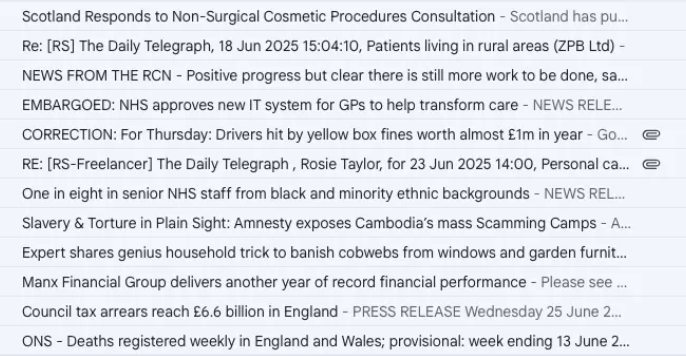
This gap is widening because link builders are increasingly pivoting toward digital PR to gain AI driven visibility. The result is a flood of "AI slop" and pitches from fake experts. The data from Muck Rack's 2026 State of Journalism report highlights the severity of this: 47% of journalists say they rarely or never receive pitches that actually align with their beat.
Why this matters: When a journalist is underwater, their filter becomes aggressive. They aren't just looking for a story; they are looking for a reason to delete your email in under a second. This connects with Clarity Matters in AI Search when the same signal needs a clearer operating decision.
The tradeoff: You can either spend your time building a massive list of "potential" targets or spend that same time deeply analyzing the last 20 articles a specific journalist wrote. The latter is slower but has a significantly higher probability of success.
Decision point: Inspect your targeting process. If you are relying on job titles or bios, you are likely contributing to the noise. Shift your focus to actual recent output to ensure true relevance.
The Technical Foundation of Deliverability
For a long time, many of us treated domain age and authentication as "checkbox" items that didn't move the needle. The data suggests otherwise. Technical health determines whether your pitch even reaches the inbox, let alone gets read.
The Impact of Domain Age
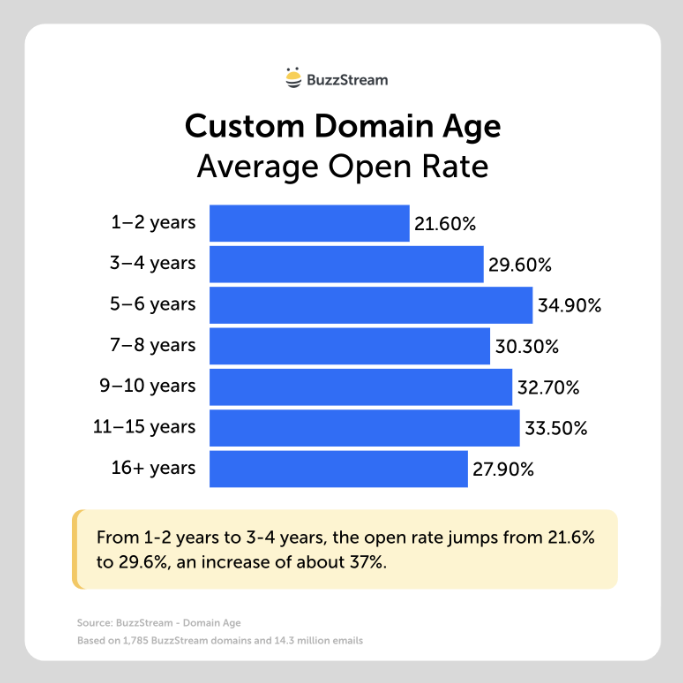
There is a measurable advantage to using established domains. Data shows that domains between five and six years old see average open rates of 34.9%, compared to just 21.6% for domains that are only one to two years old.
Crucially, this isn't just about the experience of the person sending the email. Even seasoned PR experts see low open rates when using a brand new domain. Even when a new domain is fully authenticated with SPF, DKIM, and DMARC, open rates still average around 17.9%.
Why this matters: You cannot "hack" trust with an email provider. Age is a proxy for reputation that cannot be fast tracked.
The tradeoff: If you are launching a new project, you face a choice: use a legacy domain with a known reputation or accept a lower success rate while you build age on a new one.
Decision point: If you are using a fresh domain, lower your volume and increase your quality. Pushing high volume through a young domain is the fastest way to get flagged as spam.
The Necessity of Authentication
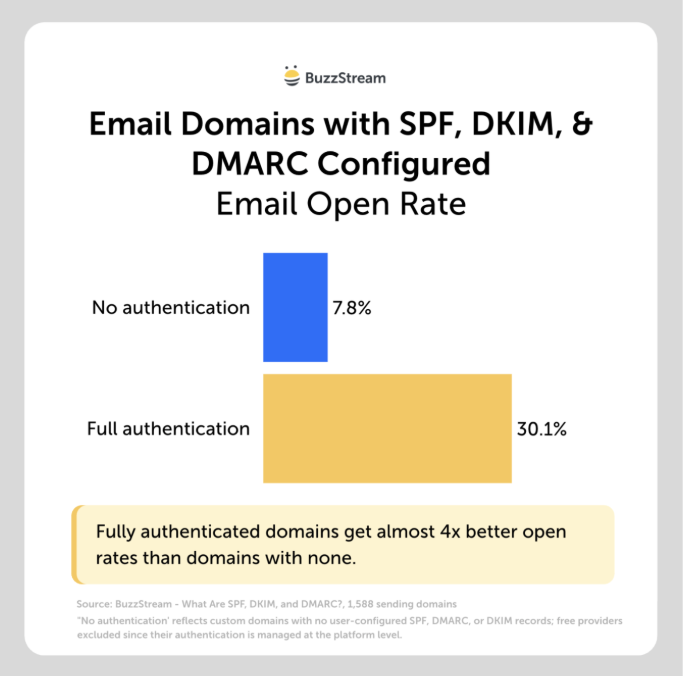
Authentication protocols like SPF, DKIM, and DMARC are essentially the "ID cards" of the email world. They tell the receiving server that you are who you say you are. A study of 1,588 domains revealed a staggering difference: fully authenticated domains saw average open rates of 30.1%, while unauthenticated domains plummeted to 7.8%.
This has become a non negotiable requirement. Major providers like Google, Yahoo, and Microsoft have tightened their sender requirements over the last couple of years. Failing to implement these records can lead to your emails being blocked entirely. A useful companion note is X Robots Tag, because it looks at a nearby part of the same system.
Why this matters: Authentication is the difference between a 30% open rate and a 7% open rate. It is the single most impactful technical lever you can pull.
The tradeoff: While it takes a developer less than an hour to set these up in the DNS settings, many teams ignore it because it feels like "IT work" rather than "PR work."
Decision point: Use a domain checker to verify your SPF, DKIM, and DMARC records today. If they are missing, this is your first priority before sending another pitch.
Optimizing the Subject Line for Human Attention
The subject line is the only thing standing between your pitch and the trash folder. In an inbox filled with AI generated templates, specificity is your only real weapon.
Lead With Concrete Findings
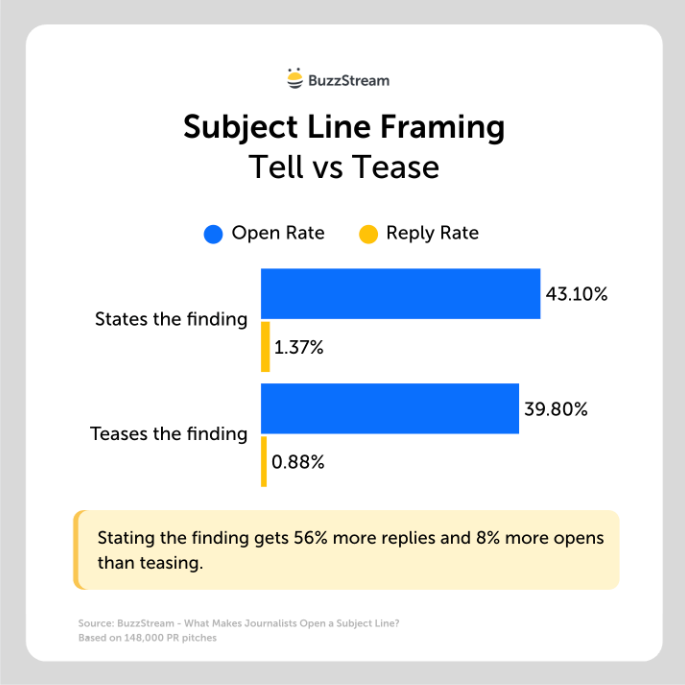
The data is clear: journalists prefer the answer over the teaser. Subject lines that stated a concrete finding (e.g., "Raleigh Among Best for New Homeowners") achieved 43.1% open rates and 1.37% reply rates. In contrast, "teaser" lines (e.g., "Which City is Best for New Homeowners?") saw lower opens (39.8%) and significantly lower replies (0.88%).
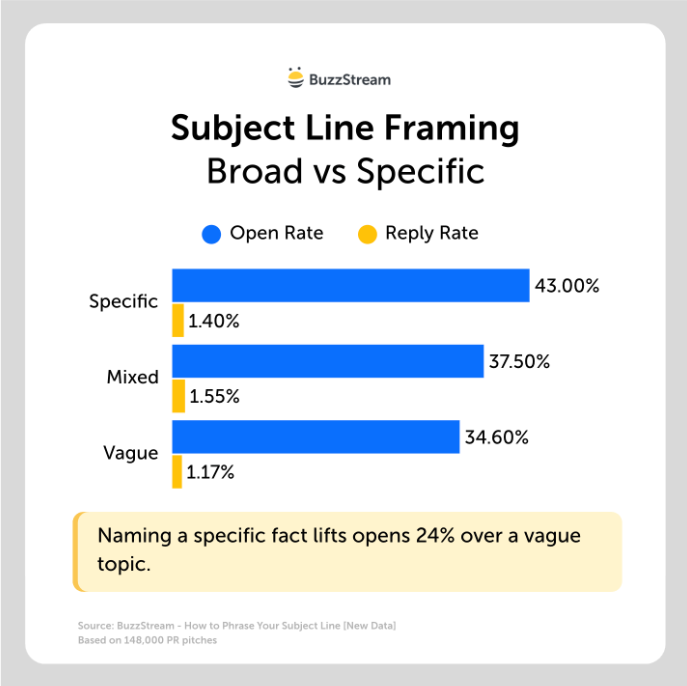
Vague subject lines like "New Study on the Housing Market" performed poorly (34.6% open rate) compared to specific ones like "Raleigh Ranked #1 City for New Homeowners" (43% open rate).
Why this matters: Journalists are time poor. They don't want to solve a riddle to find out if your story is useful; they want the value proposition delivered immediately.
The tradeoff: Teasers are often used in B2C marketing to drive curiosity, but in B2B and journalistic outreach, curiosity is often interpreted as a waste of time.
Decision point: Write your main takeaway as a full sentence first. Then, strip away every word that doesn't add concrete value. If the subject line doesn't contain the "win," rewrite it.
The Power of the First Three Words
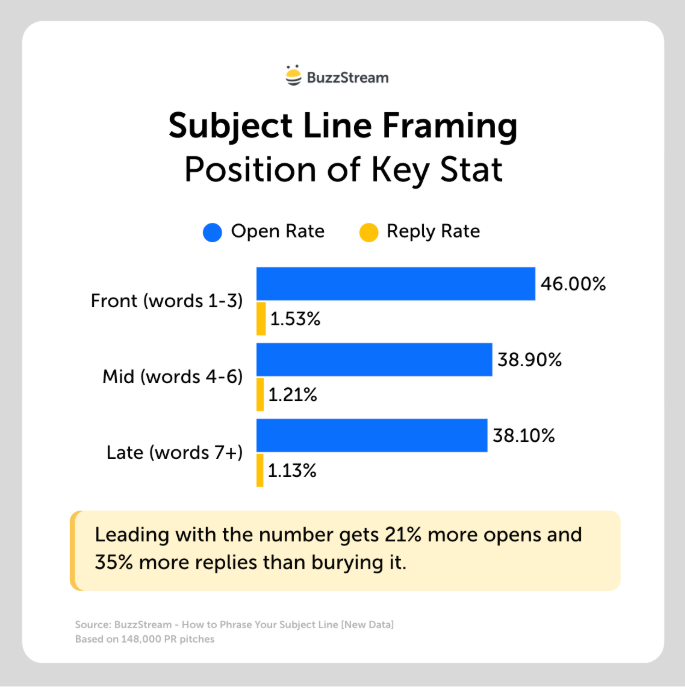
Because of how email clients truncate text on mobile and desktop, the placement of your key information is critical. Subject lines that placed the key stat or finding in the first three words saw open rates of 46%, compared to 38.9% for those that placed the key info in words four through six.
While desktop limits are around 60 characters and mobile is closer to 42, the "danger zone" is much tighter. You should flip your phrasing to ensure the hook is visible immediately. Instead of "The Best City for Homeowners is Raleigh," use "Raleigh Named Best City for Homeowners."
Why this matters: If the most interesting part of your pitch is cut off by the email client, the journalist will never see it.
The tradeoff: This often requires sacrificing "natural" sentence structure for a more "headline style" approach.
Decision point: Send a test email to your own phone. If the core value isn't visible in the first few words of the notification, you need to front load the subject line.
Designing for AI Inbox Summaries
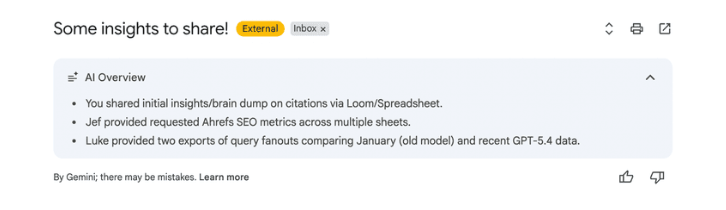
A new variable has entered the equation: AI summaries. Gmail, Apple, and Microsoft now provide AI generated snapshots of emails at the top of the message. This means a journalist might read the AI's interpretation of your pitch before they ever read your actual words.
Front Loading the Email Body
AI summaries do not read your email linearly with equal weight. They heavily favor the beginning of the message. Data shows that 87.1% of Google's AI summary content comes from the first half of the email, 82.5% for Apple, and 65.4% for Microsoft.
This suggests that the traditional "personalized opening" (e.g., "I loved your recent piece on X") may be taking up valuable real estate. If the story is relevant, the journalist cares more about the data than the flattery. By pushing the key info to the top, you ensure the AI summary captures the actual value of the pitch.
Why this matters: The AI summary is now the "second subject line." If the AI summarizes your email as "Someone wants to talk about housing," you lose. If it summarizes it as "Raleigh is the #1 city for homeowners," you win.
The tradeoff: This moves away from the "relationship first" approach of traditional PR, which can feel cold to some practitioners.
Decision point: Evaluate your opening paragraph. If the first two sentences are generic pleasantries, move your core finding to the very first line.
Leveraging Bulleted Lists
AI summaries are highly attracted to structured data. Across all platforms, bulleted text influenced AI summaries at least 64% of the time. Microsoft was the most aggressive, including bulleted info 92% of the time, followed by Google (65%) and Apple (64%).
The strategy here is to use the opening paragraph for the "what" (the main finding) and the bullets for the "why" and "how" (the supporting data). This provides the AI with a clear structure to pull from, increasing the likelihood that the summary is accurate and compelling.
Why this matters: Bullets act as a signal to the AI that "this is the important data." It reduces the chance of the AI hallucinating or missing the point.
The tradeoff: Over reliance on bullets can make an email feel like a report rather than a personal note.
Decision point: Ensure your bullets are not just repetitions of the headline, but additive details that provide the evidence needed to justify the story.
The Risk of AI Misrepresentation
AI summaries are not perfect. In about one out of three cases, Apple and Microsoft AI summaries misrepresented the original email, particularly when dealing with expert quotes and specific data points.
Why this matters: Even if you get the coverage, the journalist may have based their initial interest on a flawed AI summary. This increases the risk of inaccuracies in the final published piece.
The tradeoff: You cannot control the AI summary, but you can control the clarity of your source text.
Decision point: When you receive a response or a published piece, double check the data. Do not assume the journalist read every word of your pitch; they may have relied on the summary.
The Primacy of Relevance
Technical optimization, subject line hacking, and AI structuring are all useful, but they are amplifiers, not foundations. None of these tactics can save a pitch that is irrelevant to the recipient.
Comments
Comments are reviewed before they are published. Links are not allowed inside comments.