Understanding a Migration Hangover Traffic Drop & How Do You Avoid It?
/ 9 min read

Summary
A SEO migration hangover is the prolonged, significant, and often avoidable drop in organic traffic that follows a website. The practical question is what this changes for SEO, content quality, and AI search visibility.

Introduction
The key issue here is Launching a new website, whether it's a redesign, replatform, or full CMS migration, is often treated as a milestone for a business. But for SEO teams, it can quickly become a high risk transition. Even migrations that appear technical sound at launch can. My read is to treat it as a decision point: what signal needs to become clearer, what part of the system is currently weak, and what evidence would show that the work is improving visibility rather than only adding activity.
That is the difference between reacting to a trend and building a useful search system. Connect this point back to the page template, internal linking, entity signals, content depth, crawl accessibility, and the way the brand is represented across the wider web before deciding what to change first.
There is a specific kind of tension that comes with launching a new website. For the business owners and designers, it is a moment of celebration, a fresh start, and a visual upgrade. But for those of us focused on organic growth, it often feels like walking a tightrope. You can do everything right on the surface, yet still wake up a month later to find your traffic has fallen off a cliff. The same pattern also shows up in We Earned 1, where the practical question is how the signal becomes visible.
The danger is that a site migration is rarely just a technical switch. It is a fundamental change in how search engines perceive your authority. When things go wrong, you aren't just dealing with a temporary dip, but something far more systemic. In the worst cases, this recovery can take 12 to 18 months, which is a devastating amount of time to lose visibility and revenue.
Understanding the SEO Migration Hangover
A migration hangover is not the same as the standard fluctuation you see after a launch. It is a prolonged and significant loss of organic traffic and authority that happens because the migration was poorly executed. While most people expect some movement in their rankings after a move, a hangover is a deep, lasting drop that suggests something is fundamentally broken in the eyes of Google.
To understand this, we have to distinguish it from normal volatility. It is natural for traffic to dip by 10 to 30 percent as Google recrawls the site and re evaluates the new structure. This is a processing period. Google has to manage an immense amount of data, and it takes time to re index trillions of pages. A hangover, however, is usually characterized by a traffic loss of 50 percent or more.
The reality is that Google uses a multi stage workflow to transfer ranking signals. If the signals are interrupted or confused, the process stalls. The difference between a temporary dip and a hangover is often the difference between a few weeks of patience and a year of recovery work.
Expert Interpretation: The critical decision here is knowing when to stop waiting. Many teams make the mistake of attributing a 50 percent drop to normal volatility for two months before they start investigating. You must decide on a threshold for "normal" before you launch so you can trigger an emergency audit the moment that threshold is crossed.
The Root Causes of Post Migration Traffic Loss
Most migration failures stem from the same organizational error. The project is treated as a technical handoff between developers and designers rather than a strategic business move. When SEO is treated as a final checklist item instead of a foundational requirement, the risks increase exponentially.
Broken or Missing 301 Redirects
Redirects are the bridge that carries link equity from the old world to the new one. If a 301 redirect is missing or pointed to the wrong place, Google treats the old page as gone and strips away its ranking power. Even a single missed URL that holds significant authority can drag down the rest of the site.
Common pitfalls include using temporary 302 redirects when a permanent 301 was required, or creating redirect chains where a user and a crawler have to jump through multiple hops to reach the destination. This slows down the crawling process and dilutes the signal.
Expert Interpretation: There is often a tradeoff between a "clean" new URL structure and the safety of the old one. Developers often want to use the migration to "fix" URLs, but every change introduces a point of failure. The decision should be to prioritize the preservation of equity over the desire for aesthetic URL perfection.
Noindex Tags Left Over From Staging
This is one of the most avoidable yet devastating mistakes in the industry. To prevent Google from indexing a site while it is still in development, developers add noindex tags to the staging environment. If those tags are accidentally pushed to the live production site, you are essentially telling Google to delete your entire website from its index.
Once these tags are removed, the recovery is not instant. It can take days or even weeks for search engines to re crawl and re index the pages, during which time your traffic will vanish.
Expert Interpretation: This is a process failure, not a technical one. The decision to implement a mandatory "pre flight" check for noindex tags on the live environment is the only way to mitigate this risk. It is a five minute check that prevents a five month disaster.
Canonical Tags Pointing To Old URLs
Canonical tags tell Google which version of a page is the "master" copy. If your new site launches but the canonical tags still point back to the old domain or the old URL structure, you create a conflict. Google will continue to credit the old URLs and ignore the new ones, effectively blocking the transfer of ranking signals.
This is particularly dangerous because many automated crawling tools might miss this if they are only looking for 404 errors rather than checking the logic of the canonical tags.
Expert Interpretation: This matters because it creates a "ghost" version of your site in Google's index. You must inspect whether your CMS automatically generates canonicals and ensure those are updated to the new production environment before the DNS switch.
Content Changes That Hurt Relevance
A redesign is often used as an excuse to rewrite copy or remove "cluttered" pages. However, if a page was ranking well, it was likely because Google found the specific content, heading structure, and internal linking patterns relevant to the user's query.
When you change the copy, you change the keyword relevance. This includes removing images, videos, or body copy, as well as altering title tags and meta descriptions. If the new version of the page is "cleaner" but less informative, the rankings will drop.
Expert Interpretation: There is a constant tension between brand aesthetics and SEO performance. The decision here is to audit the top 20 percent of your highest traffic pages and ensure that the core content remains intact, even if the visual wrapper changes. A useful companion note is Is Google Fixing B2B Marketing?, because it looks at a nearby part of the same system.
Page Speed Regression
New designs often come with heavy JavaScript, large images, or clunky CMS plugins that slow the site down. Since Google uses Core Web Vitals as a ranking signal, a significant drop in performance can lead to a gradual erosion of rankings.
A slow site doesn't just hurt the bots, it hurts the user experience, leading to higher bounce rates and lower conversion rates, which further signals to Google that the new site is less valuable.
Expert Interpretation: Performance is often sacrificed for "wow factor" in design. You should decide on a performance budget before the design phase begins, ensuring that the new site meets or exceeds the speed of the old one.
Unnecessary Changes To URL Structures
Some changes are mandatory, such as moving from WordPress to Shopify where certain URL paths are forced. However, changing URLs just for the sake of "cleaning them up" is a high risk move. Even with perfect 301 redirects, the transfer of authority is not always 1 to 1.
Changing URLs at scale forces Google to reassess every single page signal. On large or complex sites, this can lead to significant volatility as Google tries to understand the relationship between the old and new structures.
Expert Interpretation: The tradeoff is between a "perfect" URL and a "stable" ranking. Unless the current URLs are fundamentally broken, the safest decision is to keep them exactly as they are.
Distinguishing a Hangover from Normal Volatility
When traffic drops, the first question is always: "Is this normal, or is it broken?"
Normal volatility usually looks like a 10 to 20 percent dip. This typically stabilizes and begins to recover within two to six weeks. During this time, Google Search Console should remain relatively quiet, with no massive spikes in 404 errors or crawl failures.
A migration hangover is different. You will see a drop exceeding 30 to 50 percent. You will notice a sharp increase in 404 errors in Search Console and a decline in the number of indexed pages. Most importantly, there is no sign of stabilization after a month. While a 30 percent drop can often be fixed, the goal is to avoid the situation entirely.
Strategies to Avoid the Hangover
A successful migration is won or lost in the months before the site actually goes live. The pre migration phase is where the real work happens.
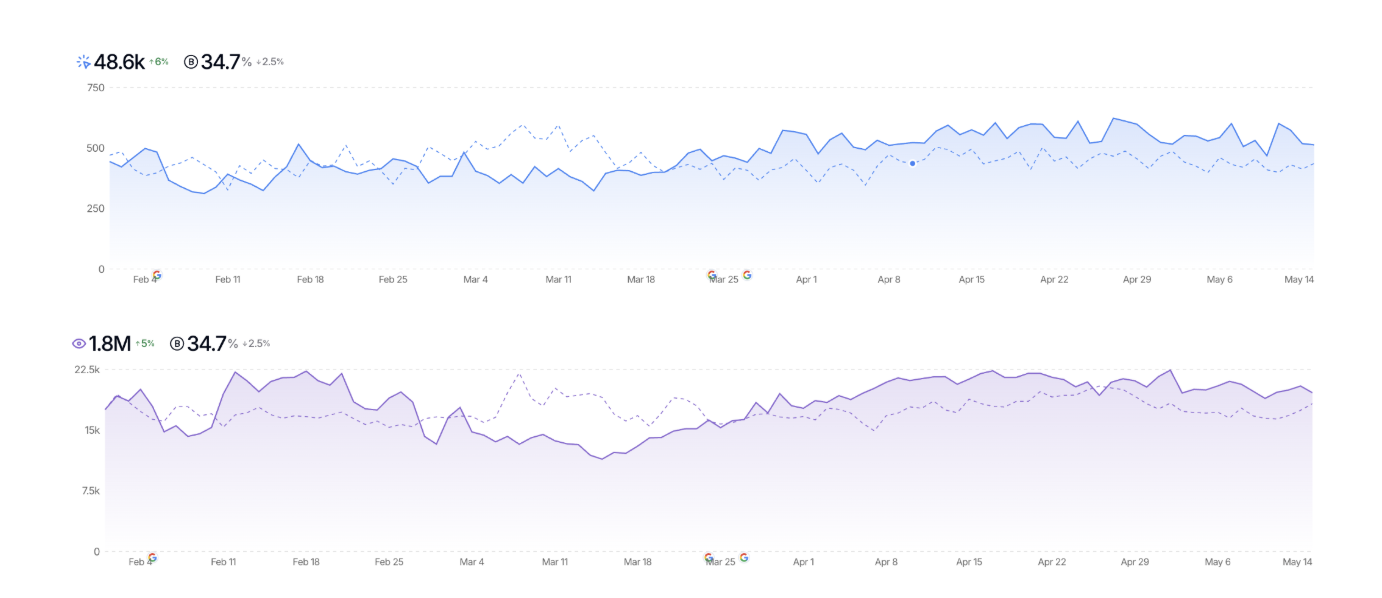
First, you must crawl the existing site to document every single URL, title tag, and canonical tag. This creates a baseline. Next, every old URL must be mapped to a new destination, and these 301 redirects must be tested in a staging environment before they ever touch a live user.
You should also audit your structured data and schema markup to ensure it carries over correctly. Benchmarking your page speed before the move is equally important, as it gives you a metric to defend against performance regressions. Finally, a rigorous check of the robots.txt file and noindex tags must be performed on the live site the moment it launches.
Recovering from a Traffic Drop
If you are already experiencing a drop, the priority is triage. The migration does not end at launch; it ends when the traffic stabilizes.
Start with a full crawl of the new site to find technical errors. Developers should prioritize fixing the highest traffic pages first to stop the bleeding. Cross check your canonicals, re submit your sitemap to Google, and verify that noindex tags aren't blocking key sections of the site.
If you find that content was significantly altered, you may need to restore the original copy or re optimize the pages for the target keywords that were lost. Rapid response is the only way to prevent a temporary drop from becoming a permanent hangover.
Comments
Comments are reviewed before they are published. Links are not allowed inside comments.