Why AI Content Starts to Sound the Same
/ 6 min read

Summary
Let's start with the bit that the AI labs would rather you didn't dwell on. Large language models do not "think" in any. The practical question is what this changes for SEO, content quality, and AI search visibility.
There's a particular flavor of panic in our industry at the moment. It's the panic of the digital marketer who has been told, repeatedly and loudly, that if they aren't piping every decision through an LLM by the end of the quarter, they will be replaced by a more obedient colleague who is.
The pitch is always the same: AI is thinking now. Hand the wheel over, sit back, and enjoy a fully optimized, hyper personalized, infinitely scalable future. Allow me to gently push back, armed with the classic MSPaint.exe.
LLMs Don't Think, They Predict The Next Token
Let's start with the bit that the AI labs would rather you didn't dwell on. Large language models do not "think" in any meaningful sense. Under the bonnet, they are statistical machines that predict the most probable next token given the sequence so far.
That is the entire trick. There is no inner monologue, no model of the world, no quiet moment where the model goes "hang on, that doesn't add up." There is only, "Given these tokens, what tokens usually come next?" This is not a hot take from a skeptic on Substack. Apple's research team published a paper with the gloriously blunt title " The Illusion of Thinking," in which frontier "reasoning" models hit a complete accuracy collapse once puzzle complexity rose beyond a certain threshold and, even more damningly, started using fewer tokens as problems got harder, as though giving up.
LLMs Don't Think, They Predict The Next Token shows why average content is becoming easier to ignore. Pages need sharper judgment, clearer examples, and more specific reasoning so they do not collapse into the answer a model can produce without visiting the site. The same pattern also shows up in to Get Cited & Stay Visible, where the practical question is how the signal becomes visible.
Exhibit A: The Car Wash
The cleanest demonstration of this in the wild is the now infamous car wash prompt: "I want to get my car washed. The nearest car wash is 100 metres away. Should I walk or drive there?" We're hovering around Ralph Wiggum levels of reasoning here, a question most 5-year olds would not struggle with.
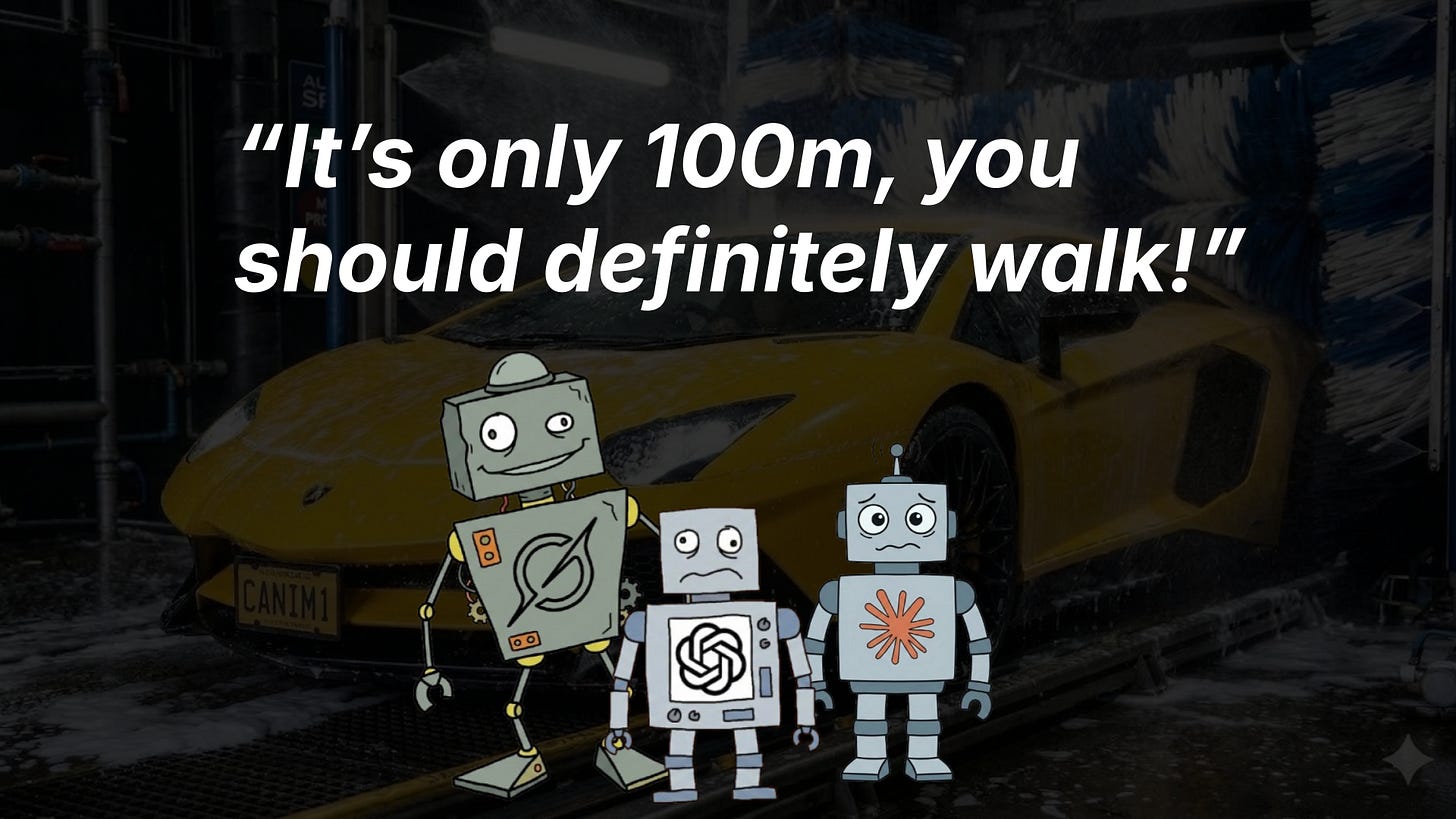
You need the car to be at the car wash, because the car is the thing being washed. The car cannot be washed in absentia while you stroll there on foot, no matter how good your intentions. When this prompt went viral, ChatGPT, Claude, and Grok all confidently advised the user to walk.
Where the pattern gets harder to control
Here is where most "AI in marketing" posts stop. They wag a finger at the car wash, suggest you keep "a human in the loop," and head off to write a LinkedIn post about it (probably with ChatGPT). But the failure modes are the comfortable bit.
The dangerous bit is what happens when the LLM is good at the task you've given it. Because if a model is "good" at a task, it means there is a great deal of training data showing it how the task is normally solved. And if it has consumed all of that training data, alongside every other frontier model, all trained on roughly the same scrape of the internet then the output it produces will, almost by definition, sit somewhere very close to the mean of what everyone else is already doing. This connects with LLMs & the Low Bar when the same signal needs a clearer operating decision. A useful companion note is It Comes from Other People, because it looks at a nearby part of the same system.
Where the pattern gets harder to control is a reminder that AI visibility needs better instrumentation than a single share score. The useful question is whether the metric changes a decision about content, brand evidence, or revenue quality.
Exhibit B: Parliament Has Been LinkedIn ified
If you want to see what convergence looks like in the wild, look no further than the House of Commons. The Pimlico Journal analyzed every word spoken in Hansard from 2007 to 2025 and tracked the Z-score frequency of phrases that are tell tale ChatGPT tics. "I rise to speak." "Is not merely." "Navigating." "Underscores." "Streamline." "Not just a [X], but a [Y]." "Bustling." Phrases that pootled along the baseline for 15 years and then, almost to the week of ChatGPT's release in late 2022, shot vertically off the chart.
"I rise to speak" alone hit a Z-score of 3.60 by 2025. The Telegraph picked the story up under the headline "ChatGPT triggers surge in MPs using AI written speeches". Set aside the democratic implications for a moment (they are not good).
Exhibit B: Parliament Has Been LinkedIn ified is where brand work becomes machine readable. Consistent third party evidence, clear entities, credible pages, and a stable narrative help search systems understand what the brand should be trusted for.
Exhibit C: Tactical MSPaint.exe On LinkedIn
I have, by accident, run my own counter experiment. For the past while, I have been posting unsolicited #SEO tips and Core Updates round ups on LinkedIn, accompanied by absolutely terrible MS Paint drawings. Not stylized "playful illustrations" produced by some agency.
Genuinely bad pictures of a stick man labeled "SEO" pointing at a robot labeled "GSC," drawn in MSPaint.exe by someone who should not be allowed near a graphics tablet. One of the most common comments I get is some version of "I love these images, they feel warm," or "something about making things your own." Which is exactly the point. There is a growing, almost feral hunger for content that is demonstrably human made; content that signals "an actual person sat down and did this, on purpose, for you." Or, as Tyler Durden put it in Fight Club: "The glass dishes with tiny bubbles and imperfections, proof they were crafted by the honest, simple, hard working indigenous peoples of wherever" That line was originally a joke about middle class consumerism.
Exhibit C: Tactical MSPaint.exe On LinkedIn points to a wider intent shift. When community, forum, or video surfaces gain visibility, the content plan has to account for where the user expects lived experience, not only which owned page should rank.
What This Means For Digital Marketing
So what do you actually do with this, beyond nodding sagely and going back to prompting? Use LLMs where they are good, on purpose, and accept the mean. For commodity work: fixing alt text at scale, summarizing a meeting, drafting a polite reply to that client who is technically wrong.
LLMs are excellent here, and the cost of being average is zero. Nobody is going to choose your brand based on the quality of your internal Slack summary. Use the tool, save the time, move on.
What this changes in the search system
I have, by accident, run my own counter experiment. For the past while, I have been posting unsolicited #SEO tips and Core Updates round ups on LinkedIn, accompanied by absolutely terrible MS Paint drawings. In this context, the useful work is to connect the claim to evidence, measurement, and the wider search system before deciding what should change.
The response is not to copy forum content. It is to understand why forum pages satisfy the query: lived experience, specificity, freshness, disagreement, and practical language.
What this changes in the search system
Let's start with the bit that the AI labs would rather you didn't dwell on. Large language models do not "think" in any meaningful sense. In this context, the useful work is to connect the claim to evidence, measurement, and the wider search system before deciding what should change.
What this changes in the search system should connect back to page architecture, internal links, supporting evidence, and the way the topic is refreshed over time. That is what turns a one off article into a stronger part of the content system.
Comments
Comments are reviewed before they are published. Links are not allowed inside comments.