The Real Reason the New York Times Puts Free Content First
/ 6 min read

Summary
Not every article needs to drive an immediate subscription. Nor is it going to. Making selected articles free to air helps. The practical question is what this changes for SEO, content quality, and AI search visibility.
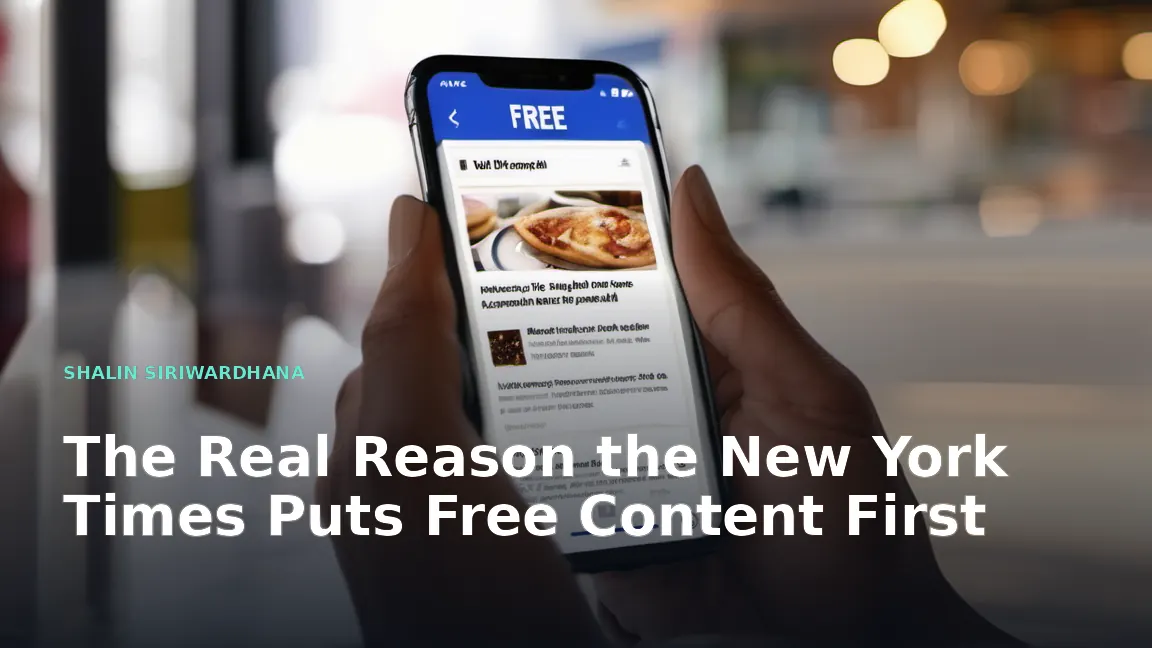
It seems counterintuitive for a business built on subscriptions to give away its best real estate for free. Yet, the New York Times does exactly that. They don't just offer free articles; they prominently signal to the reader that the content is free before they even click.
For anyone managing a paywall, the instinct is usually to protect the product. But there is a strategic difference between protecting your revenue and suffocating your growth. When you look at how the most successful publishers operate, you see that free content isn't a leak in the bucket, it is the top of the funnel.
The Strategic Value of Open Access
Expanding Your Reach
Not every piece of content is designed to trigger a subscription. In fact, expecting every article to convert a stranger into a paying member is an unrealistic goal. By selecting specific stories to remain free, publishers can maximize their visibility on high competition topics.
This is particularly critical for Search Engine Optimization. If we assume that Google prioritizes engagement metrics, then a hard paywall is a liability. Paywalls often lead to higher bounce rates and shorter time on page because users hit a wall and leave immediately. By removing that barrier for certain high value pieces, you can compete more effectively against sites that don't have paywalls.
Expert Interpretation: The tradeoff here is immediate monetization versus long term discoverability. If you paywall everything, you are essentially telling search engines that your content is only for a small group of people. The decision to make content free should be based on the "competitiveness" of the topic. If everyone else is writing about it for free, you likely need to do the same to maintain your ranking and reach.
The Psychology of Explicit Labeling
There is a hidden friction in subscription models: the "paywall assumption." Once a brand becomes known for charging for its content, users start to assume that every link they click will lead to a payment prompt. This means that even when you provide a free article, a significant portion of your audience might not click it because they assume it is locked.
The New York Times solves this by explicitly labeling free content. They don't leave it to chance; they tell the user it is free. This simple act of labeling reduces the perceived risk of the click, which directly improves engagement and reach.
Live blogs are a perfect example of this. Many publishers keep live updates free because they are highly competitive in search and serve as an entry point for new users. However, few publishers actually label them as "free." This is a low cost experiment that can yield immediate results in click through rates.
Expert Interpretation: This is a lesson in user experience. The value exchange on the internet is fragile. When you remove the uncertainty of a paywall, you lower the cognitive load for the user. You should inspect your current user journey: are you forcing users to "guess" if a piece of content is free, or are you inviting them in with a clear signal?
Building a Pipeline for Future Revenue
It is helpful to stop viewing free content as lost revenue and start viewing it as a marketing touchpoint. In any sales process, you have to move a lead from a cold state to a warm state before asking for a commitment.
Free content serves as the introduction. It allows a cold audience to experience the quality of the journalism or the depth of the analysis without financial risk. It is an investment in the relationship rather than a transaction. By providing value upfront, you create a future opportunity for a subscription once the user trusts the brand. The same pattern also shows up in X Robots Tag, where the practical question is how the signal becomes visible.
Expert Interpretation: The danger here is the "free trap," where you provide so much value for free that there is no incentive to pay. The balance lies in providing enough value to prove quality, but leaving enough curiosity or utility behind the wall to justify the cost. The decision is about where to draw the line between "introduction" and "product."
Testing and Implementing This Strategy
The way you apply this depends on where your brand sits in its growth cycle. A brand that is just starting to introduce premium features has a different set of priorities than a legacy publisher with a massive existing archive.
For Emerging Premium Brands
If you are moving from a completely free model to a premium one, you may not feel the "paywall assumption" yet. However, it is still a smart move to create a dedicated "free to access" section on your homepage. This sets a clear expectation for your audience and helps you segment your content strategy from day one.
For Established Premium Publishers
If you already have a strong paywall, you should focus on three specific areas:
Labeling: Be explicit. Use badges or clear text to signal that a piece of content is open to everyone. Prominence: Look at the New York Times. They place free content in their most trafficked areas. They use this traffic to funnel users toward their app. You need to define what your primary goal is and place your free content in a way that leads users toward that goal. Measurement: Shift your KPIs. While traffic is often a secondary metric for subscription businesses, you need to identify which specific traffic metrics actually predict a subscription. Is it the total number of visits, or is it the session duration and the frequency of returning visits?
Expert Interpretation: Many companies make the mistake of treating all traffic as equal. To make this strategy work, you must distinguish between "vanity traffic" and "qualified traffic." The goal of free content isn't just a high page view count; it is to identify users who exhibit the behaviors of future subscribers.
Optimizing for Visibility
To truly maximize the impact of free content, you should experiment with visibility beyond the homepage. This includes adding "free to air" badges to featured images or incorporating this information into structured data and Open Graph images. This ensures that when your content is shared on social media or appears in search results, the user knows there is no barrier to entry.
Very few brands can survive on a hard paywall alone. For the vast majority of us, free content must be a deliberate part of an audience acquisition strategy. It is the bridge that allows a stranger to become a reader, and eventually, a subscriber.
Why This Matters
Introduction The world's most successful subscription publisher, The New York Times, regularly gives some of the most valuable real estate on its homepage to free articles, and, crucially, makes sure readers know they're free. It's a. The practical read is that brand signals need to be consistent enough for both people and AI systems to form a stable view of the company, its expertise, and its trust signals. A useful companion note is Brand Signals Are Rewriting the Authority Stack, because it looks at a nearby part of the same system.
The risk is usually hidden in the execution layer. A page can look fine to a human and still fail for an automated visitor if the form, call to action, rendering path, or confirmation step is not accessible enough for the agent to complete the task.
1. Free Content Maximizes Reach
Not every article needs to drive an immediate subscription. Nor is it going to. Making selected articles free to air helps publishers maximise reach around important, highly competitive stories. It also gives subscription publishers a. The search implication is whether the section improves the evidence around the page, not simply whether it adds more wording. Clear entities, crawlable structure, internal links, and useful context are what make the topic easier to evaluate. This connects with Real Reason Internal Links Quietly Decay & when the same signal needs a clearer operating decision.
The useful check is whether this improves the system behind search performance, not only the words on the page. Internal links, crawlable content, clear entities, current evidence, and a sensible page structure all help the recommendation become easier to trust.
Comments
Comments are reviewed before they are published. Links are not allowed inside comments.