AI Search Loves Listicles: What 25,000 URLs Reveal About Citations
/ 6 min read

Summary
Of the roughly 25,000 unique URLs we reviewed, half were listicles. Across nearly 400 million citations from all models, 63%. The practical question is what this changes for SEO, content quality, and AI search visibility.
For a long time, we’ve focused on how to rank in a search engine results page. But the goalpost has shifted. Now, the real challenge is ensuring that when a user asks an AI for a recommendation or an explanation, your brand is the one being cited in the response. This connects with We Earned 1 when the same signal needs a clearer operating decision. The same pattern also shows up in X Robots Tag, where the practical question is how the signal becomes visible.
The reality is that we have very little control over the massive training datasets that build these models. However, we have a significant amount of influence over the content these models retrieve in real time via internet searches to supplement their answers. If you want to change what an LLM says about your business, you have to change what it finds when it looks for you.
Recent research from Evertune provides a rare, data backed look at this process. By tracking hundreds of brands across 250 categories, they analyzed the 6,000 most cited URLs for six major models: ChatGPT, Copilot, Gemini, Google AI Mode, Google AI Overview, and Perplexity. The findings from these 25,000 unique URLs offer a practical roadmap for anyone trying to navigate the transition from traditional SEO to Generative Engine Optimization (GEO).
The dominance of the listicle in AI citations
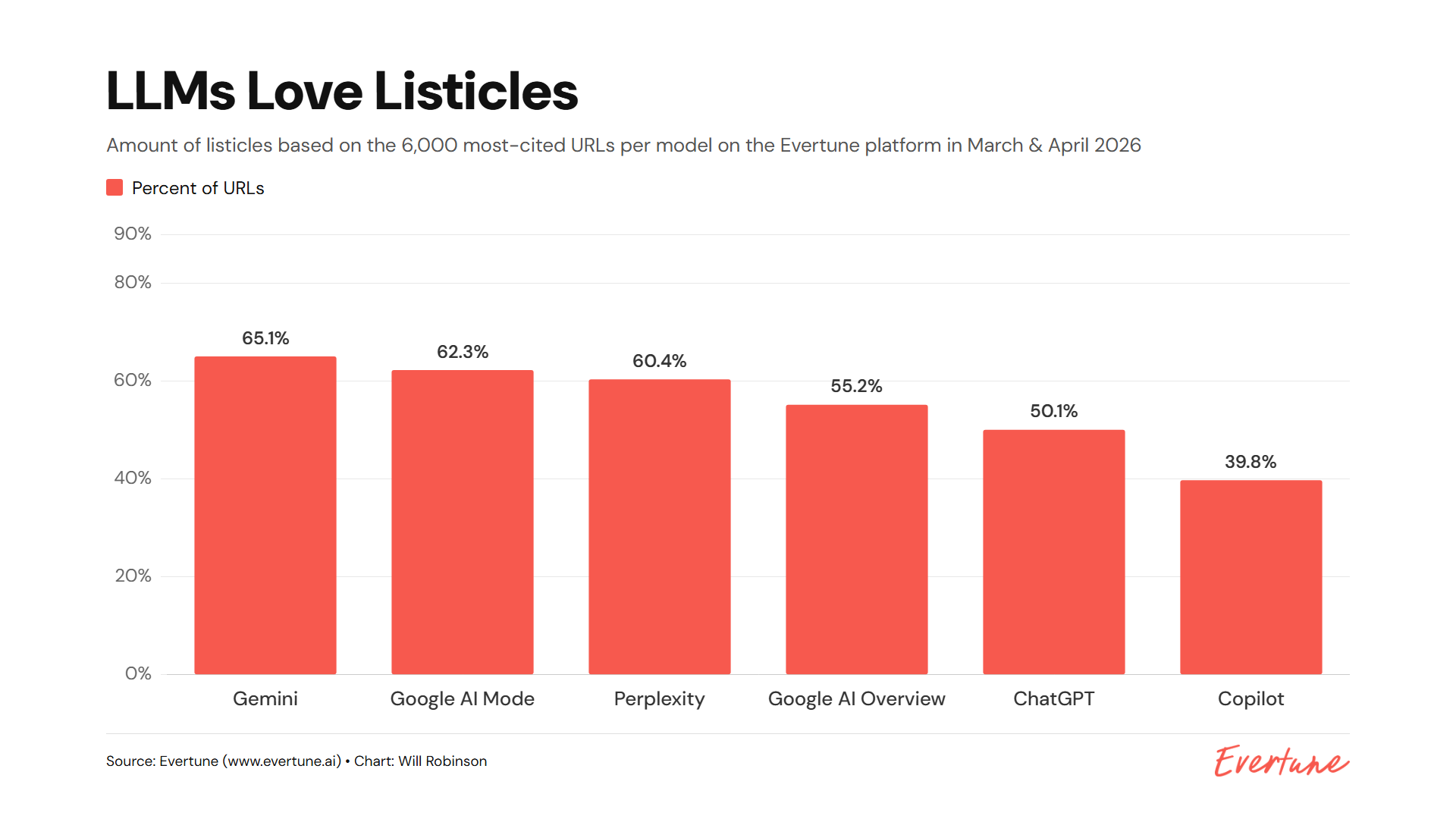
The most striking finding from the data is just how much LLMs lean on listicles. Out of the 25,000 unique URLs analyzed, half were listicles. Even more telling is the citation volume: 63% of nearly 400 million citations across all models pointed back to listicle style content.
This isn't a coincidence. Listicles are essentially pre digested information. They are tightly focused on a specific intent, such as "the best laptops for gamers", which aligns perfectly with the way users prompt AI. Because the format is structured, it is significantly easier for a model to parse, synthesize, and reproduce in a chat interface.
For brands, this is particularly important when it comes to product comparisons. Listicles often do the heavy lifting for the AI by comparing features, pricing, and materials side by side. This structured comparison is exactly what ChatGPT now leverages in its shopping widgets.
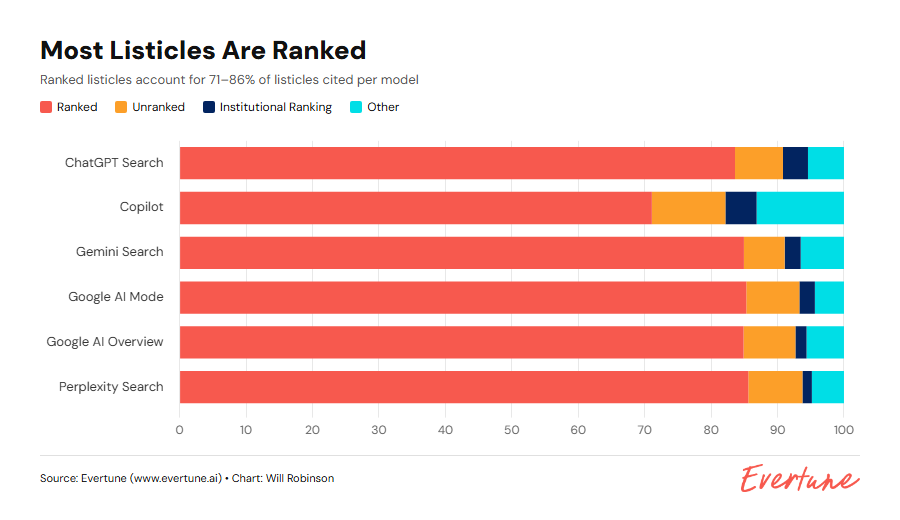
Not all lists are created equal, however. The data shows a strong preference for ranked lists (e.g., "Top 5 CRM Tools"), which made up between 71% and 86% of the listicles cited, depending on the model. Unranked lists, like "7 Ways to Save on Groceries," were far less common. Institutional rankings, the heavy, data driven lists like those from U.S. News & World Report, represented a tiny fraction of the citations, between 1.4% and 4.7%.
Expert Interpretation: This reveals a critical tradeoff between "prestige" content and "utility" content. While a deep dive whitepaper might establish your authority with a human reader, a ranked list is what gets you cited by a bot. The decision here isn't to abandon long form thought leadership, but to ensure that your core value propositions are mirrored in the "Top X" formats that AI models prefer. If your product isn't appearing in ranked lists on third party sites, you are effectively invisible to a large portion of AI driven discovery. A useful companion note is 000+ Tracked Events Reveal, because it looks at a nearby part of the same system.
Where models agree (and where they diverge)
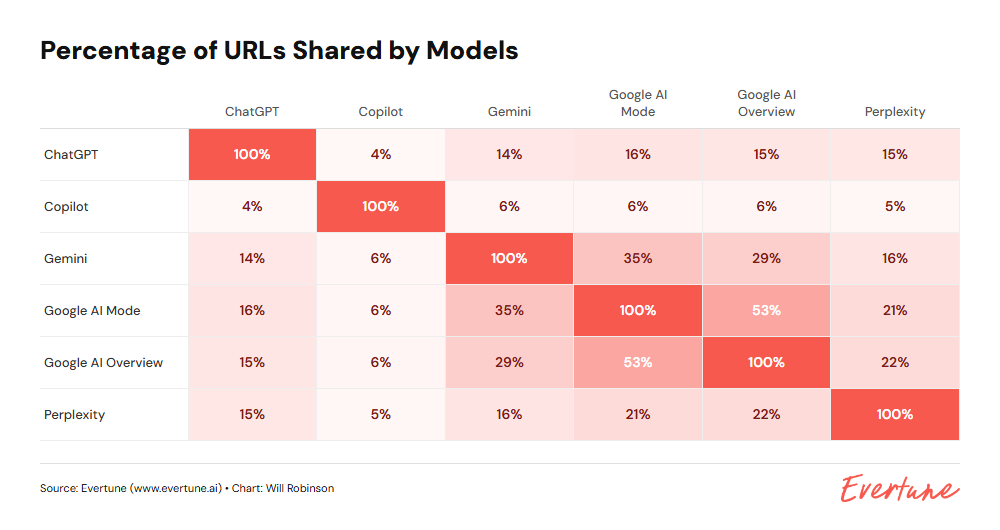
When looking at the 6,000 most cited URLs across six models, there is a theoretical pool of 36,000 URLs. In reality, there were only 25,000 unique URLs. This overlap suggests that while each AI has its own "personality," they are often drinking from the same well of information.
The strongest overlap exists within the Google ecosystem. Gemini, Google AI Mode, and Google AI Overviews share a massive amount of common ground. More than half of the URLs cited by Google AI Mode also appear in Google AI Overviews, and Gemini shares a similarly large portion of its top sources with both.
Other models show some overlap with Google's tools, though to a lesser extent. Perplexity shares over 20% of its cited URLs with Google AI Mode and AI Overviews, while ChatGPT shares more than 15% with each.
The outlier is Microsoft Copilot. Copilot showed very little overlap with other models, sharing only 4% to 6% of its cited URLs. This divergence is likely due to a combination of different training sets, varying crawl permissions, and the specific way Copilot integrates with Bing's index.
Expert Interpretation: The high overlap among Google powered models means that if you optimize for one, you likely win across the board for that ecosystem. However, Copilot's independence is a warning against a "one size fits all" strategy. The decision for a content strategist should be to identify which AI tool their specific target audience uses most. If your customers are heavily embedded in the Microsoft ecosystem, the tactics that work for Gemini might not move the needle for Copilot.
The anatomy of a highly cited page
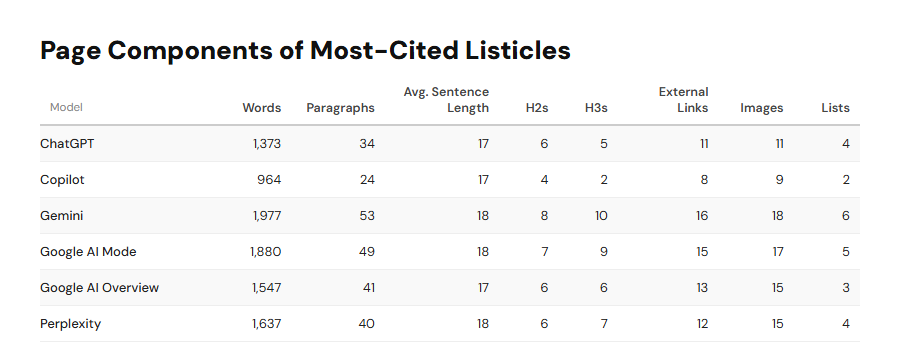
While there is no magic formula that guarantees a citation, the data reveals clear patterns in the physical structure of the pages that LLMs prefer. Most of the 25,000 heavily cited URLs fell within a length of 1,000 to 2,000 words.
Other common traits included:
An average sentence length of around 18 words. Frequent use of internal and external links. Consistent use of structured headings (H2s and H3s) to organize the narrative.
Interestingly, different models have different "appetites" for length. Copilot tends to prefer brevity, typically citing pages that average 964 words and 24 paragraphs. Gemini, on the other hand, leans toward more verbose content, with cited pages averaging 1,977 words and 53 paragraphs.
Expert Interpretation: This suggests that "readability" for an AI is closely tied to "scannability" for a human. The use of H2s and H3s isn't just for UX; it's a signaling mechanism that tells the AI where one point ends and another begins. The tradeoff here is between depth and conciseness. If you write a 4,000 word exhaustive guide, you might be too verbose for Copilot; if you write a 300 word blurb, you lack the substance Gemini looks for. The decision should be to aim for the 1,000 to 2,000 word range as a baseline, using clear headers to make the content modular.
Practical takeaways for Generative Engine Optimization (GEO)
The overarching lesson from this analysis is that while each LLM has its own quirks, there are universal preferences that can be leveraged to improve brand visibility and sentiment.
First, the demand for highly structured, hyper specific content is universal. Listicles are the gold standard here because they provide a clear, predictable structure. The goal should be to create these lists yourself or, more importantly, to ensure your brand is included in lists created by others.
However, there is a caveat: avoid the temptation to create "spammy" or overly self promotional lists. Google already penalizes this behavior in traditional search, and it is unlikely to be a viable path for AI citations.
Perhaps the most reassuring finding is that traditional SEO is not dead; it is the foundation of GEO. Pages that rank well for human users generally perform well in bot driven searches. This is especially evident in the Gemini based models, where there is a strong correlation between traditional search visibility and AI citations.
Expert Interpretation: The most important decision a brand can make right now is to move away from "broad" content and toward "hyper specific" content. Instead of a general guide on "How to improve productivity," a GEO focused approach would be "The 7 Best Productivity Tools for Remote Project Managers in 2024." By narrowing the scope, you increase the relevance of the page to specific user prompts, making it a more attractive candidate for a citation. The goal is to be the most precise answer to a very specific question.
Comments
Comments are reviewed before they are published. Links are not allowed inside comments.