Building a Global Content Factory with AI (Without Losing the Human Touch)
/ 8 min read

Summary
Most multinational content operations were designed to solve one problem: how to publish the same message in many languages. The practical question is what this changes for SEO, content quality, and AI search visibility.

For decades, there has been a quiet war between global headquarters and local marketing teams. HQ wants consistency, speed, and cost efficiency. Local teams want content that actually resonates with their customers, reflects local product availability, and speaks the regional dialect. Usually, HQ wins because the cost of supporting forty different markets with unique content is simply too high.
But the rise of AI search has flipped the script. We are discovering that the very efficiency we built into our global content machines is now a liability. When every market looks the same to an AI, the system stops seeing them as distinct markets and starts seeing them as duplicates. To survive this shift, we have to stop building "translation machines" and start building "knowledge factories."
The Legacy of the Efficiency Machine
Most multinational content operations were built to solve a specific financial problem: how to scale a message across dozens of languages without the budget growing linearly with every new market. To do this, the industry leaned on a set of highly effective tools designed for repetition.
Translation memory (TM) became the gold standard, storing approved sentences so they never had to be paid for twice. Machine translation (MT) provided the raw draft, which a human post editor then polished. Translation management systems (TMS) acted as the plumbing, moving content from HQ to vendors and into the CMS. Everything was wrapped in global templates to ensure a uniform look and feel. A useful companion note is 000x Human Traffic in 5 Years, because it looks at a nearby part of the same system.
The KPIs reflected this obsession with efficiency. Success was measured by cost per word, TM use, and the speed of a global launch. If a local team complained that a page "didn't feel right," it was often dismissed as a subjective preference that couldn't compete with the hard data of cost savings.
Expert Interpretation: The tradeoff here was short term margin for long term brand equity. By prioritizing TM use, companies essentially traded local relevance for predictability. The decision to ignore local nuance was a financial one, not a strategic one, and it worked as long as search engines relied on simple signals like hreflang to separate markets. The same pattern also shows up in Brand Signals Are Rewriting the Authority Stack, where the practical question is how the signal becomes visible.
Why the "Efficiency Model" Fails in AI Search
Traditional search engines were designed to select a page. AI search, however, is designed to synthesize an answer. It pulls facts, passages, and evidence from various sources to construct a response. This shift exposes a fundamental flaw in the "same message, different language" approach.
The Problem of Canonical Tokenization
When search engines encounter a cluster of pages that are nearly identical, they don't store every version in full. Instead, they use a process called canonical tokenization. One version is chosen as the primary (canonical) source, and the others are treated as alternate pointers that provide the correct language or country context. This connects with Real Reason Internal Links Quietly Decay & when the same signal needs a clearer operating decision.
This works fine for a standard results page where the goal is simply to provide the right URL. But it fails during AI retrieval. When an AI pulls a specific passage to answer a query, that passage is stripped of its URL context. If the passage comes from the canonical version, the AI may lose the information that tells it which specific market that information applies to.
The "Strongest Instance" Bias
When content is mirrored across markets, the strongest version of that content wins. In most cases, this is the U.S. or the main English site. The consequence is a breakdown in local accuracy: a customer in Germany might be given information about U.S. product availability, or a patient in Japan might see a use case for a product that isn't even approved in their country.
Translation Memory as a Deduplication Tool
There is a painful irony here for those of us who optimized for TM use. Translation memory was built to maximize reuse, but AI retrieval systems are built to discard it. Every time we reused a sentence across thirty markets, we made those markets look more identical to the machine. High TM use essentially tells the AI that these pages are not unique sources of truth, but merely copies of a single global page.
Expert Interpretation: This is a critical pivot in how we view "quality." In the old world, a perfect translation was a high quality page. In the AI world, a perfect translation of a global page is a duplicate. The decision now is whether to prioritize linguistic accuracy or informational uniqueness.
Balancing the Global and Local Engines
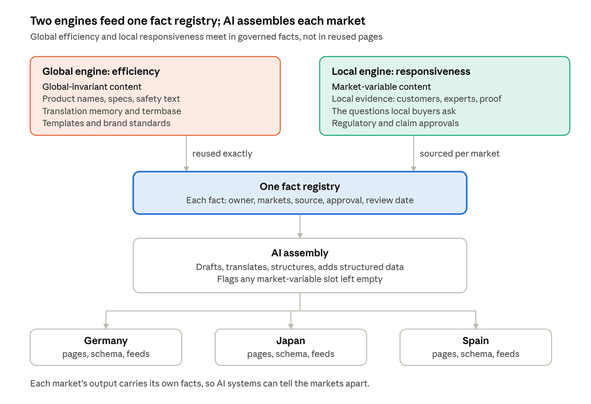
To fix this, we need to revisit the concept of the "twin engines" of marketing agility. Every multinational must balance two opposing forces.
The global engine provides the foundation: shared platforms, brand governance, and consistent standards. The local engine provides responsiveness: the ability to pivot based on local competitors, regulations, and customer behavior. Historically, the local engine was treated as a cost center to be minimized because local responsiveness was expensive.
Most companies are currently using AI to make the global engine faster. They are using it to translate more content into more languages with fewer people. This is essentially just a faster photocopier; it produces more of the same near identical pages, just at a higher velocity.
The real opportunity is using AI to make the local engine affordable. If AI handles the tedious work of drafting and formatting, local teams can stop fighting for "control" and start providing the only thing AI cannot: local evidence and judgment.
Expert Interpretation: The risk here is "AI driven bloat." If you simply speed up the global engine, you are accelerating your path toward canonical tokenization. The strategic decision is to shift AI resources away from translation and toward the assembly of localized knowledge.
The Architecture of a Modern Content Factory
A content factory designed for the AI era stops treating "pages" as the primary product. Instead, the product is governed, market scoped knowledge. Pages are simply one way to publish that knowledge.
1. The Fact Registry
Before a single word is written, the organization needs a Fact Registry. This is a single source of truth where every claim is documented. A registry entry should include:
Which specific markets and languages the fact applies to. The source of evidence for the claim. Approval status from legal, medical, or regulatory bodies. The expiration date for the next review.
This prevents a fact that is true in the U.S. from being accidentally retrieved as a truth for the UK or France.
2. Separating Invariants from Variables
The translation workflow must change. We have to distinguish between global invariant content and market variable content. Global invariants, such as product names, should remain identical across languages so AI systems recognize them as the same entity. However, market variable slots must be treated differently. If a slot for local evidence is empty, the system should flag it for a human, rather than defaulting to the U.S. version.
3. AI as the Assembler
Once the fact registry and segment rules are set, AI takes over the assembly. It drafts content based on approved facts, structures pages around actual local questions, and ensures the correct local evidence is integrated. The cost savings no longer come from reusing sentences, but from automating the production of pages that are grounded in local evidence.
Expert Interpretation: This moves the "human touch" from the end of the process (editing) to the beginning (evidence gathering). The tradeoff is a higher upfront investment in governance (the registry) for a significantly lower risk of AI driven market leakage.
Redefining the Human Touch
We often think of the "human touch" as a post editor cleaning up a machine translation. But AI is already outperforming humans in several content types. The value of the human has moved upstream.
In a modern factory, local humans are required for four specific tasks: supplying local evidence (customers, certifications, and research), identifying local questions that buyers actually ask, providing local judgment on nuance, and verifying regulatory compliance.
AI can format a case study, but it cannot find a local customer willing to be a reference. It can translate a question, but it cannot tell you that buyers in Brazil care about a different feature than buyers in Germany.
Writing for Passages, Not Pages
Since AI retrieves passages that lose their URL context, the content itself must be "self identifying." We have to write in a way that ensures a snippet remains useful even when stripped from the page.
Embed the market in the sentence: Instead of saying "The system is available through.", write "In Germany, the system is available through.". Date every figure: Use phrases like "As of September 2026" so the AI knows the data is current. Cluster claims and qualifiers: Keep the claim, the market, the date, and the regulatory context in the same paragraph so they are retrieved as a single unit. Use question shaped headings: Match the headings to the actual questions local buyers ask and provide the answer in the first two sentences.
Expert Interpretation: This is a shift from "creative writing" to "structured communication." The tradeoff is that the prose may feel slightly more repetitive, but the benefit is a massive increase in the accuracy of AI generated answers.
Measuring Market Leakage
Most global teams track how many pages they published. They should instead track what AI assistants are actually saying about them in each market. This requires a system of priority prompts in the local language, run regularly across major AI assistants.
The most critical metric is "market leakage." This occurs when an AI provides an answer for one market using content from another. Tracking this gives local teams tangible evidence that their need for unique content is a business necessity, not just a preference.
It is also vital to test in the local language. An English only visibility check will never reveal what a user in Seoul or Madrid is experiencing.
The Cost of Silence in Regulated Industries
In regulated industries, like medical devices, the risks are higher. A company might have a technically perfect site with correct hreflang and localized URLs. To a traditional SEO, it looks great. But to an AI, it is invisible.
Comments
Comments are reviewed before they are published. Links are not allowed inside comments.