Good Vs. Bad PSEO: Learnings from a Decade of Building Scalable Content Engines
/ 7 min read

Summary
Programmatic SEO is a way of publishing, not a kind of content. It has three parts: a repeatable search pattern, a structured. The practical question is what this changes for SEO, content quality, and AI search visibility.

The barrier to publishing at scale has effectively vanished. With generative AI, a brand can spin up thousands of pages in a single afternoon and call it a programmatic SEO strategy. For a while, this worked. It drove massive traffic and organic revenue, and because the cost was low and the speed was high, it was an easy sell to management. A useful companion note is X Robots Tag, because it looks at a nearby part of the same system. The same pattern also shows up in to Get Cited & Stay Visible, where the practical question is how the signal becomes visible.
But those same advantages are now the primary points of failure. We are seeing aggressive pSEO initiatives collapse or trigger manual penalties because the fundamental question of whether these pages deserve to exist was ignored. Google has tightened its scaled content abuse policies to target low quality, unoriginal content regardless of whether it was made by a human, a bot, or both. When you prioritize volume over value, you aren't building an asset; you're building a liability. This connects with We Earned 1 when the same signal needs a clearer operating decision.
Understanding pSEO as a Publishing Method
One of the biggest misconceptions in the industry is treating programmatic SEO as a content type. It isn't. pSEO is a publishing method. To do it correctly, you need three specific components working in tandem: a repeatable search pattern, a structured dataset that ensures every page is unique and valuable, and a template designed to answer the user's query for every single variation.
Consider a currency converter. The search pattern is "convert X to Y." The dataset consists of live exchange rates for every possible currency pair. The template then transforms each row of that data into a functional page. In this scenario, no one is writing thousands of articles by hand because the data does the heavy lifting. You only publish as many pages as your data can actually support.
The goal here is genuine utility. The focus should be on solving a specific problem a user has during their journey. pSEO simply makes that solution accessible across a vast array of search queries and modifiers. It is a way to tailor a solution to a specific search context, not a shortcut to inflate page counts.
Expert Interpretation: The critical tradeoff here is between "prompt driven" and "data driven" scale. If your pages are different only because you swapped a city name in an AI prompt, you are mass publishing, not doing pSEO. The decision you must inspect is the source of your uniqueness: is it coming from a database of facts, or a language model's ability to rephrase a sentence?
The Divide Between Good and Bad pSEO
From the outside, a high quality pSEO project and a mass publishing spam operation look identical. Both result in thousands of pages. To tell them apart, you have to look at the engine underneath. The distinction isn't about whether AI was used to write the copy; a page built on proprietary data and drafted by AI can be incredibly useful, while a hand written page with no data behind it is useless.
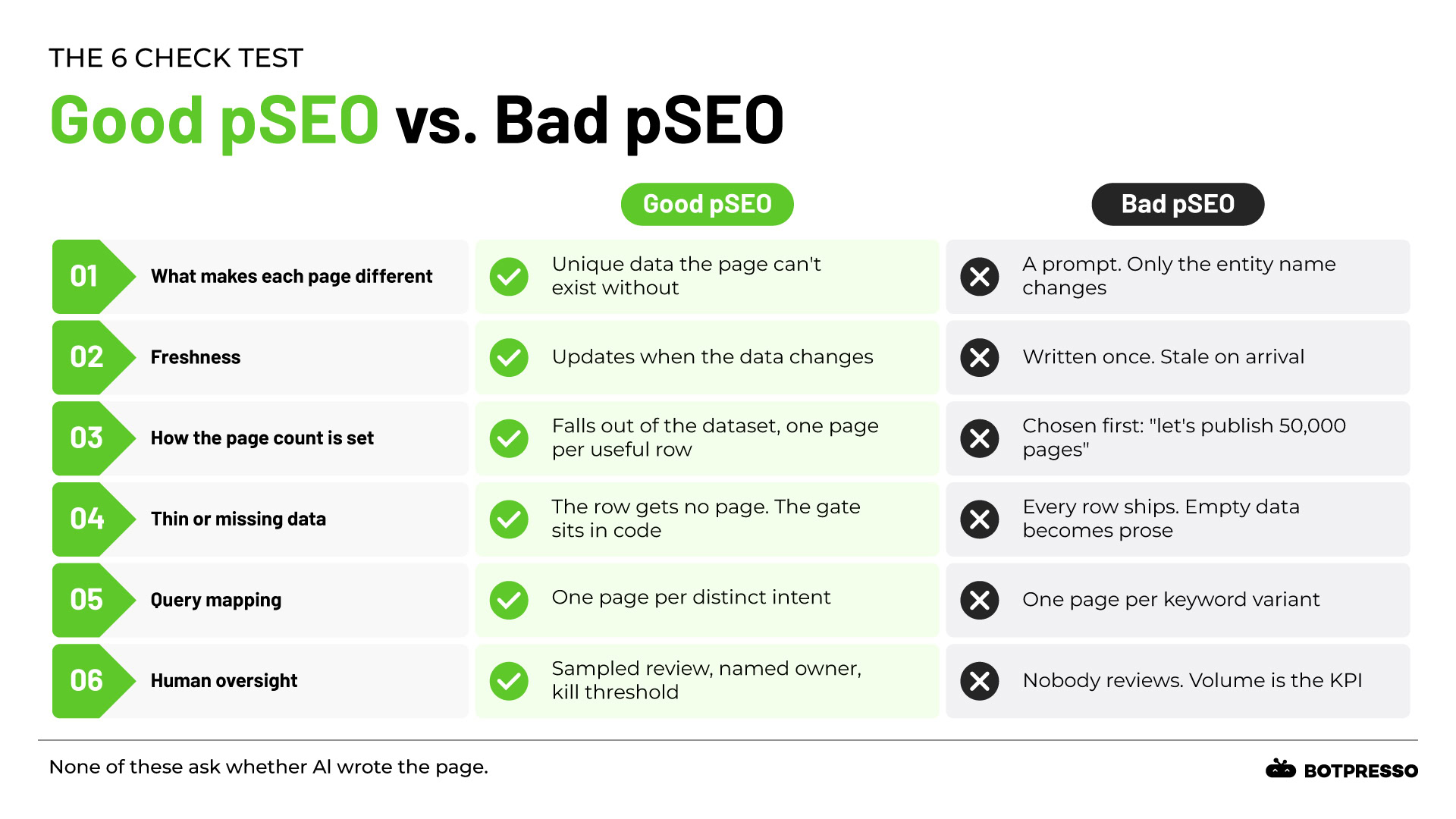
If you want to diagnose your own program, ask a simple question: would a visitor who arrived at your site directly ever land on this page on purpose? If the answer is no, the intent was likely "I want this traffic" rather than "I want to help this user."
Creating pages simply because the technology allows you to do so is programmatic spam. Good SEO, whether manual or programmatic, is defined by the benefit provided to the user. If the pages don't provide a distinct advantage or answer a specific need, they are just noise in the index.
Expert Interpretation: This is where most teams fail because they confuse "indexable" with "valuable." Just because Google will index a page doesn't mean it should be there. The risk is that low quality programmatic pages don't just fail individually; they can degrade the trust Google has in your entire domain.
The Evolution from Static Templates to AI Pipelines
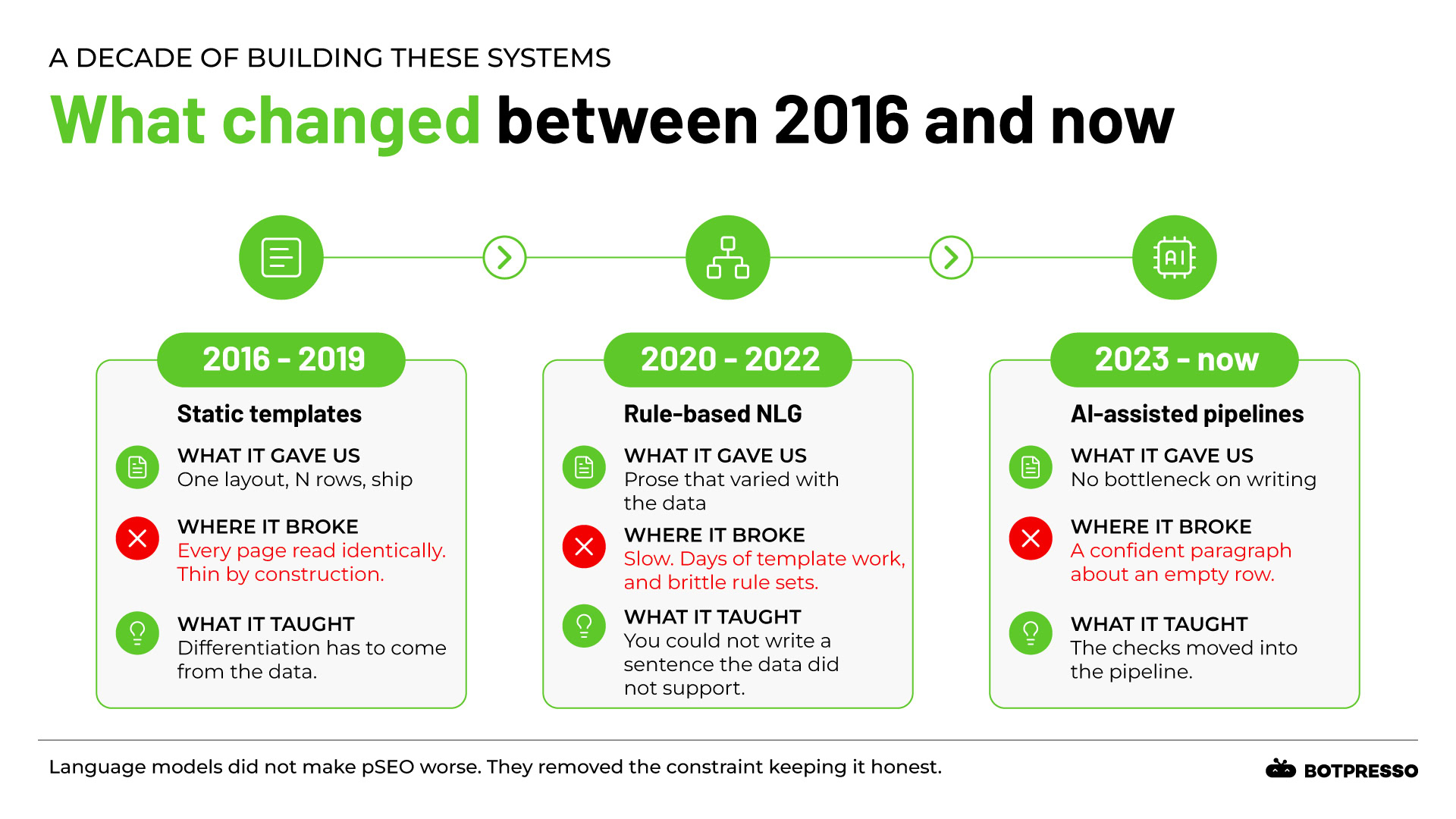
The visual output of a pSEO page hasn't changed much since 2016, but the ease of shipping a bad page has increased exponentially. In the earlier days, we used rule based engines. These systems wrote sentences based strictly on structured data; they could only say what the data and the template author allowed. The process was slow, but that slowness acted as a quality filter.
Modern language models have removed that friction. An LLM can write a fluent, confident paragraph about a data row that is essentially empty, and the average reader won't be able to tell. The tool no longer stops us from publishing nonsense.
Because of this, the workflow has to evolve. The human role has shifted from writing to architecture and auditing. Humans must now do the research and define the structure of each page, the AI drafts the sections based on that strict structure, and a subject matter expert reviews the facts and brand alignment before the page goes live. We are no longer limited by our tools, so we must be limited by our own standards.
Expert Interpretation: The tradeoff here is speed versus accuracy. AI pipelines allow for near instant deployment, but they introduce "hallucinated utility", content that looks helpful but provides no real value. The decision point is where you place your human review: if it's at the end of a 10,000 page run, it's too late. Review must happen at the template and sample level.
A Rigorous pSEO Pre Flight Checklist
To avoid the "spray and pray" trap, I use a specific set of checks at different stages of the publishing lifecycle.
Before the First Page Ships
Before a single URL is created, you need to verify the foundation. First, identify a unique data source. If you cannot point to a specific dataset that powers the pages, you aren't doing pSEO. You should also define the minimum data completeness required for a row to trigger a page; if the data is too thin, the code should prevent the page from being generated.
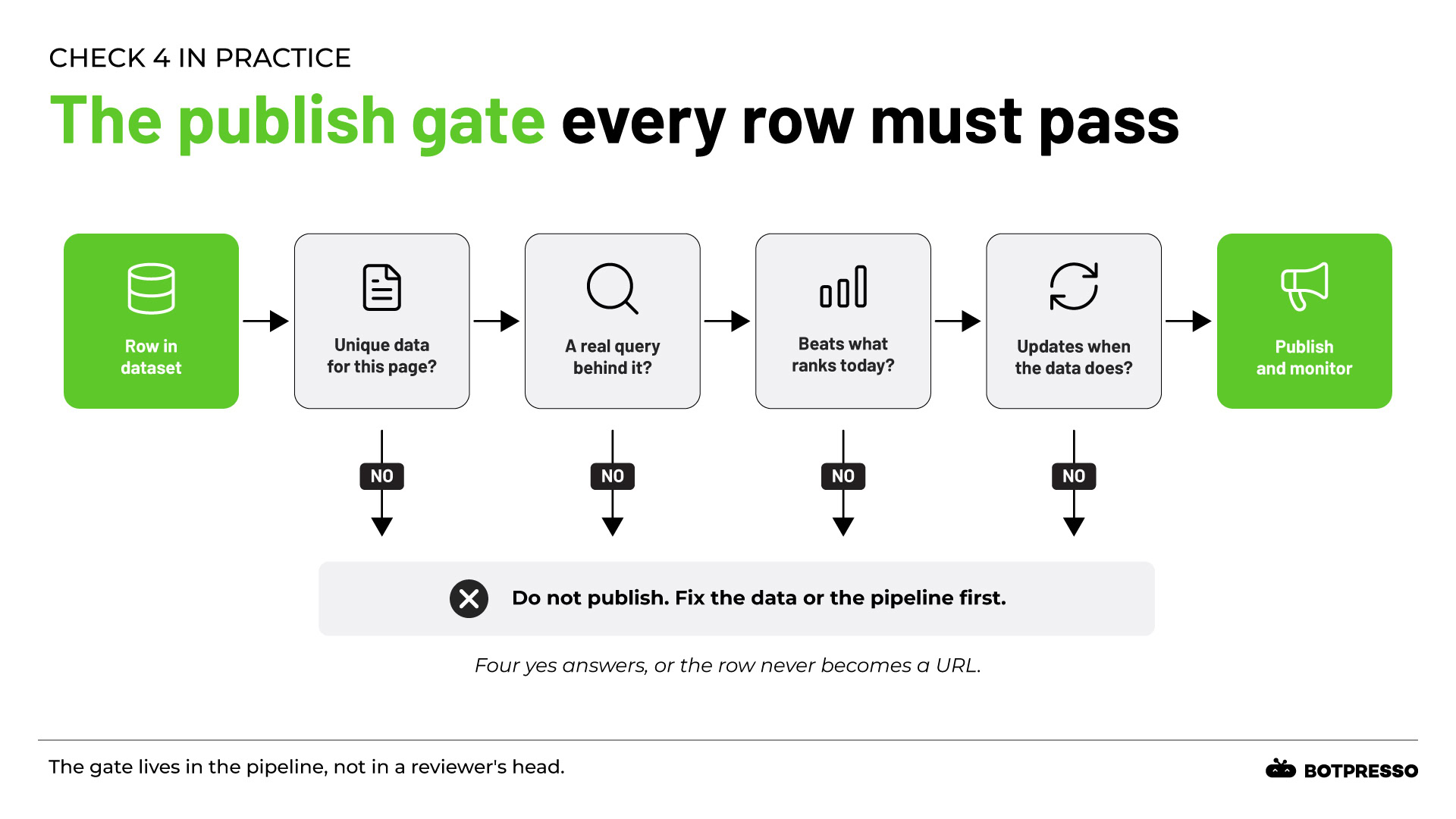
Ensure each template maps to a distinct user intent rather than just a keyword variation. Metadata, including titles, descriptions, and schema, requires as much care as the body content. Finally, establish a disclosure policy regarding how the pages are built and how often the data is refreshed. To truly stand out, look for ways to combine two datasets into something new or add your own proprietary measurements.
At the Moment of Launch
The most common failure in pSEO is publishing the entire set at once. Instead, ship a test batch of 25 to 50 pages. This allows you to monitor the indexation rate before committing thousands of URLs to the index. Use log based tracking to monitor indexation from day one, as Search Console often lags.
Most importantly, perform a manual sample review. Reading ten pages from start to finish will provide more insight into the quality and user experience than any automated SEO score ever could.
Ongoing Maintenance and Pruning
Once the pages are live, the work shifts to maintenance. Track crawl hits per URL by template on a monthly basis. You must establish a "kill rule" before you even launch: if a certain percentage of a page set earns no impressions (including within AI generated search features) over a specific window, those pages must be pruned or merged.
Whenever a template is edited, remember that you are changing every single page in that set simultaneously, which necessitates a full re review. Pruning should happen on a regular schedule, not as a reaction to a Google core update. By the time an update hits, the site level trust may already be compromised.
Expert Interpretation: The hardest part of pSEO isn't publishing; it's deleting. There is a psychological bias toward growth, but in pSEO, pruning is a growth strategy. The decision to delete underperforming pages is what separates a sustainable content engine from a spam site.
Adapting pSEO for the Era of AI Search
The landscape of search is shifting. Data shows a significant increase in zero click searches, partly due to AI Overviews that provide answers directly on the search results page. For programmatic pages, this means that raw traffic can no longer be the only metric of success. The click may never happen, but the influence remains.
Your content still shapes the answers that AI provides. The goal now is to build fewer pages, but ensure each one holds data that is genuinely unique. If an AI needs a source for specific data, such as rental price ranges in a particular city, it will link to the page that provides that unique data. It has no incentive to link to a page that simply repeats information found on a dozen other sites.
In this environment, the value of proprietary data is magnified. The focus shifts from capturing the click to becoming the authoritative source that the AI relies upon to generate its answer.
Expert Interpretation: We are moving from a "traffic first" model to an "influence first" model. The tradeoff is that you may see lower session counts even as your brand's visibility increases. The strategic decision here is to pivot from quantity to "data density", making each page so information rich that it becomes an indispensable reference point for both humans and AI.
Comments
Comments are reviewed before they are published. Links are not allowed inside comments.