How Brand Evidence Shapes AI Opinions
/ 6 min read

Summary
Everything you put into your footprint is fodder for three things AI has to decide about you. Together, they provide the fodder. The practical question is what this changes for SEO, content quality, and AI search visibility.
AI forms opinions about your brand from what it can see online. That's your digital footprint.
The problem is that AI often sees only fragments of your business. It sees your website, content, reviews, and mentions, but much of the expertise, customer insight, and operational knowledge that makes your business valuable never makes it into the digital footprint. The solution is to surface that knowledge, organize it into a single source of truth, and turn it into machine readable signals.
What you feed the machines is understandability, credibility, and deliverability (UCD)
Everything you put into your footprint is fodder for three things AI has to decide about you. Together, they provide the fodder for the whole funnel.
What you feed the machines is understandability, credibility, and deliverability (UCD) is where brand work becomes machine readable. Consistent third party evidence, clear entities, credible pages, and a stable narrative help search systems understand what the brand should be trusted for.
Understandability
Does AI know who you are, what you do, and who you serve? You already know where your understandability comes from: What often gets missed is the operational detail that explains what you actually do once a client is inside.
Credibility
Does AI believe you're good at it? This is N-E-E-A-T-T credibility, notability, experience, expertise, authoritativeness, trustworthiness, and transparency, an extension of Google's E-E-A-T. You know what credibility signals you currently feed: your case studies, your credentials, and your testimonials.
What many businesses don't realize is how much N-E-E-A-T-T credibility is already embedded in their day to day operations.
Deliverability
Does the AI engine have the content to hand you to the subset of its users who are your audience? You know where your deliverability comes from: the topical content, the marketing, and the authority pieces you commission. Deliverability is often hiding in plain sight, in the content generated by your business operations and offline activities.
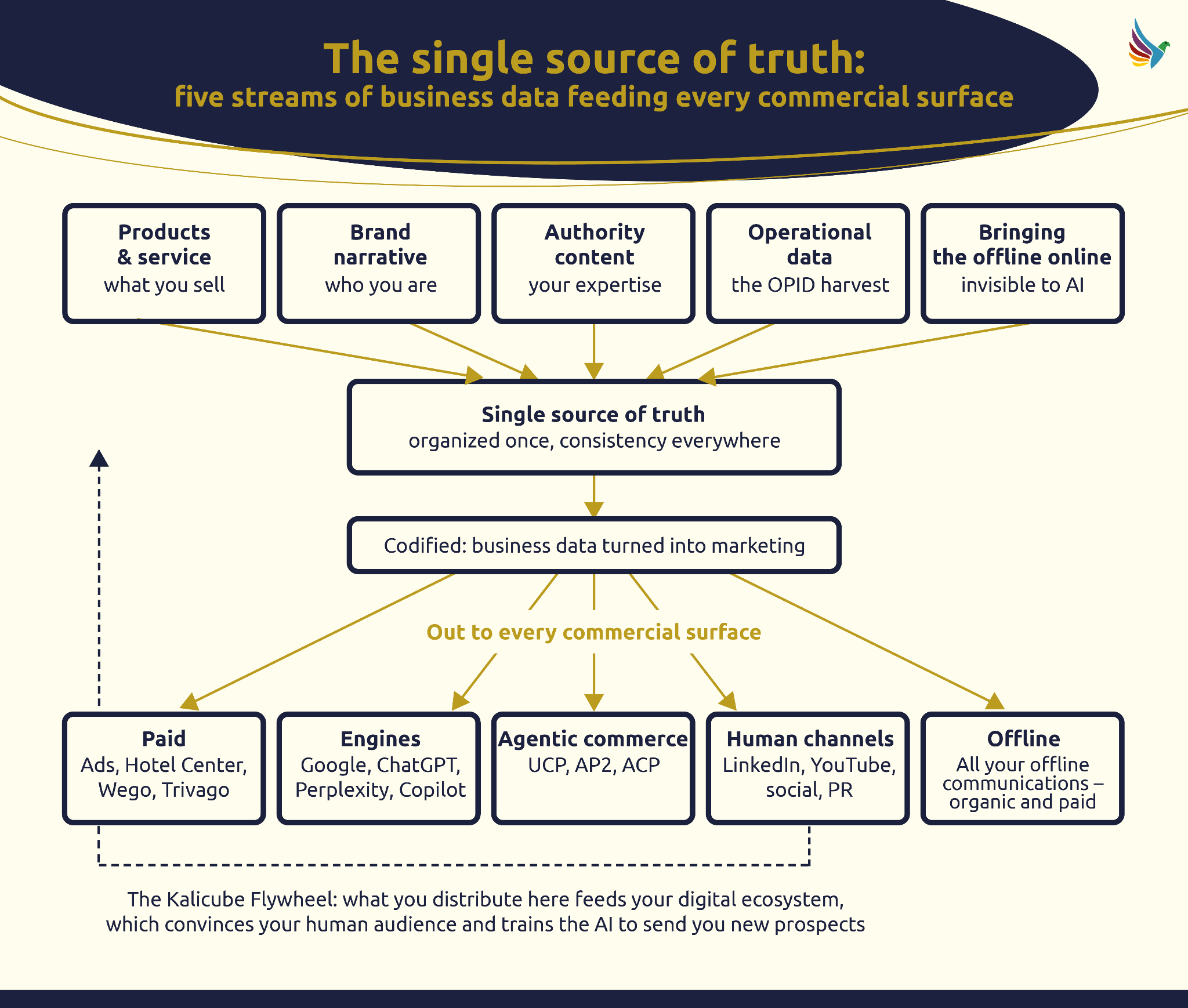
5 streams of business data feeding every commercial surface
All three elements of the UCD trio are fed by the five inputs below, and how much each contributes varies by business. The point isn't to file each input under one letter. Organized and codified, the five together give AI the fodder it needs from top to bottom of the funnel.
1. Products and services: What you sell, and you already do it
Your products and services data: what you sell, at what price, under what conditions, and with consistent names and identifiers. This is mostly about understandability, with credibility riding alongside it. Most businesses already do this, so the work is in the depth, not the effort.
Don't just list what you sell. Describe who each offering is for, what problem it solves, what it costs, what it doesn't do, and how it differs from the next option. A thin product page tells AI a product exists.
2. Authority content: Your expertise, and almost everybody does it
This is the marketing you already create to show you know your field: your articles, videos, guides, data studies, and the thought leadership you publish to tick the box marked "content created." People put effort into it to build authority, rank, do SEO, and position themselves as experts. It leans toward deliverability because it's what tells AI which territory to surface you in. But everybody does it, which is exactly why it's the least differentiating of the five on its own. The same pattern also shows up in We Earned 1, where the practical question is how the signal becomes visible.
It earns its weight only when it's tied to the rest: the same expertise proven by your operations and corroborated by third parties, not just asserted in a blog post. It's necessary, but it's not where your advantage hides.
3. Brand narrative and voice: Who you are, who you serve, and why you're the best
All marketers create brand narratives, so the work here is about consistency and clarity rather than invention. Everybody communicates who they are, what they do, and who they serve, and keeping that clear and consistent matters enormously. But three things are often left out, and AI needs all of them.
Intent: It isn't enough to name your ideal customer profile (ICP). You have to pair your ICP with what they're after: the cohort to intent combinations from the funnel query pathway. AI has to know not just whose problem you solve, but which problem, and at which moment, before it can hand you to them.
4. OPID business operations: The stream almost nobody harvests
This is everything your business generates by running: onboarding, performance, integration, devotion, and all the day to day activity around them. It's the most powerful of the five because the material comes from your clients and from the work your team does to serve them, which is exactly the material that rarely makes it online. It sits behind closed doors, buried in a CRM, parked on a platform nobody values, and almost nobody harvests it. This connects with What AI Says About Your Locations when the same signal needs a clearer operating decision.
It feeds all three elements of understandability, credibility, and deliverability more effectively than anything else you own. Understandability comes from the granular detail of what you actually do and the exact circumstances in which you help. Most of that is only ever discussed inside the business.
5. Bringing the offline online: The stream almost nobody runs
This section is all about the marketing and audience engagement you do offline: the talks you give, the festivals or hackathons you sponsor to support your community, the interviews, the panels, and the rooms full of clients. It's obvious to you, but largely invisible to AI. Bring the offline online and feed it to the machines by publishing self reporting content and linking to the social posts and summary articles others write.
That's a huge win most brands miss. But it works the other way, too. Your codified source of truth can feed your offline communication, so the story a client hears from you at a conference, in a newspaper, on the radio, or face to face is consistent with the story you're telling AI on the web. A useful companion note is Beyond Brand Sovereignty, because it looks at a nearby part of the same system.
Organize and codify the five into one source of truth
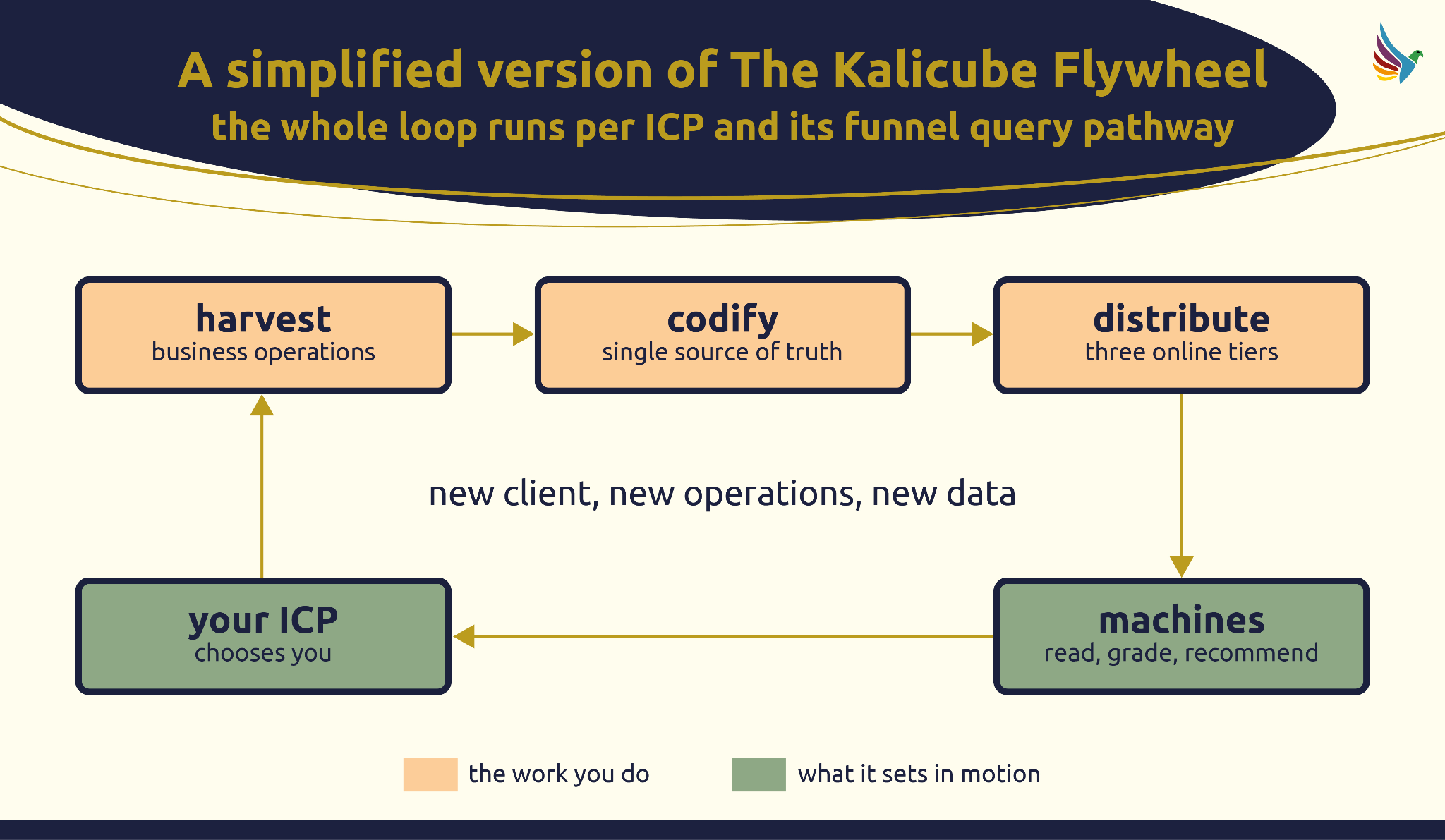
Once you've harvested all five streams, organize and codify them into a single source of truth: a database you build to output whatever format each surface needs, including HTML, schema, MCP, RDF, prose, audio, video, and images. Organize the data once, centralize it, set up a system that codifies it on the way out, and from there you can distribute it in a few clicks while your digital footprint stays clear and consistent as it grows. Then distribute it across your digital ecosystem in the format your human audience expects and packaged so machines can ingest it cleanly.
Where you publish affects how much the machine believes you, and the rule is simple: the less of you there is in it, the more it trusts it. You're working across three tiers.
First party: You claim
You publish on your own properties, in your own voice. You state who you are and set the frame. It's the baseline, and on its own it proves nothing because you wrote it and you published it.
What this changes in the search system
Everything you put into your footprint is fodder for three things AI has to decide about you. Together, they provide the fodder for the whole funnel. In this context, the useful work is to connect the claim to evidence, measurement, and the wider search system before deciding what should change.
What this changes in the search system should connect back to page architecture, internal links, supporting evidence, and the way the topic is refreshed over time. That is what turns a one off article into a stronger part of the content system.
Comments
Comments are reviewed before they are published. Links are not allowed inside comments.