How SEO Turns Customer Success into AI readable Proof
/ 9 min read

Summary
OPIDC stands for onboarded, performed, integrated, devoted, and codified. The first four stages map to the customer success. The practical question is what this changes for SEO, content quality, and AI search visibility.

Introduction
The key issue here is SEO has expanded beyond conversion into the operational side of the business, because that's where the signals AI engines increasingly rely on get created. When AI systems decide whether to recommend a brand, they evaluate post sale signals like onboarding. My read is to treat it as a decision point: what signal needs to become clearer, what part of the system is currently weak, and what evidence would show that the work is improving visibility rather than only adding activity. This connects with to Measure SEO Beyond Clicks when the same signal needs a clearer operating decision. The same pattern also shows up in We Earned 1, where the practical question is how the signal becomes visible.
That is the difference between reacting to a trend and building a useful search system. Connect this point back to the page template, internal linking, entity signals, content depth, crawl accessibility, and the way the brand is represented across the wider web before deciding what to change first.
Most of the best work a company does is invisible. It happens in private Slack channels, during quarterly business reviews, and inside the quiet satisfaction of a client who finally solved a long standing problem. For years, we treated this as the "operational" side of the business, something separate from the "marketing" side where we told the world how great we were.
That separation is now a liability. AI engines do not just look at your landing pages or your carefully crafted slogans to decide if they should recommend you. They are looking for signals that happen after the sale. They want to see if you actually onboard people correctly, if you deliver measurable results, and if your customers actually like you when you are not paying them to say so.
The tragedy is that the evidence AI needs to trust you is currently dying in CRMs and support tickets. It is trapped in the heads of account managers and delivery teams. If we want to remain visible in an AI driven search landscape, we have to stop treating SEO as a content exercise and start treating it as an evidence extraction process.
The five stages of turning success into signals
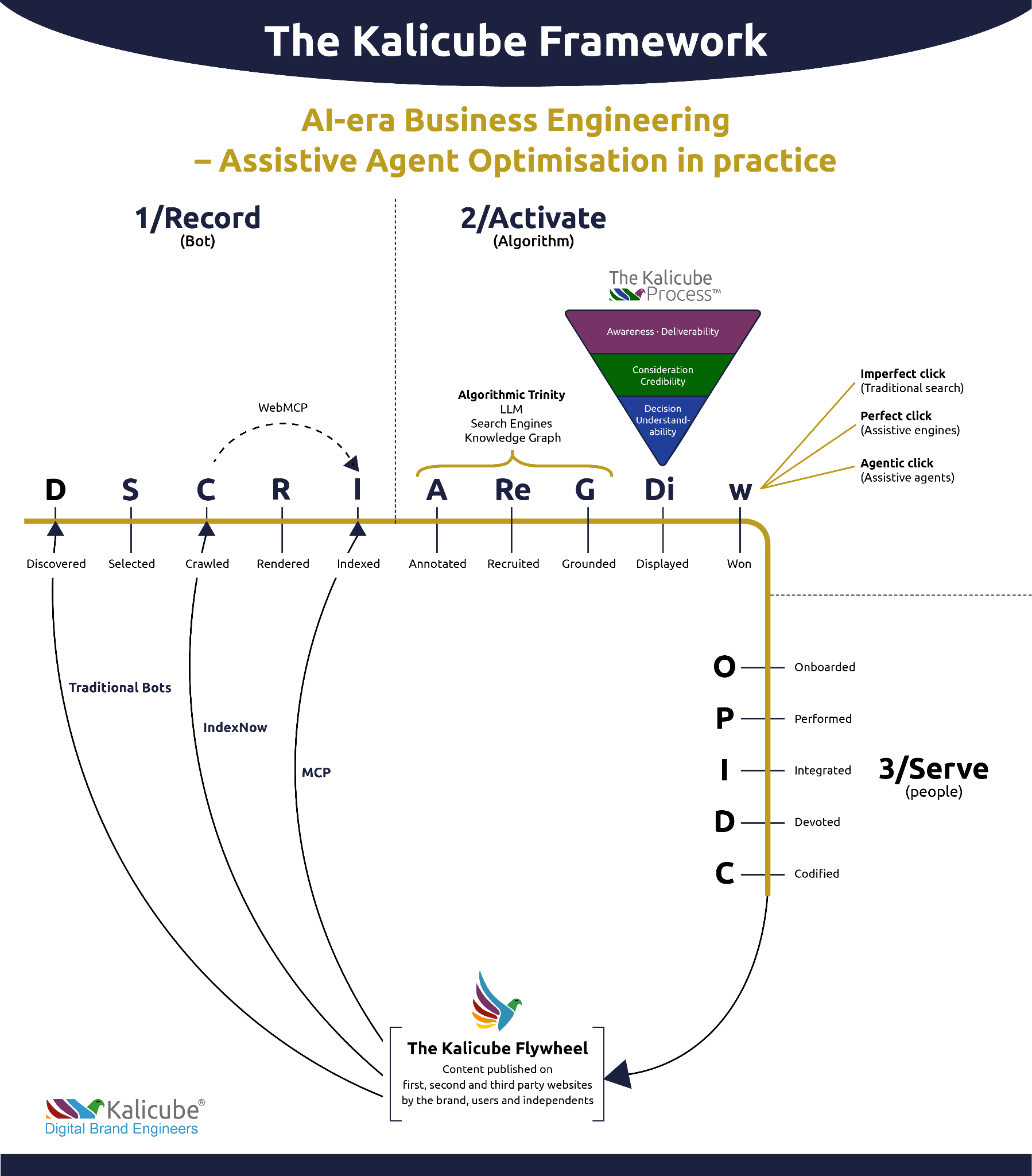
To move from invisible success to AI readable proof, I look at a framework called OPIDC. It stands for Onboarded, Performed, Integrated, Devoted, and Codified. The first four stages are not marketing tasks, they are the actual lifecycle of a customer in almost any SaaS or service business. You move them from the sale to adoption, then to retention, and finally to advocacy.
The fifth stage, Codified, is where the SEO work actually begins. Codification is the act of taking those real world experiences and turning them into machine legible evidence. It is the bridge between a happy customer and an AI engine that can evaluate and recommend your brand based on that happiness.
This creates a sequence of fifteen gates that a brand must pass through. First are the ten technical gates of the AI pipeline, which include things like being discovered, crawled, indexed, and grounded. But the final five gates are the people phase. If you fail the people phase, the technical optimization does not matter because the AI has no evidence to ground its recommendation in.
Expert Interpretation: This matters because it shifts the definition of SEO from "ranking for keywords" to "proving business value." The tradeoff here is time. Extracting real evidence takes longer than writing a generic blog post. The decision you need to inspect is whether your current SEO strategy is based on creating "content" or capturing "proof."
Operational success is the raw material
The first four stages of OPID are where the money is actually made. Onboarding is the process of moving a client from the promise of the sale to the reality of delivery. Performance is achieving a measurable outcome. Integration is becoming a structural part of the client's daily operations. Devotion is earning advocacy that the client gives freely.
These stages are managed by sales, support, and customer success teams. Marketing usually just shapes the message after the fact. But the raw material for AI visibility is not a message, it is the evidence produced by the people doing the delivery. If you want to influence AI, you have to stop asking for "content" and start asking for "harvesting."
When you approach a customer success manager and ask for a blog post, they will likely ignore you because it feels like extra work. But if you tell them that the evidence their team produces every week determines whether AI recommends the company to the next prospect, they become collaborators. You are no longer asking them to write, you are asking them to help you capture the value they are already creating.
Expert Interpretation: The risk here is friction between departments. Marketing often wants a polished story, while operations provides raw, messy data. The tradeoff is polish versus authenticity. AI engines prefer the raw, specific data over the polished marketing narrative. You must decide if you are willing to publish "unpolished" proof to gain machine trust.
Serving the human and the agent simultaneously
We are entering a period where every business has two customers. One is the human being who uses the product. The other is the AI agent that helps that human make decisions. The work of the business is to serve both, but the challenge is that the agent cannot always see the work you are doing in private.
Most of your most persuasive evidence is invisible to everyone except the client in the room. Every other prospect, and every AI agent weighing you against a competitor, is standing outside that room. The agent is the only one that can potentially see the delivery in real time, but it needs a way to evaluate that delivery against the terms you promised.
If you please the human but fail to provide the agent with readable proof of that success, you risk losing the repeat business that the agent influences. The goal is to engineer the business so that the quality of the work is visible and ingestible by the machine.
Expert Interpretation: This matters because the agent often controls the "re selection" process. The tradeoff is transparency. To be AI readable, you have to be more transparent about your processes and outcomes than you might have been in a traditional "secret sauce" business model. You must decide how much of your operational process you are willing to make public to win the agent's trust.
The verification loop of the open web
AI agents often operate within walled gardens, but they are not trapped there. When an agent sees a delivery experience that is disappointing, it does not just accept it. It returns to the open web to verify if the experience was a fluke or a pattern.
The agent looks for public evidence that either supports or contradicts the current experience. If the open web is full of independent, codified proof of your credibility, the agent may treat a single bad experience as an exception and continue to recommend you. However, if the open web confirms the weakness or shows inconsistency, the agent will conclude it backed the wrong brand and switch to a competitor.
You will never see this decision happen in a dashboard. It happens silently in the latent space of the model. The agent's loyalty is not based on a contract, but on the alignment between the direct experience and the public evidence.
Expert Interpretation: This is why "reputation management" is now a technical SEO requirement. The tradeoff is that you cannot control the narrative with a press release. You need a volume of distributed, third party proof. The decision to inspect is whether your public footprint is a mirror of your actual delivery or a fantasy version of it.
Closing the satisfaction gap during onboarding
Onboarding is the bridge between the sale and the first success. The goal is to close the satisfaction gap, which is the distance between what was promised during the sales process and what the customer actually experiences when the work begins.
Many businesses fail here because they do not align their scorecards. If the sales team promises one version of success and the delivery team measures another, the relationship breaks down in the first few weeks. To fix this, you have to ask the customer exactly how they will know the project is a success before the contract is even signed.
From an SEO perspective, this stage is critical because it defines the baseline. You cannot prove performance if you have not codified the starting point. The onboarding phase is where you capture the "before" state, which is the only way to make the "after" state readable to an AI.
Expert Interpretation: This matters because AI needs a delta to measure. A claim of "improvement" is a commodity. A claim of "moving from X to Y" is a signal. The tradeoff is the effort required to document the baseline. You must decide if your onboarding process is a mere checklist or a data collection event.
Proving performance against a baseline
Performance is not just doing the job, it is proving that the job made a difference. Most companies make the mistake of reporting outcomes in vague terms. They say "we helped the client grow" or "we improved efficiency." These are claims that both humans and AI engines are trained to question.
Proof that a machine can evaluate confidently looks like this: "Reduced support tickets by 43 percent in six months against a baseline of 1,200 a month." This is a concrete fact. It provides a starting point, a result, and a timeframe. It is a data point that an AI can use to compare you against a competitor.
The trap is measuring only what the customer notices, like a finished project or a shipped order. True performance proof is about the measurable change in the client's business baseline. A useful companion note is X Robots Tag, because it looks at a nearby part of the same system.
Expert Interpretation: This is the difference between a testimonial and a case study. The tradeoff is that specific numbers are sometimes sensitive. You may need to use percentages or normalized data to protect privacy while still providing the signal. The decision is how to balance client confidentiality with the need for machine readable proof.
Becoming a repeatable use case
Integration happens when you stop being a vendor and start being the answer the customer reaches for every time a specific need arises. This is the point where the customer stops shopping. You have become structurally embedded in how they operate.
In a SaaS context, this is the account that renews without a conversation. In a service context, it is the buyer who comes back without comparing prices. For an AI agent, this is the brand it drops into the basket because it has already run the comparison and you have won.
When you reach this stage, you have created a repeatable use case. This is the highest form of proof because it demonstrates that your value is not a one time event, but a sustainable system.
Expert Interpretation: This matters because "stickiness" is a powerful signal for AI. The tradeoff is that integration can lead to complacency. You must decide if you are documenting the integration as a static state or as an evolving partnership that continues to produce new signals.
Comments
Comments are reviewed before they are published. Links are not allowed inside comments.