The Search Everywhere Optimization Pyramid: How to Build Visibility Before Search
/ 9 min read

Summary
Peer driven decisions happen across a handful of environments specific to each industry. For example: In Facebook groups where. The practical question is what this changes for SEO, content quality, and AI search visibility.
Introduction
The key issue here is The customer journey used to start on the SERP. But that's no longer the case. By the time a buyer types a search query into Google, they usually already have a few potential brands in mind. They've: Seen the same product recommended across multiple Instagram. My read is to treat it as a decision point: what signal needs to become clearer, what part of the system is currently weak, and what evidence would show that the work is improving visibility rather than only adding activity. This connects with AI Is Merging Paid and Organic Visibility when the same signal needs a clearer operating decision. A useful companion note is Grounding Wars Are Coming, because it looks at a nearby part of the same system.
That is the difference between reacting to a trend and building a useful search system. Connect this point back to the page template, internal linking, entity signals, content depth, crawl accessibility, and the way the brand is represented across the wider web before deciding what to change first.
For years, the standard marketing playbook assumed the customer journey began with a search query. We optimized for the moment a user typed a problem into a search bar, believing that the Search Engine Results Page (SERP) was the primary discovery engine. But the reality has shifted.
If you look closely at how people actually buy today, you'll realize that by the time a potential customer reaches Google, the decision is often already half made. They aren't browsing for options with a blank slate; they are arriving with a mental shortlist of brands they've already encountered elsewhere. They've seen a specific tool praised in a Reddit thread, watched a creator demonstrate a product on an Instagram Reel, or heard a peer recommend a service in a private Facebook group. The same pattern also shows up in Which Brands Are Vanishing from AI Search?, where the practical question is how the signal becomes visible.
In this new environment, Google has transitioned from being the starting point of discovery to being the final step of confirmation. The real battle for market share is now won or lost before the search even happens.
Where the Mental Shortlist is Actually Built
The "shortlist" is the small group of brands a buyer considers viable before they ever look for a review or a pricing page. This list isn't built on a corporate website; it's built in the digital spaces where peers talk to peers.
Depending on the industry, these environments vary, but the pattern is the same. It happens in Facebook groups where the same three brands are recommended repeatedly. It happens on Reddit, where a community consensus forms around a "best in class" tool. It happens through the algorithmic repetition of Instagram Reels and YouTube videos, where influencers and independent creators create a sense of ubiquity for a brand.
We also see this in professional circles on LinkedIn, where an industry expert mentions a specific tool, or on podcasts where a trusted host gives a shout out. Even AI generated answers are now contributing to this, as LLMs consistently name the same brands when asked for recommendations.
When a user finally performs a search, the query is usually narrow: "Brand X vs. Brand Y" or "Brand X reviews." If you are only optimizing for the head term (e.g., "best CRM"), you are fighting for a spot in a conversation that has already moved past the discovery phase. You are optimizing for the last slide of a presentation the buyer has already watched.
Expert Interpretation: The critical shift here is moving from a "capture" mindset to an "influence" mindset. The tradeoff is that influencing a shortlist is slower and less linear than capturing a search query. The decision you need to inspect is your current resource allocation: are you spending 90% of your budget on the SERP while ignoring the platforms where the actual decision making occurs?
The Two Objectives of Search Everywhere Optimization (SEvO)
To combat this shift, we need a framework I call Search Everywhere Optimization (SEvO). This isn't just about "being on social media"; it's a strategic approach to visibility with two distinct goals.
First is Direct Visibility. This is the immediate goal: appearing in the places where the shortlist is being constructed. When a buyer is narrowing their options, your brand needs to be present. This is the easier objective to track because you can see it in the data, specifically through an increase in branded search queries and direct traffic.
Second is Engine Comprehension. This is a longer term play. Every time your brand is mentioned in proximity to a specific problem, a target audience, or a solution on a third party platform, you are providing a signal to AI systems. You are essentially training the AI to associate your brand with a specific category. This is much harder to measure in real time; it's a cumulative effect that only becomes apparent in hindsight when you notice your brand appearing more frequently in AI generated recommendations.
Expert Interpretation: This creates a tension between short term wins (traffic) and long term infrastructure (AI comprehension). The risk is focusing only on direct visibility and ignoring the "dots" that need to be connected for AI systems to recognize your authority. You must decide if you are optimizing for the next quarter's leads or the next three years of AI driven discovery.
Evidence of the Shift: Analyzing the Modern SERP
If you don't believe the SERP has changed, you only need to look at the current results for high intent buyer queries. In many niches, the traditional "listicle" or vendor page has been pushed aside by user generated content (UGC) and community platforms.
SaaS and CRM
For a query like "best CRM for small business," the journey doesn't start with a blog post. Buyers have typically already consumed YouTube reviews and navigated several Reddit threads before they ever click a traditional comparison article.
Consumer Fitness
In the "best home gym equipment" category, the consideration set is heavily shaped by community recommendations within specific subreddits. The peer to peer trust in these forums outweighs the polished marketing of a brand's own site.
Ecommerce Platforms
When users search for "Shopify vs. WooCommerce," Reddit often occupies prime real estate (sometimes as high as position 2). The decision is shaped by these discussions and video content long before a vendor's landing page is visited.
Consumer Electronics
For "best noise canceling headphones," the majority of the top results are social or user generated. Brands that rely solely on their own web presence are effectively invisible in the broader conversation.
Running and Apparel
Even in highly commercial apparel categories, Reddit threads frequently dominate the first page of results. The SERP has become a confirmation layer, a place to verify what the community has already suggested.
Expert Interpretation: The presence of Reddit and YouTube in these top spots isn't a fluke; it's a reflection of Google's attempt to surface "hidden gems" and authentic human experience. The tradeoff is that you lose control over the narrative. You can no longer simply "write" your way to the top; you have to "earn" your way into the community conversation.
The Search Everywhere Optimization Pyramid
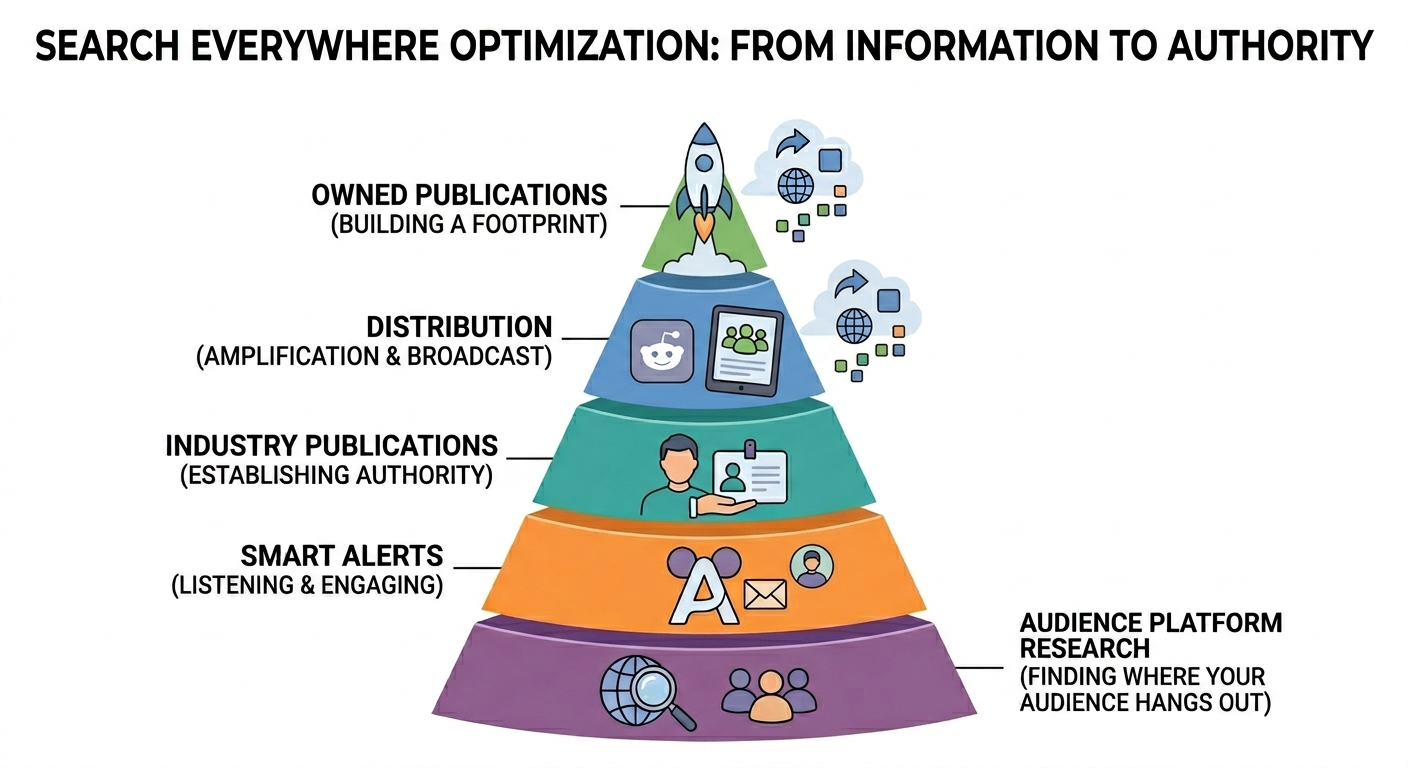
To build this visibility without burning out your team, I use a pyramid framework. Each layer provides the necessary foundation for the one above it. If you skip a layer, the rest of the structure becomes unstable.
Layer 1: Audience Platform Research (APR)
The foundation is not a content calendar, but research. You must map exactly where your Ideal Customer Profile (ICP) goes to research and compare options. This is not a generic "be on social" strategy. It is a precise map of sub communities and engagement patterns.
Too many teams skip this and default to whatever platform is trending internally. I've seen B2B consultants waste time on Pinterest when their audience is on LinkedIn, or DTC brands focusing on LinkedIn when their buyers are on TikTok. You need a deep research pass for every ICP to document where they actually hang out.
Layer 2: Alert Systems and AI Prioritization
Once you know where the audience is, you need to know when they are talking. This requires a strong alert system that triggers whenever a competitor is mentioned, a relevant question is asked, or a problem your product solves is surfaced.
The challenge here isn't just the tool, it's the noise. High volume alerts can quickly become overwhelming. The goal is to use AI to filter these alerts, excluding the noise so that only the high intent, decision making conversations reach your desk.
Layer 3: Industry Publications
You cannot build third party credibility by only publishing on your own domain. A byline in a publication your ICP already trusts carries significantly more weight. When a user sees your name in a Reddit thread and then searches for you, finding a trusted industry publication in the results validates your authority.
industry publications solve the distribution problem. Instead of fighting for visibility on a new blog post, you use the existing distribution network of an established publication.
Layer 4: Distribution
Distribution is where most great content goes to die. Producing the content is the easy part; ensuring the right people see it is the hard part. Before scaling production, you need a distribution infrastructure: a network of partners to share your work, a system to repurpose one long form piece into multiple social posts, and a strategic use of paid amplification to reach a wider audience.
Layer 5: Your Own Publications
Only after the first four layers are in place do you focus on your own blog. Most SEO teams treat the blog as Layer 1, but in 2026, owned content must be highly specialized and add value that isn't already available elsewhere. When you use your distribution channels and third party placements, your owned content becomes the destination for users who have already been primed by the other layers.
Expert Interpretation: The most common mistake is flipping this pyramid upside down. Companies spend 80% of their time on Layer 5 (the blog) and 0% on Layer 1 (APR). The tradeoff is that you create "perfect" content that nobody finds because you haven't built the trust or the distribution paths to lead people there. The decision to inspect is: "Am I creating content for a vacuum, or am I creating it to support an existing conversation?"
The Day to Day Execution Model
Implementing this doesn't require a total overhaul of your daily routine, but rather a phased approach to execution.
Phase 1: The APR Sprint. Spend a dedicated period mapping your ICP's digital footprint. Identify the specific subreddits, Facebook groups, and influencers that actually move the needle in your category.
Phase 2: Alert Setup and AI Filtering. Implement your monitoring tools. Spend time refining your exclusions so your team is only alerted to conversations that have a high probability of influencing a buying decision.
Phase 3: Industry Publications and Distribution. Shift your focus from "volume of posts" to "quality of placements." Secure bylines in trusted outlets and build the repurposing engine that pushes that authority across social channels.
Phase 4: Owned Content at Scale. Finally, produce high value, unique content on your own site. Use this content to deepen the relationship with the leads that your SEvO efforts have already brought to your door.
Measuring the Pre Click Journey
Measuring SEvO is different from measuring traditional SEO. You aren't just looking at keyword rankings; you are looking for signals of "mental shortlist" inclusion.
The most reliable metric is the increase in branded search volume. When people start searching for your brand name specifically, it's a sign that they've encountered you on a third party platform and are now using Google to confirm their assumptions. monitor the sentiment and frequency of your brand's mentions in the community hubs identified during your APR phase.
Comments
Comments are reviewed before they are published. Links are not allowed inside comments.