It’s Possible Your Migration Issues May Be Due to Site Quality
/ 6 min read

Summary
I believe that not only does a site migration trigger a new review of site quality from Google, but also that Google's standards. The practical question is what this changes for SEO, content quality, and AI search visibility.

There is nothing more frustrating than executing a site migration by the book, only to watch your indexing numbers plummet. You check the redirects, you verify the sitemap, and you wait, but the pages simply won't land in the index. It feels like a technical glitch, but often, the technicals are flawless.
Recently, several reports have surfaced about sites struggling to get indexed after moving to a new domain. After consulting with a few of these cases, a theory has emerged that shifts the blame away from the server and toward the content itself. While this isn't a proven law of the algorithm yet, the patterns are too consistent to ignore. The same pattern also shows up in We Earned 1, where the practical question is how the signal becomes visible.
The Theory: Migration as a Quality Trigger
The prevailing assumption is that a migration is a technical event. We focus on 301 redirects and Search Console settings. However, the theory here is that a site migration actually triggers a fresh, complete review of site quality by Google.
It is not just that a review happens, but that the bar for what constitutes "quality" has been raised significantly. In essence, moving your content to a new home may be forcing Google to look at your pages through a modern, much stricter lens than it used to use on your old domain.
Expert Interpretation: This suggests that Google may not be auditing every single page of every site in real time. Instead, a domain change acts as a "reset" or a flag that prompts a re evaluation. The tradeoff here is that while you might have been "grandfathered in" on an old domain with mediocre content, the migration strips away that legacy protection. You should inspect whether your content relies on old authority rather than current value.
When Technical Perfection Isn't Enough
Consider a case involving a hobbyist blog. The site had a history of good performance, though it had been sliding slightly over the previous year. The owner decided to migrate to a new domain and followed every industry best practice. They used the Change of Address tool in Google Search Console, mapped their redirects meticulously, updated internal links, and ensured the new sitemap was submitted.
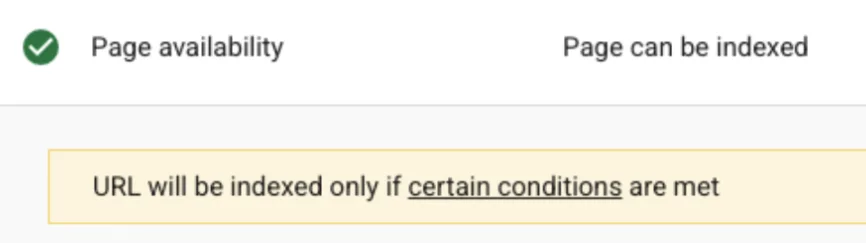
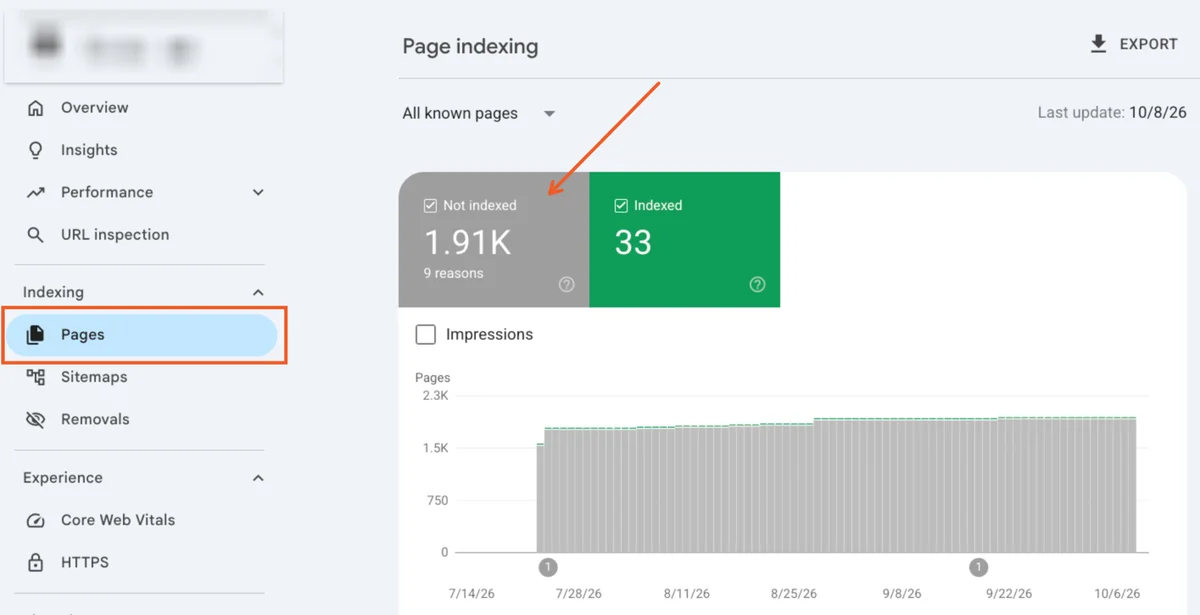
Despite this, the results were disastrous. About 98% of the URLs remained unindexed. Even the few pages that Search Console claimed were indexed were, in reality, missing from the search results. The status for these pages was "crawled, currently not indexed."
This is a critical distinction. Google wasn't having trouble finding the pages or crawling them. It had seen the content and consciously decided it didn't belong in the index. Live tests in GSC showed the pages were technically available, and there were no manual actions or obvious duplication issues causing the block.
Expert Interpretation: When you see "crawled, currently not indexed" on a technically sound site, it is a loud signal that the issue is qualitative, not quantitative. The decision is an editorial one made by the algorithm. The risk here is spending weeks trying to "fix" the server or the robots.txt file when the problem is actually the substance of the writing.
Identifying the "Commodity Content" Trap
Upon reviewing the hobby blog, the writing was thorough and well structured. However, it lacked original value. The content was what we call "commodity content" a set of information that is essentially the same across dozens of other websites.
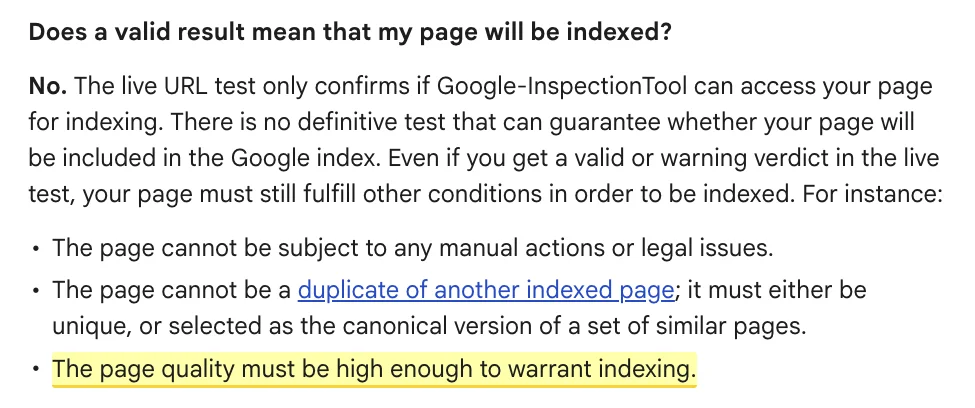
Google has updated its guidance on creating helpful content, specifically regarding the "main content" of a page. The main content is the core section that fulfills the user's search intent. Google now places a heavy emphasis on originality, which they define as the degree to which content provides unique perspectives or information that cannot be found elsewhere on the web.
If a page simply summarizes existing knowledge without adding a new angle, a unique data point, or a personal insight, it is commodity content. In the case of the hobby blog, the content was "good" by traditional standards, but it wasn't "original" by modern Google standards.
Expert Interpretation: The tradeoff for many creators is between "comprehensiveness" and "originality." Many believe that if they cover every point of a topic, they have a high quality page. Google is signaling that comprehensiveness without originality is just noise. You must decide if your content provides a "unique value add" or if it is simply a mirror of the top five results already in the SERPs.
Why the Old Domain Survived
The most pressing question is why the old site was indexed and ranking if the quality was supposedly insufficient. Why does the migration suddenly make the content "bad"?
The theory is that if Google applied these strict quality standards to every single page on the internet simultaneously, the resulting loss of indexed content would be catastrophic. Instead, it is possible that these standards are applied more aggressively during specific events, such as a domain migration.
By moving to a new domain, the site essentially asked Google to evaluate it as a new entity. Without the historical "trust" or legacy status of the old domain to lean on, the content had to stand on its own merits. Because the pages offered nothing that wasn't already available elsewhere, the system chose not to index them. A useful companion note is AI Agents Read Your Site & It’s Breaking, because it looks at a nearby part of the same system.
Expert Interpretation: This implies a "legacy bias" in the algorithm. Old sites often survive on momentum. The danger here is that a migration can act as a catalyst that exposes underlying quality issues that were previously hidden. Before migrating, you should inspect whether your traffic is driven by the strength of your domain or the unique value of your content.
Strategies for Recovery
If you find yourself in a position where your new domain won't index, you have to move through a specific hierarchy of troubleshooting.
First, exhaust the technical possibilities. Verify your redirects, check the Change of Address tool, and use the Live Test in GSC to ensure there are no rendering issues. It is often wise to bring in an external SEO expert at this stage to ensure you aren't missing a simple technical oversight. It is also important to remember that migrations take time. Some delays are normal.
However, if months pass and only your homepage is indexed, you are likely facing a quality issue. In the hobby blog case, four months had passed with no movement, confirming that the problem was not a matter of patience.
If the issue is indeed quality, the solution is not to write more of the same, but to change the nature of the content. This may require a shift in business direction. You need to produce a small number of articles that are truly original and insightful. This means moving away from summarizing known facts and moving toward creating new information, sharing unique experiments, or providing a perspective that is genuinely rare.
There is a lingering uncertainty, however, regarding whether Google evaluates these new, high quality pages individually or if a low overall site quality score will continue to suppress them. Another drastic option is to abandon the migration and start fresh on a new domain with entirely new, original content from day one.
Expert Interpretation: The decision here is between "incremental improvement" and "total pivot." If your entire content library is commodity based, adding three original posts might not move the needle for the whole site. You have to decide if your current content strategy is fundamentally flawed. The tradeoff is time versus risk. Fixing a site's quality profile is a long game, whereas starting over is a high risk but potentially faster path to a clean slate.
Comments
Comments are reviewed before they are published. Links are not allowed inside comments.