Organic Traffic Is Still Worth Tracking, Just Not All of It
/ 9 min read

Summary
A LinkedIn discussion, started by Peter Rota, ignited an explosive debate over whether we should retire organic traffic as an SEO. The practical question is what this changes for SEO, content quality, and AI search visibility.

Introduction
The key issue here is HubSpot changed the name of its flagship conference from INBOUND to UNBOUND. This wasn't a casual rebrand. It reflected a broader shift away from legacy SEO strategies built around top of funnel traffic. Modern search is shifting closer to a zero click. My read is to treat it as a decision point: what signal needs to become clearer, what part of the system is currently weak, and what evidence would show that the work is improving visibility rather than only adding activity. This connects with AI Is Merging Paid and Organic Visibility when the same signal needs a clearer operating decision.
That is the difference between reacting to a trend and building a useful search system. Connect this point back to the page template, internal linking, entity signals, content depth, crawl accessibility, and the way the brand is represented across the wider web before deciding what to change first.
For years, the gold standard of SEO success was a climbing line on a traffic graph. More visits generally meant more visibility, which we assumed led to more revenue. But the environment has shifted. We are moving toward a "zero click" reality where the traditional relationship between a search query and a website visit is breaking. The same pattern also shows up in Questions That Reveal Your Real Search Performance, where the practical question is how the signal becomes visible.
A telling signal of this shift is HubSpot's decision to rename its flagship conference from INBOUND to UNBOUND. This wasn't just a branding exercise; it was a recognition that the legacy playbook, built on capturing massive amounts of top of funnel (TOFU) traffic, is no longer the primary driver of growth. When roughly 60% of searches now end without a single click to the open web, the very foundation of how we measure "success" in search needs to be rebuilt.
The discovery process has moved. Potential buyers are now using LLMs like Perplexity, ChatGPT, and Google’s AI Mode to research and narrow down their options before they ever think about clicking a blue link. This means attribution has gone dark, and the buyer journey is more fragmented than ever. People are using AI to discover, Google to verify, and your website only when they are ready to convert.
The problem isn't organic traffic, it's how we filter it
There has been a lot of debate recently, including a heated discussion on LinkedIn started by Peter Rota, about whether we should stop tracking organic traffic entirely. I don't think that's the answer. Traffic isn't obsolete, but it is dangerously incomplete if it's decoupled from intent and revenue. A useful companion note is We Earned 1, because it looks at a nearby part of the same system.
Organic traffic is a poor standalone KPI because it lacks context. As Adam Heitzman has noted, a drop in total visitors isn't always a crisis; in some cases, it's actually a sign of optimization. If you are shedding thousands of users who bounce after three seconds because they landed on a generic glossary page, you haven't lost anything of value.
Consider a scenario where a company prunes away low intent informational fluff and focuses instead on high intent service pages. The overall traffic might drop by 20%, which would have triggered a panic in 2018. However, if that shift results in a 30% increase in organic revenue because the remaining visitors are actually qualified buyers, the strategy is a resounding success. The goal is to stop treating a click on a "What is [X]?" blog post as equal to a click on a pricing page.
Expert Interpretation: The tradeoff here is between vanity and validity. Most marketers are conditioned to report "growth" in volume because it's an easy win in a slide deck. However, the decision you need to inspect is whether your current reporting distinguishes between "curiosity traffic" and "intent traffic." If you can't see the difference, you are managing your strategy based on noise, not signal.
The collapse of TOFU traffic and the new focus
Rand Fishkin once noted that top of funnel marketing was always done on "rented land," but that land is now being reclaimed by AI. Buyers no longer want to navigate to a website to read a 2,000 word glossary post or a basic feature comparison. They want instant answers, Reddit threads, or a summary from an LLM.
Generic, consensus based informational traffic is trending toward zero. The irony is that many SEO teams are still spending the bulk of their resources on the exact content types most vulnerable to this shift: FAQs, roundups, and long form explainers. If the "informational business blog" is dying, we have to identify what remains on the site that is actually worth tracking.
I believe we should shift our focus toward "distribution moats", high intent transactional nodes that AI cannot easily replicate. Specifically, there are a few page types that remain critical for organic reporting:
The Homepage: Interestingly, data from Siege Media suggests that LLM recommendations often drive users to search for a brand name directly and land on the homepage, even if the AI provided a link. Pricing Pages: While AI can summarize a pricing plan, buyers still want to visit the official source to read the fine print and verify the offer before committing. Product and Service Pages: These are the destination for users who have moved past discovery and are now in the verification phase.
Expert Interpretation: The risk here is "sunk cost fallacy." Many teams will continue producing TOFU content because they have a machine built for it. The decision to make is whether to pivot your content production from "answering basic questions" to "providing unique, proprietary insight" that an LLM cannot synthesize from other sources. If your content is a summary of existing web knowledge, it is a commodity that AI will eventually replace.
How the modern search journey works in practice
To understand why the metrics are changing, it helps to look at the actual behavior of a B2B buyer, for example, someone looking for a modern CX platform.
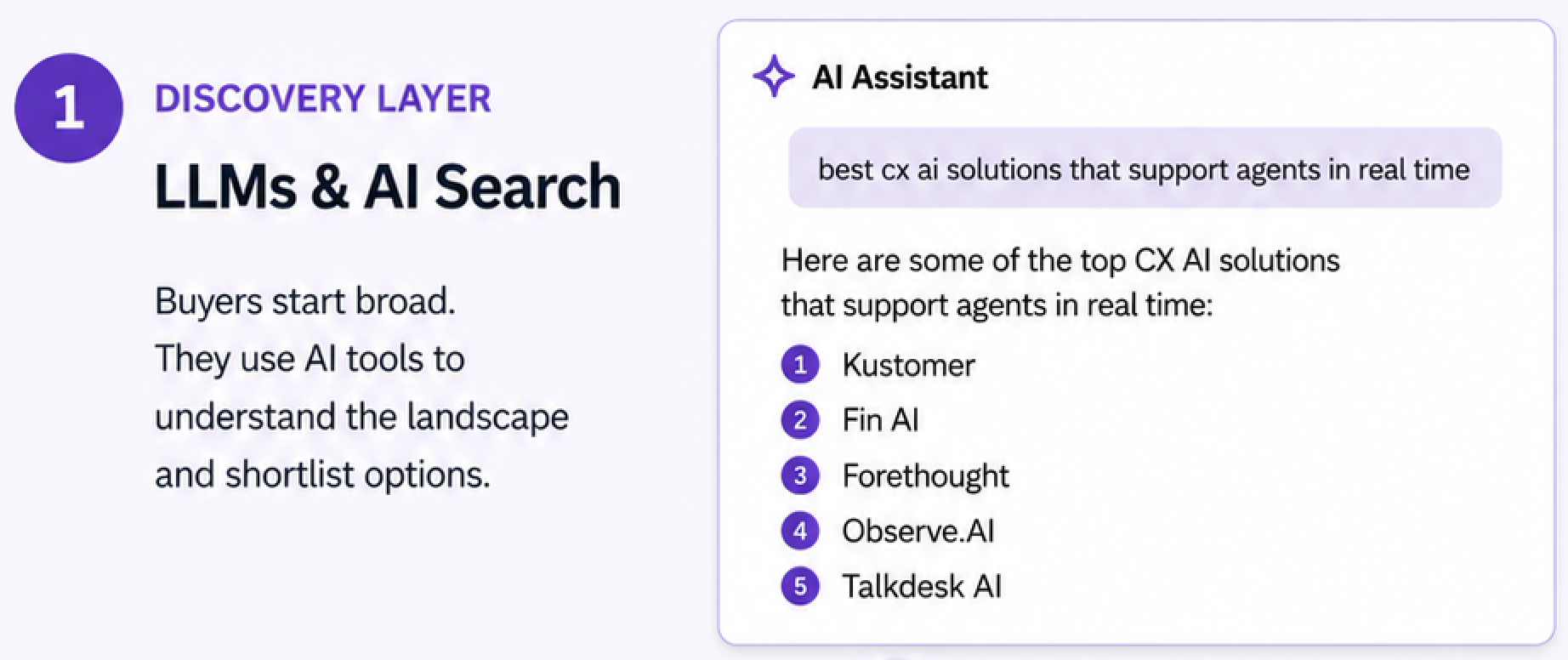
1. AI search: The discovery layer
The journey often begins with a broad, long tail query like "best cx ai solutions that support agents in real time." Instead of clicking through five different blogs, the buyer reads an AI generated summary that lists a few top contenders. The AI has handled the "discovery" phase without the buyer ever visiting a website.
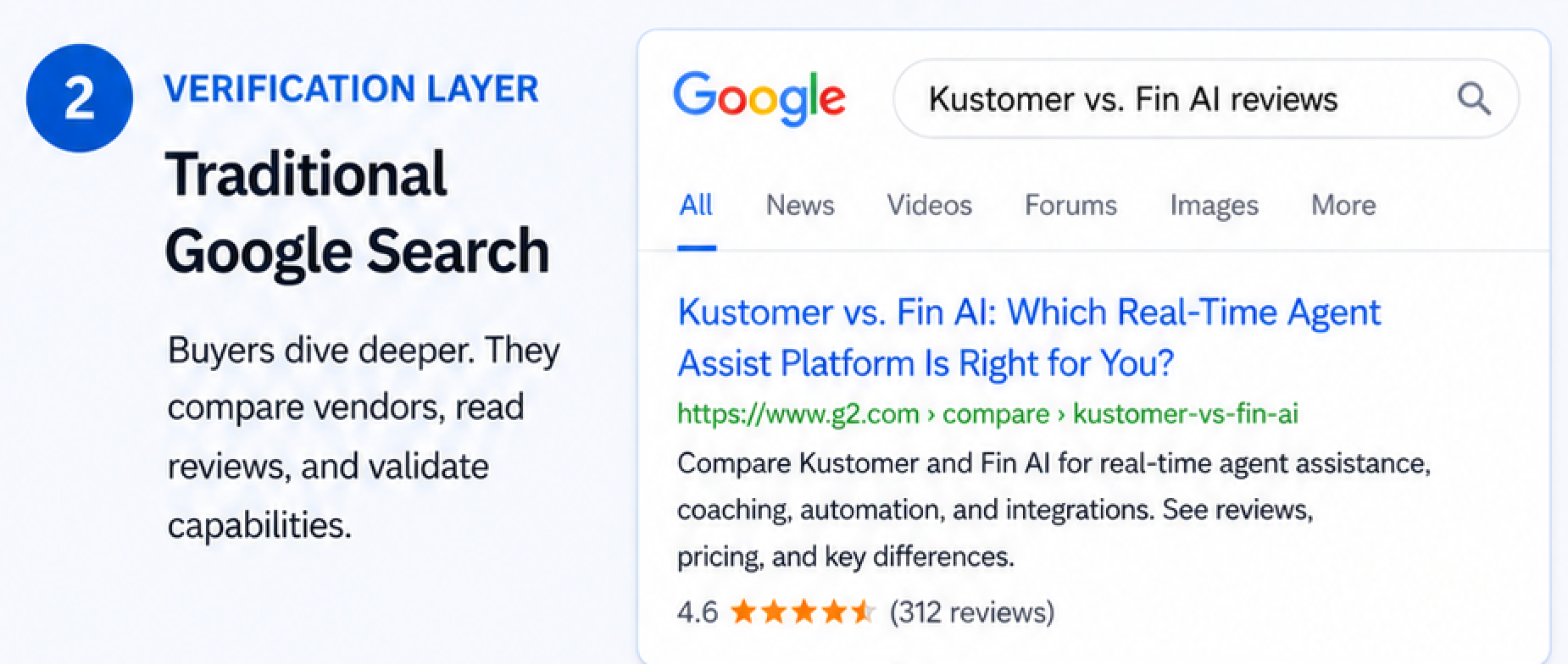
2. Google Search: The verification layer
Once the buyer has a shortlist from the AI, they move to traditional search. They aren't looking for "what is CX AI" anymore; they are looking for specific reviews, comparison guides, and detailed feature pages to validate the claims made by the AI. This is where Google still holds immense value, as a verification tool.
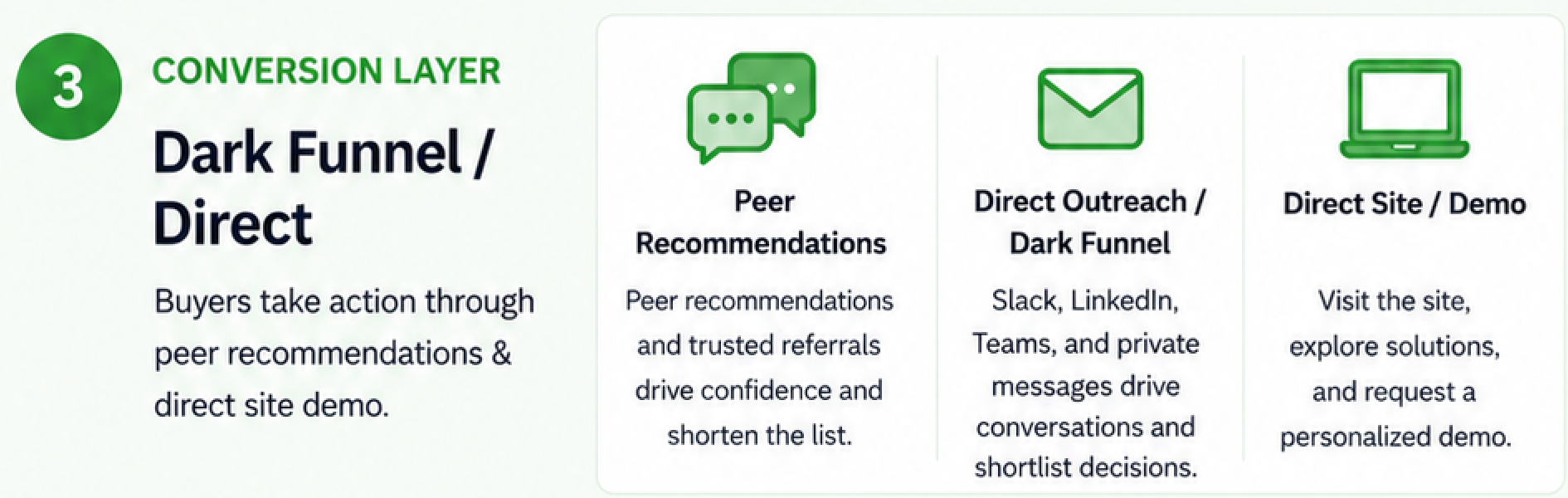
3. Dark funnel: The conversion layer
Finally, the buyer enters the "dark funnel." They might have seen your brand in an AI summary and verified it on Google, but they now navigate directly to your site via a branded search to find the pricing page or request a demo. This is the most valuable type of organic traffic, but it's often the hardest to attribute to the original AI discovery.
Expert Interpretation: This fragmented journey means that the "first click" is no longer the most important metric. The tradeoff is that you lose linear attribution in exchange for higher quality leads. You must accept that the "discovery" phase is happening in a black box, and your goal is to ensure that when the user moves to the "verification" phase, your brand is the one they find.
Reporting on SEO when attribution goes dark
Fighting for 100% accurate, linear query data is a losing battle. Between Google's anonymized queries and the opaque nature of LLMs, we can no longer track every single click. Instead of fighting the "dark funnel," we need to adapt our reporting to be directional.
As Matthew Mellinger suggests, the goal should be identifying macro trends and shifts that prove business impact rather than hunting for every single click. This requires two structural changes to your dashboard:
- Prioritize page level reporting over query level: Query positions are volatile and often misleading. Focus instead on the health and conversion rates of your key high intent pages.
- Shift toward directional trends: Look for patterns in branded search and conversion spikes rather than obsessing over the rank of a single keyword.
Expert Interpretation: The decision here is to move from "micro management" to "macro analysis." The tradeoff is a loss of granular control, but the benefit is a reporting structure that actually reflects how people buy. If you continue to report on keyword rankings for TOFU terms, you are reporting on a world that no longer exists.
AI SEO metrics for accountability and executive buy in
While it would be ideal to simply track revenue, marketing investments require justification. Since traditional clicks and ranks are failing as KPIs, we need a new set of metrics that hold teams accountable while proving visibility to executives.
Input metrics: What you can control
These are the strategic actions your team executes daily. You should be measured on these inputs because they build your long term moat:
Topical Coverage: Are you answering the complex, multi layered questions that LLMs are generating around your core business? Topic Clustering: How effectively are you using internal linking to connect high intent pages and build topical authority? Distribution Velocity: Content creation is only half the battle. How effectively is the team pushing these assets into newsletters, social channels, and communities? Update Frequency: Are your cornerstone "money pages" being refreshed to remain accurate and competitive?
Lagging indicators: New SEO KPIs
These are the outcomes that prove your inputs are working:
Branded Search Volume: This is the strongest proxy for AI success. If more people are searching for your brand by name, it's a sign you are being recommended in the AI discovery layer. Self Reported Attribution: Adding a "How did you hear about us?" field to your lead forms, specifically including "AI Search / ChatGPT" as an option, provides data that software cannot. LLM Referral Traffic: Tracking direct sessions and conversions coming from AI interfaces. Third Party Category Coverage: Monitoring whether your brand is mentioned in the "best of" lists and category summaries generated by AI.
Expert Interpretation: The key here is the balance between inputs and outcomes. Executives often only care about outcomes, but in an AI driven world, the link between input and outcome is lagged. You must educate your leadership on why "topical coverage" (an input) is the only way to achieve "branded search growth" (the outcome).
Shifting the C-suite away from vanity traffic
Moving a leadership team away from total organic traffic requires a gradual, transparent transition. You cannot simply delete the traffic graph from your report; you have to replace it with something more meaningful.
Comments
Comments are reviewed before they are published. Links are not allowed inside comments.