The New Organic Growth Stack: Search, Social, Communities & AI
/ 7 min read

Summary
For our State of B2B AI Discovery 2026 report with AirOps, we tracked roughly 380,000 AI answers covering 81 enterprise software. The practical question is what this changes for SEO, content quality, and AI search visibility.
It is a frustrating realization for many marketers: your keyword rankings might be stable, but your actual traffic is dropping. The reason is simple. Google is increasingly answering the user's question directly on the results page. When the AI provides the answer, the user has no reason to click through to your site.
Data from early 2026 shows that nearly 68% of U.S. Google searches ended without a single click. Even more concerning is that B2B buyers are shifting their starting point. Many no longer begin their journey with a search engine, but with an AI chatbot. To survive this, we have to stop thinking about SEO as just "on site optimization" and start thinking about a growth stack that spans the entire ecosystem where AI pulls its data. A useful companion note is Brand Signals Are Rewriting the Authority Stack, because it looks at a nearby part of the same system.
The Fragmentation of Modern Search
Search is no longer a single destination; it has splintered across different surfaces. To understand where to invest, we have to look at what these AI surfaces actually cite. Research covering 81 enterprise software topics across six AI surfaces reveals a consistent baseline: product pages are still the most cited sources. Whether it is Gemini or Perplexity, vendor sites and tool directories take the lion's share of citations, ranging from 52% to 72%.
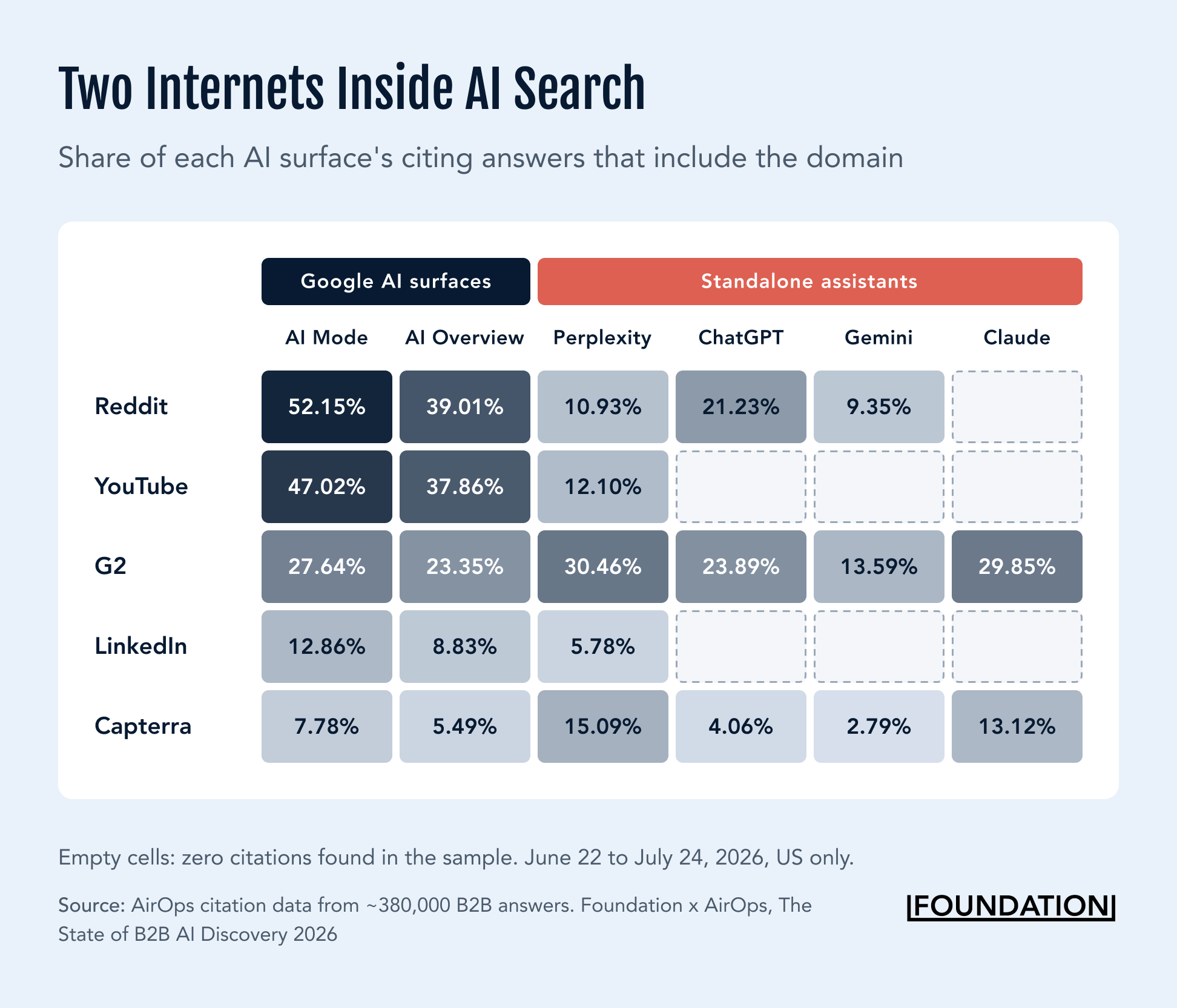
However, this is a crowded foundation. You aren't just competing against your direct rivals, but also against third party directories that list you alongside them. The real divergence happens above this foundation. Google's AI features, like AI Overviews, tend to lean on what already ranks in traditional search. In contrast, standalone LLMs like Claude or ChatGPT use their own retrieval methods, leading to a very different mix of citations.
Expert Interpretation: The tradeoff here is between "control" and "reach." You control your product pages, but you don't control the directories or the AI's choice to cite a competitor. The decision you need to make is whether to double down on your own domain or diversify into the "uncontrolled" surfaces that AI engines trust more for unbiased validation.
Building Your Growth Stack Layer
Visibility now depends on surface coverage. If you only exist on your own domain, you are invisible to the AI surfaces that prioritize community sentiment or third party reviews. You need to build a presence across the specific domains that each AI surface trusts. This connects with AI Is Merging Paid and Organic Visibility when the same signal needs a clearer operating decision. The same pattern also shows up in 7 Ways to Build Visibility, where the practical question is how the signal becomes visible.
Prioritizing the Pages You Own
Despite the rise of chatbots, Google still handles about three quarters of desktop searches. AI Overviews reach billions of users. But there is a catch: ranking high in traditional search no longer guarantees you will be cited in the AI overview. In fact, citations from top ranking pages have been declining.
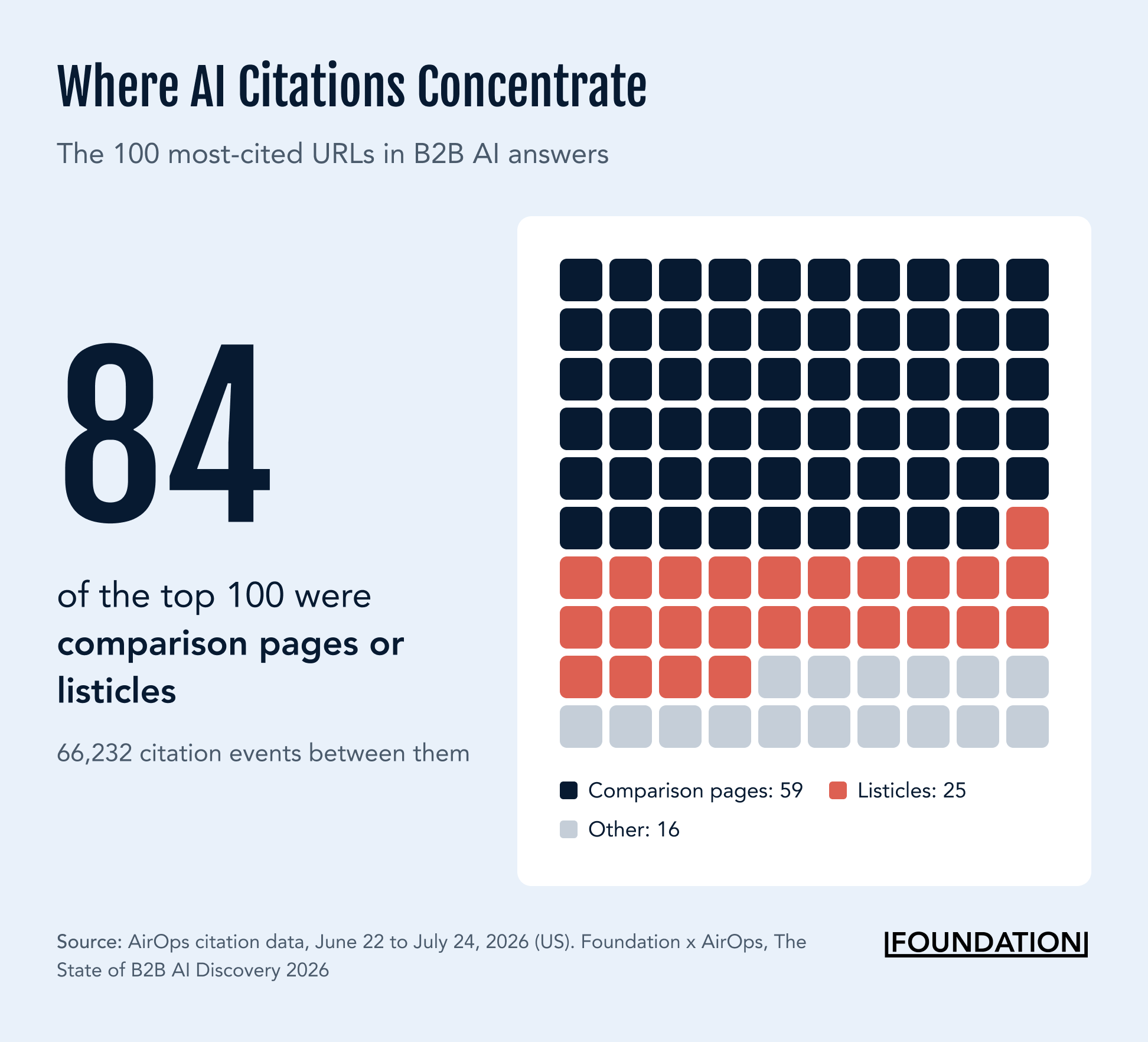
The data shows that AI engines are heavily favoring specific types of content. Out of the 100 most cited URLs in recent studies, 84 were either listicles or comparison pages. This means the "editorial" side of your blog might be getting the budget, but your product and comparison pages are what actually drive the citations.
Expert Interpretation: Many teams make the mistake of treating the blog as the primary growth engine. In an AI world, the "utility" pages, comparisons and feature lists, are more valuable for retrieval. Inspect your current budget: are you spending more on "thought leadership" posts than on updating the comparison pages that AI actually cites?
Integrating Into Buyer Communities
Reddit has become a powerhouse for AI citations. Because Google sends a massive amount of traffic to Reddit threads, and Google's AI features then cite those threads, it creates a powerful loop. In some categories, like security tools, community citations can make up as much as 14% of the total.
However, this is a volatile layer. For example, ChatGPT's citation rate for Reddit dropped significantly over a single month, while Google's surfaces remained steady. This suggests that relying on a single community platform is risky. The goal should not be a single viral post, but a consistent presence of helpful, accurate answers across multiple subreddits.
Expert Interpretation: The tradeoff here is authenticity versus scale. You cannot "SEO" your way into a community; you have to actually be useful. The decision is whether to treat Reddit as a marketing channel (which often fails) or as a customer support and education channel (which earns citations).
Defining the Category Narrative on Social
LinkedIn serves as a primary source for Google's AI surfaces, appearing in a notable percentage of AI Mode and AI Overview answers. Interestingly, standalone bots like Claude or Gemini rarely cite LinkedIn. This makes LinkedIn a "Google surface play."
This is where the category narrative is set. When executives and practitioners describe how a problem should be solved on LinkedIn, Google's AI picks up that language. This is why employee amplification is critical. It is not about the number of likes or followers, but about whether the AI adopts the way your team describes the category.
Expert Interpretation: The risk here is the "vanity metric" trap. Most social media managers report on engagement, but for an organic growth stack, the only metric that matters is whether your narrative is appearing in AI Overviews. You should decide which specific category questions you want to own and ensure your team is answering them consistently.
Optimizing Video for AI Search Features
YouTube is heavily cited in AI Mode and AI Overviews, but almost non existent in Gemini's citations. This is because AI Overviews use "query fan out," meaning they run multiple searches to build an answer and pull in videos that already rank well in Search.
The mistake most B2B companies make is creating videos for people who already know the brand. To get cited by AI, you need videos that answer the questions buyers ask before they have a shortlist. This means focusing on "best of" lists, alternatives, and direct comparisons.
Expert Interpretation: Video production is expensive, so the tradeoff is between high production value and high utility. AI doesn't care about your cinematography; it cares about the transcript and the answer. Prioritize clear, question based titles that mirror exactly how a buyer phrases their search.
Leveraging Review Profiles as Infrastructure
If you want to be seen by users of Claude or Perplexity, you must prioritize review sites. These standalone engines lean heavily on third party validation. For some categories, like recruiting software, review citations can reach 25%. Platforms like G2, Capterra, and Gartner are essentially retrieval infrastructure for these bots.
Because these profiles are live sources, they cannot be a "set it and forget it" project. They need to be managed as active assets. If your profile is stale, the AI is citing outdated information about your product.
Expert Interpretation: The tradeoff here is the loss of narrative control. You cannot edit a review, but you can influence the volume and freshness of them. The decision is whether to treat your review profiles as a marketing brochure or as a live data feed that feeds the AI engines.
Determining Your Starting Point
You cannot build every layer of this stack simultaneously. The priority depends entirely on where your specific buyers are spending their time and which AI tools they prefer.
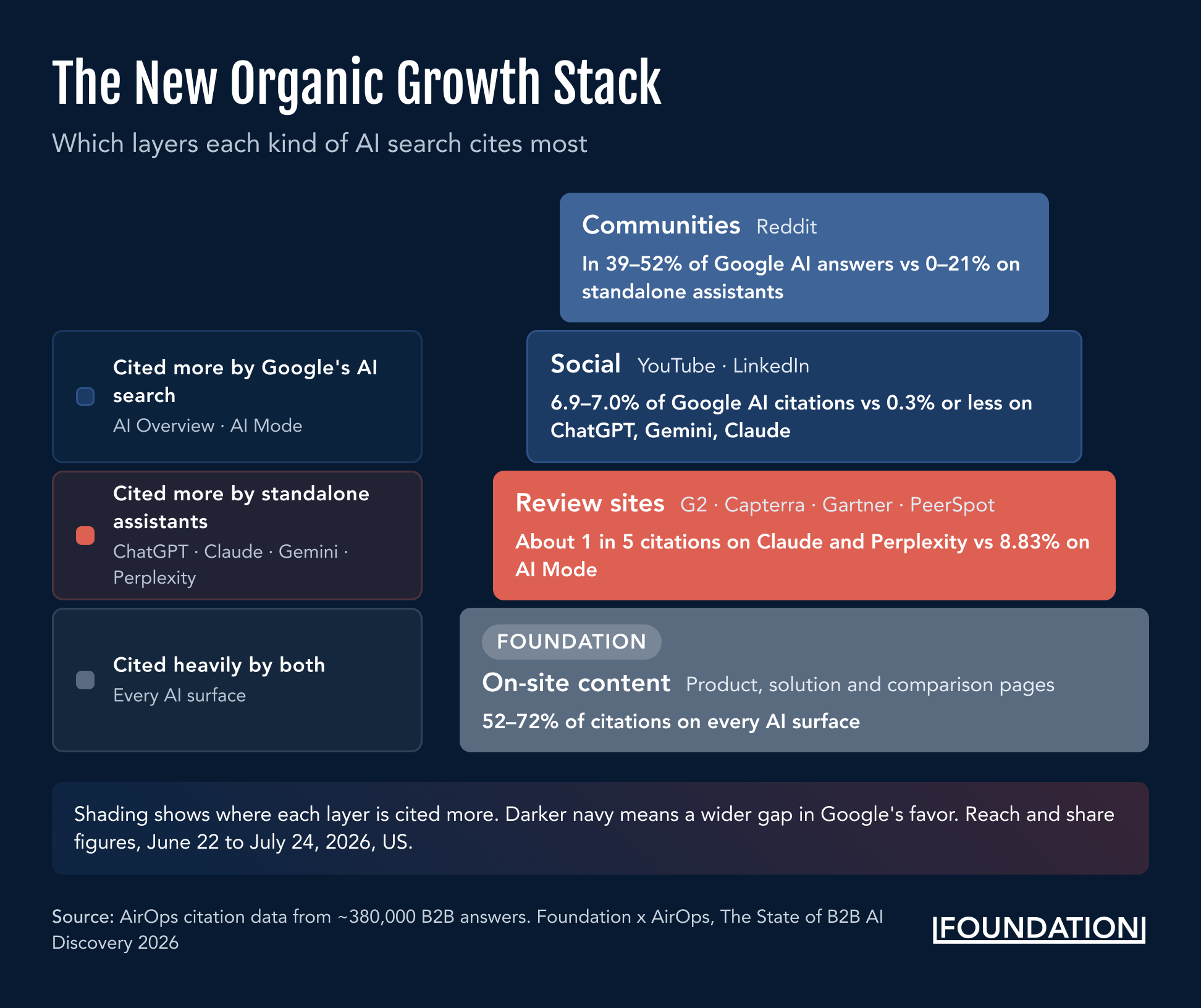
The first step is to gather intelligence from your sales calls and onboarding sessions. If your customers are primarily using Google, your priority should be the community, video, and social layers to feed the AI Overviews. If they are using ChatGPT or Claude, you should prioritize your own product pages and your review profiles.
you must analyze your specific category. The source mix varies wildly between niches. For instance, a company in the managed database space would find that review sites only account for 8% of citations, while communities account for 13%. If that company followed a generic HR tech playbook, they would waste their budget on review sites while ignoring the communities where their buyers actually live.
Expert Interpretation: The biggest risk is copying a "best practice" stack from a different industry. The decision you must make is to audit your own category's citation mix before allocating a single dollar of budget. Your growth stack should be a reflection of your buyers' behavior, not a generic SEO checklist.
Comments
Comments are reviewed before they are published. Links are not allowed inside comments.